What Salesforce Customers Should Ask Before Renewal
A Salesforce renewal is easier to control when the right questions are asked early. Use this guide to test usage, shelfware, contract terms and future demand before negotiation pressure builds.
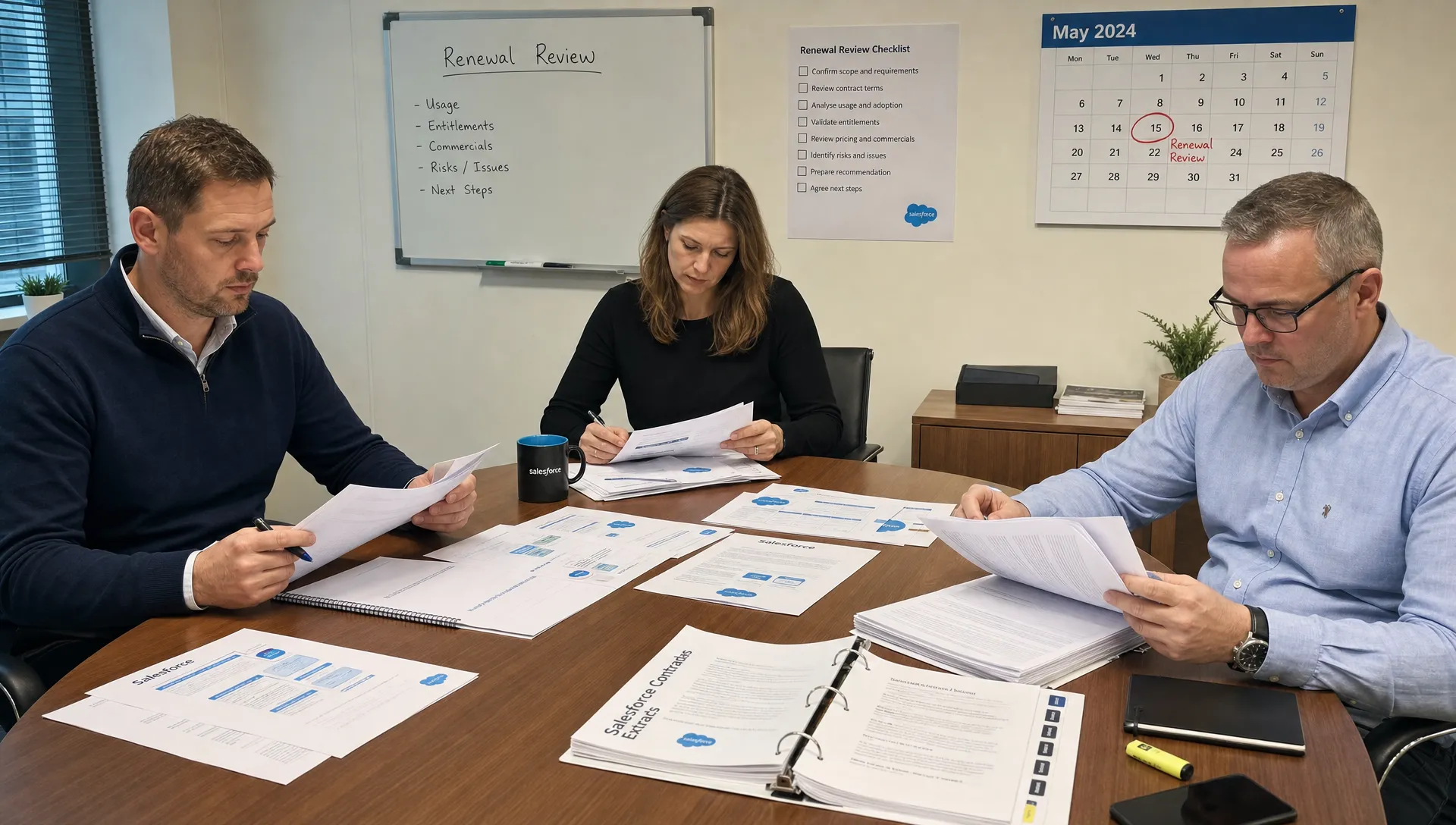
Renewal pressure rarely arrives all at once. It builds quietly through a missed notice period, a rushed usage report, a late quote, a product bundle nobody has fully unpacked and a budget owner who is asked to approve spend before the evidence is clean.
For many Salesforce customers, the problem is not that the renewal is complex. The problem is that the wrong questions are asked too late. By the time a proposal is on the table, the conversation has often narrowed to discount, term length and internal approval. Those matter, but they are not the full renewal.
A better renewal starts earlier and asks sharper questions. Not adversarial questions. Commercially mature ones. The aim is to understand what you need, what you use, what you can justify and where you may be giving away leverage without noticing.
Start with one question: what are we actually renewing?
Before you review pricing, build a plain baseline of the current estate. That means order forms, amendments, product schedules, support terms, licence quantities, renewal dates, contracted uplift language and any side commitments that influenced the original deal.
The strongest Salesforce customers do not rely on a single renewal quote as the source of truth. They compare the quote with the contract pack, the admin data and the business plan. This is where small gaps become visible: an add-on inherited from a previous programme, a product edition that no longer fits the use case, a co-termed SKU with a different renewal path or a support level that nobody has reviewed in years.
If your internal baseline is weak, the renewal conversation will be shaped by the supplier's version of your estate. That does not mean the supplier is wrong. It means you have less control over the facts.
| Renewal baseline area | Question to ask | Why it matters |
|---|---|---|
| Contract documents | Do we have every active order form, amendment and notice clause? | Missing documents create last-minute surprises. |
| SKU list | Do we understand each product, edition and add-on? | SKU names can hide overlap, legacy spend or unused scope. |
| Licence quantities | Are contracted seats aligned with active, eligible users? | Overbuying often sits in the gap between contracted and real demand. |
| Renewal mechanics | What happens if we do nothing? | Auto-renewal, uplift language and notice dates can reduce room to move. |
| Future demand | Which new requirements are approved rather than hoped for? | Unapproved growth can become permanent committed spend. |
If you want a broader frame for this work, SaaSed has written separately about treating the renewal as a buying decision, not just a pricing event.
Are our licences aligned with real usage?
Usage is not one number. Login activity tells you something, but it does not tell you enough. A user may log in regularly and only need a lighter permission set. Another user may rarely log in because the team is blocked by adoption issues, poor process design or incomplete enablement. A licence may be technically assigned but commercially unjustified.
Salesforce customers often find the clearest renewal evidence by separating usage into several layers. Start with assigned users, then look at active users, then meaningful product activity. Review whether users are consuming the capabilities that required the current edition or add-on in the first place.
For example, a Sales Cloud user count may look healthy on paper, but that does not answer whether every user needs the same edition. A Service Cloud deployment may be business-critical, yet some queues, integrations or add-ons may be dormant. Marketing, analytics, integration and platform SKUs need the same scrutiny because they often sit outside the cleanest user-count logic.
Good questions include:
- Which users have not logged in during the period that matters for our business cycle?
- Which assigned users are using only a narrow part of the licence capability?
- Which products have low adoption because they are no longer needed, not because implementation is unfinished?
- Which usage gaps are temporary and which are structural?
- Which licences should be retained because they support a known compliance, operational or revenue dependency?
Procurement can help keep this discussion honest. IT can explain technical dependencies. Finance can test whether future demand has a budgeted basis. Business owners can confirm whether a low-use area is a failed deployment, a delayed programme or simply no longer relevant.
Are we carrying shelfware or genuine optionality?
Shelfware is not always obvious. It is not only unused seats. It can be unused environments, underused add-ons, duplicated capability across clouds, excessive edition levels, products bought for a project that changed shape or capacity purchased because the previous negotiation rewarded a larger bundle.
The practical question is not "what can we cut?" It is "what spend would we willingly buy again today, knowing what we now know?"
That question changes the tone. It avoids lazy cost-cutting and forces a clean commercial test. If the licence, SKU or add-on still has a job to do, keep it and document why. If it no longer has a credible owner or use case, it belongs in the renewal challenge pile.
A common trap is keeping shelfware because it was expensive to negotiate in the first place. The money already spent is not the renewal decision. The next commitment is.
What commercial terms matter more than the headline discount?
Discount is visible. Terms are quieter. In many Salesforce renewals, the long-term economics are shaped less by the first-year price and more by what the contract allows over time.
Review the order form and governing terms before you negotiate the number. Salesforce publishes its standard legal materials on the official Salesforce legal agreements page, but your actual position depends on the signed documents, amendments and order forms that apply to your organisation.
The questions worth asking are plain:
- Is there an annual price uplift and how is it calculated?
- Are there notice periods or auto-renewal mechanics that limit our timing?
- Can products be reduced, swapped or rebalanced at renewal?
- Are all SKUs co-terminous or are we dealing with staggered renewal pressure?
- Does the term length match the certainty of our roadmap?
- Are future purchases tied to the same commercial structure?
- Have support, sandbox, storage, integration or data-related costs been reviewed separately?
This is where CFOs and CIOs often see the renewal differently. A lower first-year price may look attractive, but a long commitment with weak flexibility can be expensive if the business changes. Equally, a shorter term can cost more if the platform is stable, adoption is strong and future volumes are predictable.
The right answer depends on evidence. If the organisation has a clean view of demand, a longer term may be defensible. If there is uncertainty around business units, go-live timing, product fit or headcount, flexibility may be worth more than an extra percentage point of discount.
SaaSed covers some of these traps in more detail in its guide to contract renewal risks worth catching early.
Which future requirements are real enough to buy now?
Future growth is one of the hardest parts of a Salesforce renewal. Nobody wants to block a credible roadmap. Nobody wants to fund a wish list that becomes locked-in spend.
Salesforce customers get into trouble when every possible future requirement is treated as a renewal requirement. A planned country rollout, acquisition, service transformation or data programme may deserve to be included. A vague idea from an unapproved roadmap probably does not.
The test should be practical. Is there an approved business case? Is there named budget? Is there an accountable owner? Is there a realistic implementation window inside the proposed contract term? Will the new capacity be used soon enough to justify buying it now?
If the answer is no, you may still want commercial protection for future demand. That can be a better route than buying capacity early. The point is not to under-resource the business. It is to stop uncertainty from being priced as commitment.
For a deeper planning lens, SaaSed has a useful piece on which Salesforce opportunities belong in your renewal plan.
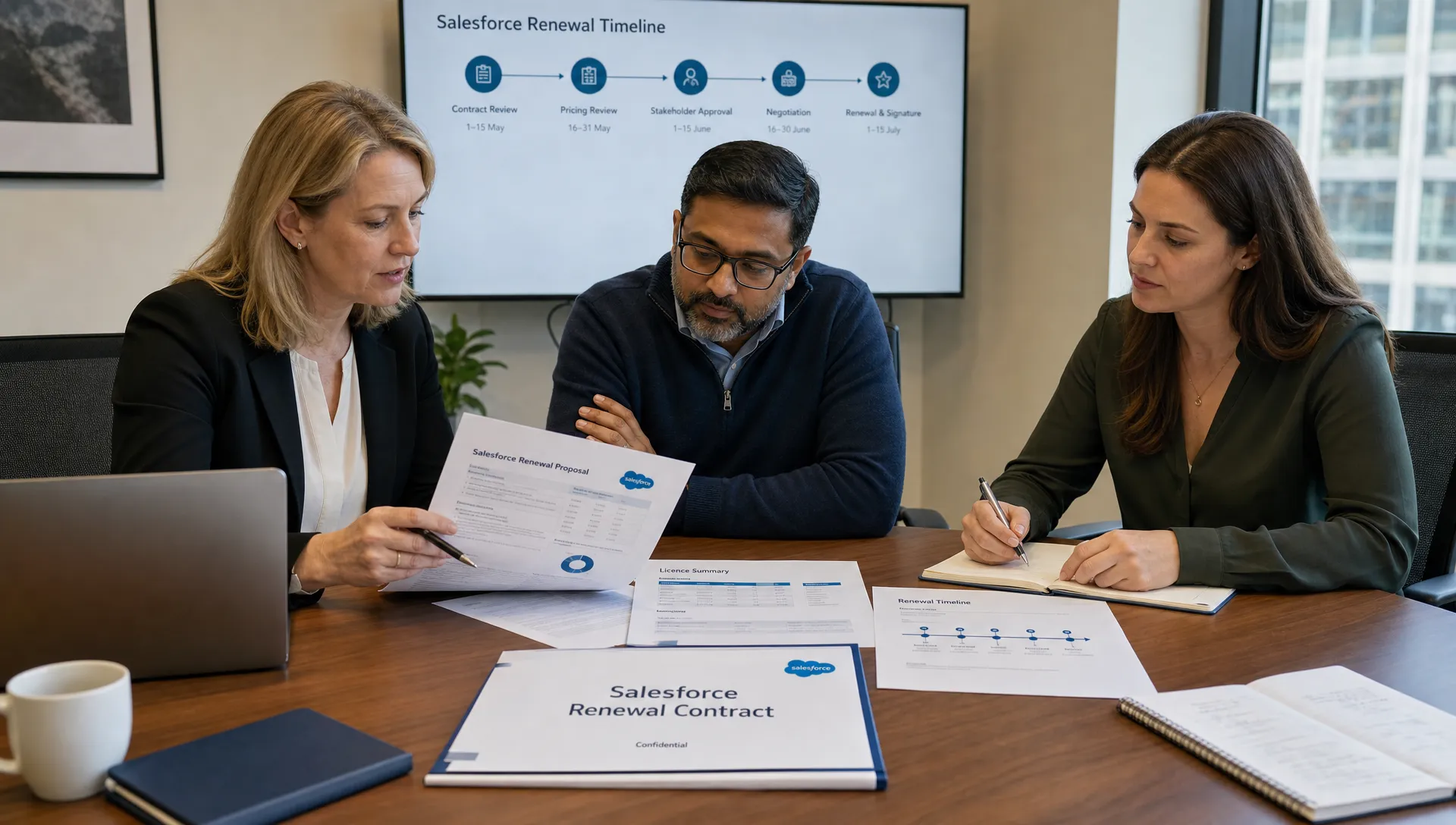
What would happen if we changed nothing?
This question is simple and revealing. If you did nothing, would the contract renew automatically? Would pricing rise? Would unused licences remain locked in? Would staggered SKUs continue to fragment your negotiation? Would a delayed internal decision leave you accepting terms you would not have chosen two months earlier?
Renewal inertia is rarely caused by laziness. It is caused by timing. Teams are busy, ownership is split and the person who knows the contract detail may not be the person who owns the budget. Salesforce is often a strategic platform, which means nobody wants to create operational risk close to expiry. That pressure can make the existing agreement feel safer than it really is.
A clear "do nothing" scenario gives leadership a baseline. You can then compare every option against it: renew as-is, reduce, restructure, add, extend, shorten or negotiate commercial protections for later purchases.
Are Finance, IT, Sales Ops and Procurement working from the same evidence?
A renewal can unravel when each team is right from its own angle but nobody has reconciled the evidence.
Finance sees committed spend, budget pressure and future cost exposure. IT sees platform dependencies, integration risk and administrative reality. Sales Ops or RevOps sees field adoption, pipeline process and user behaviour. Procurement sees negotiation timing, contract structure and leverage.
None of those views is enough alone. The renewal owner should bring them into one working pack before external negotiation begins. That pack does not need to be beautiful. It needs to be trusted.
It should answer four things: what we have, what we use, what we need next and what we are prepared to change. If those answers are not aligned internally, the negotiation will expose the gaps.
What is our negotiation posture before commitment is requested?
Salesforce customers do not need to be combative to negotiate well. They do need to be prepared.
Preparation means knowing your walk-away points, your acceptable trade-offs and your internal approval path. It means understanding which asks are essential, which are useful and which are merely nice to have. It also means knowing what you will not trade away for a short-term saving.
A mature negotiation posture includes a few uncomfortable but necessary checks. Who can approve a change in term length? What evidence supports a reduction? What future demand can be discussed without committing too early? What happens if the supplier pushes for a wider bundle? How much time is left before internal governance becomes the bottleneck?
Good negotiation is rarely about a dramatic final call. It is usually about removing avoidable weakness before the commercial conversation starts.
A practical question set for your next renewal meeting
For Salesforce customers with a renewal inside the next year, the following questions make a useful agenda. They work best when Finance, IT, the platform owner and Procurement answer them together.
- What is the full list of active Salesforce contracts, order forms and amendments?
- Which renewal dates, notice dates and uplift clauses matter most?
- Which SKUs are business-critical and which need challenge?
- Which licences are assigned, active and meaningfully used?
- Which products are underused because of timing, adoption issues or lack of need?
- Which future requirements are approved, funded and owned?
- Which proposed additions should be deferred or protected commercially instead of bought now?
- What flexibility do we need around reductions, swaps, co-termination or future purchases?
- What is our preferred term length and what evidence supports it?
- What internal approvals could slow us down if we wait too long?
The value of these questions is not the list itself. It is the conversation they force. They move the renewal away from opinion and towards evidence.
Common mistakes to avoid
One mistake is letting the renewal quote become the first serious internal review. By then, commercial framing has already begun and time is working against you.
Another is treating all usage gaps as waste. Some low-use areas may be temporary because a project is mid-rollout, training is delayed or integration work is unfinished. Cutting without context can create more risk than saving.
A third mistake is over-relying on historic discount. Previous discount levels can matter, but they are not the whole story. Changes in product mix, term length, volume, support, future growth and contract flexibility can all change the commercial shape.
The final mistake is allowing future ambition to bypass evidence. Growth matters. So does timing. If a requirement is not approved, funded or owned, it should not automatically become a committed renewal line.
Frequently Asked Questions
How early should Salesforce customers start renewal preparation? For a material Salesforce estate, six to nine months is a sensible minimum. Larger or more complex environments may need longer, especially where there are multiple clouds, staggered contracts or internal governance steps.
What is the most important renewal question for a CFO? The CFO should ask which spend would be bought again today based on current usage, approved demand and contract flexibility. That question separates justified investment from inherited commitment.
What should a CIO focus on before renewal? The CIO should test platform dependency, technical fit, product overlap, security or integration requirements and the operational risk of any proposed reduction. Cost control should not weaken the environment the business relies on.
Can licence reductions damage the Salesforce relationship? Not if they are evidence-led and handled early. A clear rationale is easier to discuss than a last-minute demand. The aim is a renewal that reflects real business need, not an arbitrary cut.
Is discount still worth negotiating? Yes, but discount should sit alongside term length, uplift protection, flexibility, SKU structure and future purchase mechanics. A good renewal is not always the one with the most attractive headline percentage.
Before you renew, make the evidence clean
For Salesforce customers, the best renewal conversations start before the quote. They start with a clean view of contracts, licences, usage, risks and future demand. Once that evidence is in place, the commercial discussion becomes calmer and more precise.
If you want an independent review of your renewal position, SaaSed can help with contract and SKU review, usage audit, shelfware analysis and negotiation preparation. You can book a complimentary Salesforce audit conversation to understand where your leverage may be stronger than it looks, before renewal talks begin.
Want this kind of intel on your renewal?
Don’t head into your next software negotiation alone
Contact Us