Why Salesforce Experience Matters in Contract Negotiation
Salesforce contract negotiation is not won by asking for a better discount. It is won by knowing where the contract hides risk, waste, renewal pressure and leverage before the renewal conversation starts.
Salesforce contract negotiation looks simple from the outside. A renewal date approaches, a quote arrives, the buyer pushes back, both sides trade positions, then someone signs.
That surface view misses where the real work happens.
Salesforce is not a single SaaS licence with a clean user count and a tidy annual uplift. For many organisations, it is a layered commercial estate: core CRM clouds, add-ons, legacy order forms, partial rollouts, acquired products, integration dependencies, unused licences, overbought SKUs and terms that have accumulated over several renewal cycles. The negotiation is rarely just about discount. It is about understanding what the estate actually is, what the business needs next and where the contract is quietly limiting future choices.
That is why Salesforce experience matters in contract negotiation. Not as a badge. Not as theatre. It matters because the detail is where value leaks.
For CFOs, CIOs, IT leads and procurement teams, the question is not whether a skilled general negotiator can ask for a better price. Of course they can. The harder question is whether they can see the commercial shape of the Salesforce account before the seller does. That requires specific experience.
Salesforce experience is not the same as general SaaS experience
A strong SaaS procurement background helps. It brings structure, commercial discipline and a useful instinct for renewal risk. But Salesforce has its own commercial rhythm.
The product catalogue is broad. Names change. Bundles evolve. Some licences look similar until you inspect entitlements, usage patterns and dependencies. A product that seemed essential three years ago may now sit untouched. A cheaper SKU may not support a critical process. A discounted add-on may create a larger baseline later. A multi-year agreement may protect price in one area but remove flexibility somewhere else.
Salesforce experience means knowing how those choices tend to play out in real renewals. It means recognising the difference between a useful concession and a concession that only looks good in the quote. It also means understanding how timing, stakeholder alignment and internal evidence affect the approval path.
This is closely linked to the broader point that contract negotiation shapes far more than the headline Salesforce price. It can shape flexibility, risk, growth options and the amount of spend that becomes difficult to unwind later.
The contract is a system, not a price sheet
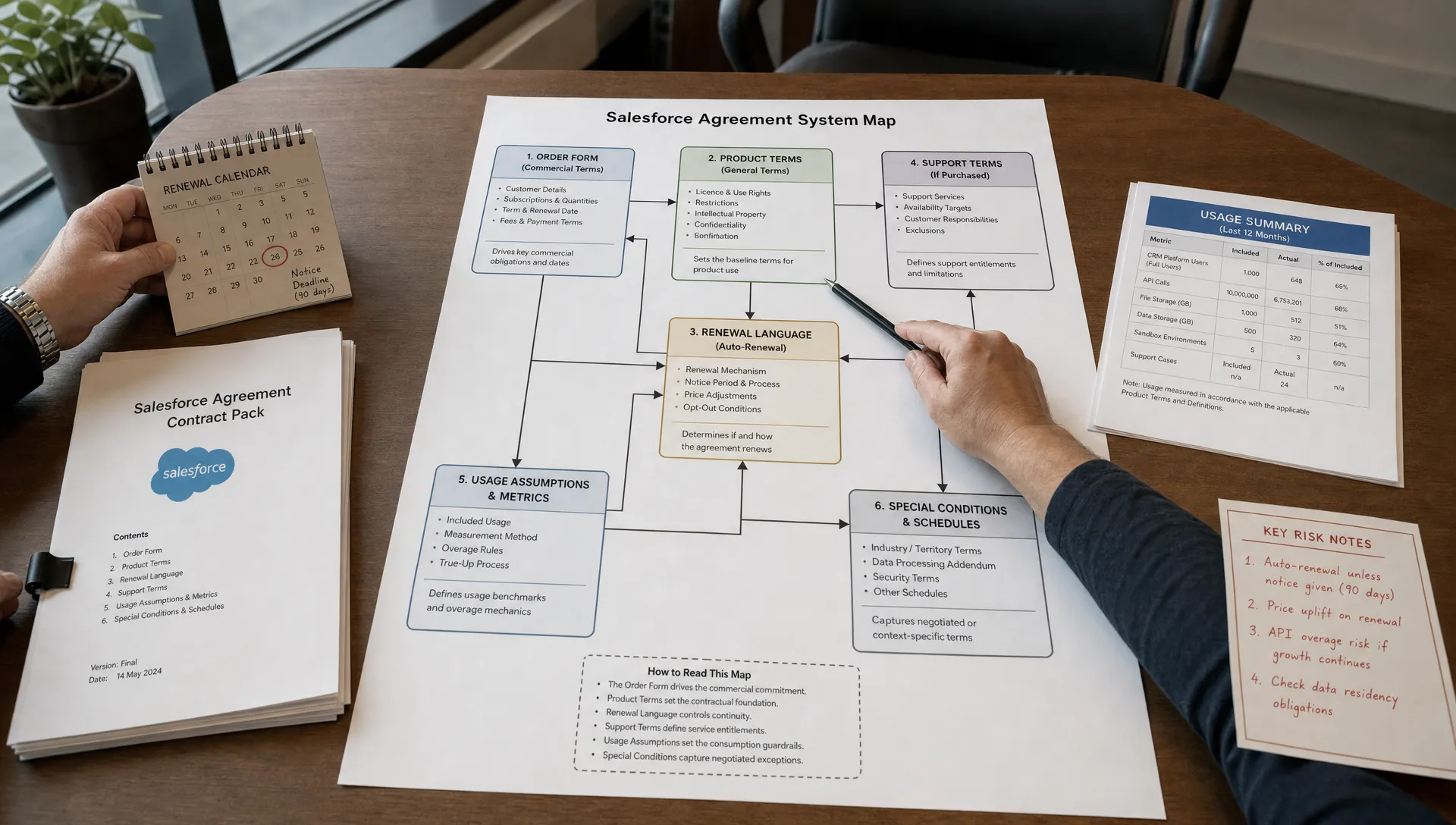
Salesforce agreements usually contain several moving parts. The order form may be the most visible, but it does not sit alone. Legal terms, product terms, renewal language, support terms, usage assumptions and special conditions all influence the final economics.
Legal teams should anchor their review in Salesforce's own public materials, including the Salesforce agreements and terms page. But the commercial reading of those documents is where practical experience starts to matter.
A clause that looks harmless in isolation can have a different meaning when paired with a particular SKU structure. A renewal provision may be manageable for a stable estate but poor for an organisation expecting a restructure, divestment or platform consolidation. A discount may be generous for year one yet less attractive if it applies to licences that will not be used.
Experienced Salesforce negotiators read the contract as a system. They ask how one part affects another.
They look at the baseline, not just the quote. They check whether shelfware is being carried forward. They test whether each SKU still supports a current business need. They look at the roadmap and ask whether the proposed package helps or hinders it. They also look at what has changed since the last agreement, because old assumptions are often the source of new waste.
Where Salesforce experience finds leverage
Good leverage rarely comes from a louder pushback email. It comes from evidence.
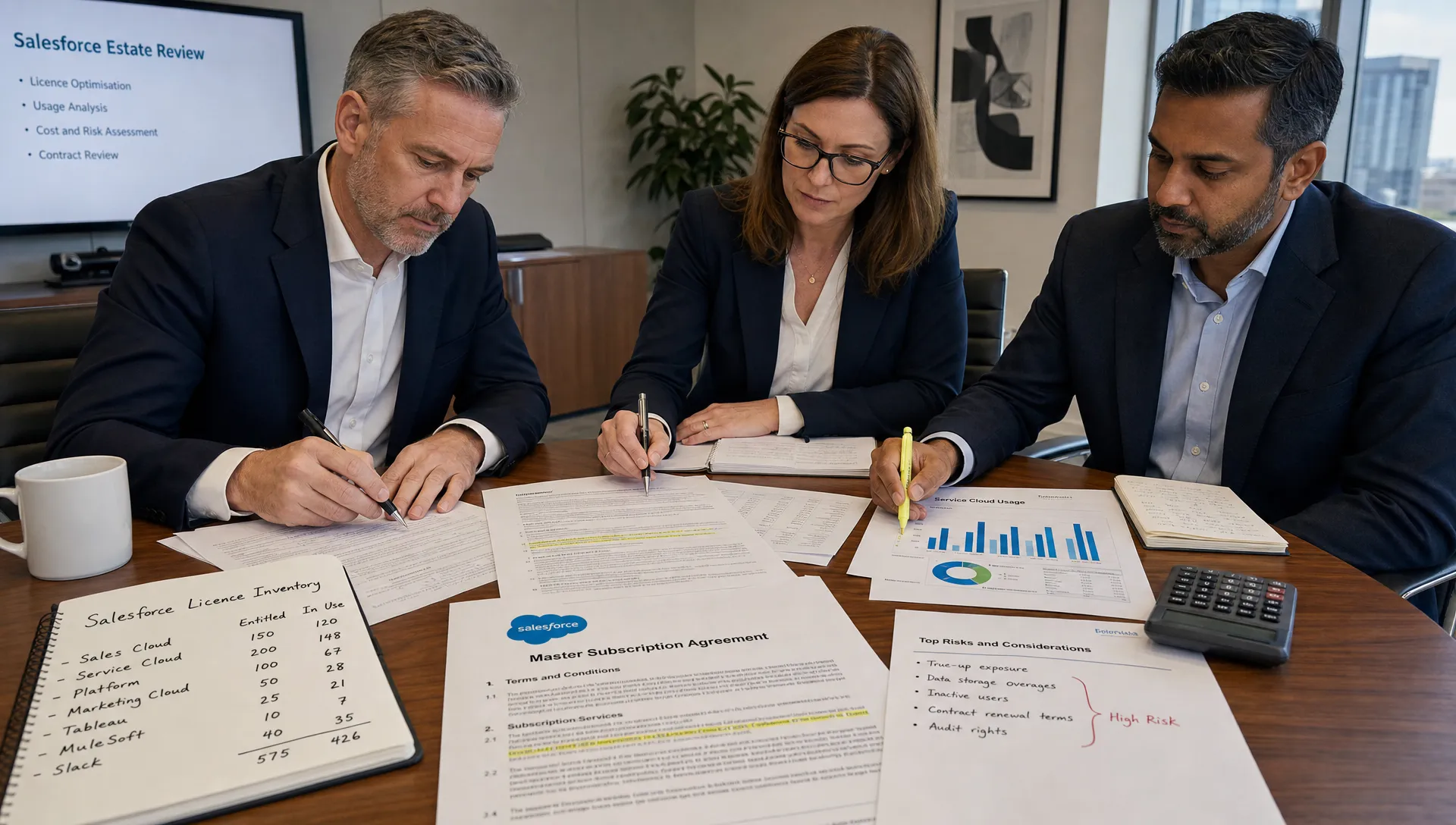
In Salesforce negotiation, evidence usually sits in four places: contract history, usage data, future demand and internal alignment. A team with Salesforce experience knows how to connect those four areas before the commercial conversation becomes constrained.
Contract history shows what has been bought, when it was bought, what commitments were made and which terms may now be working against the buyer. Usage data shows whether the organisation is getting value from the current licence mix. Future demand shows what is genuinely needed next. Internal alignment gives procurement the authority to hold a position without being undermined by late stakeholder exceptions.
The key is not to gather more information for its own sake. It is to build a clean commercial view that can survive scrutiny. That is why Salesforce procurement teams look for hidden leverage early, before the renewal becomes a timetable problem.
In practice, experienced teams tend to test questions such as:
- Which licences are assigned but not actively used?
- Which SKUs are tied to processes that have changed or been retired?
- Which products are business critical, and which are only politically familiar?
- Which future requirements are confirmed, and which are still assumptions?
- Which commercial terms reduce flexibility at the next renewal?
These are simple questions. The value is in knowing what the answers mean inside a Salesforce renewal.
Timing changes the outcome
Salesforce negotiation often begins too late. By the time the renewal quote lands, internal stakeholders may already be anchored to the current estate, the seller may have framed the options and the business may feel short of time.
Experience changes the timing. It pushes the real work upstream.
A renewal readiness review several months before the deadline gives finance, IT and procurement time to separate genuine need from inherited spend. It also gives the organisation time to clean the data, challenge assumptions and align on what it is prepared to accept.
Late negotiation tends to focus on discount. Early negotiation can address scope, structure, terms and risk.
That distinction matters. A discount on the wrong estate is still poor procurement. A smaller discount on a cleaner, more flexible estate can be the better outcome. The numbers only make sense when the commercial structure underneath them is sound.
This is why we often say that Salesforce negotiation starts before the formal negotiation. The renewal meeting is not the start of leverage. It is where leverage is either visible or absent.
What Salesforce-specific experience changes
The clearest way to see the difference is to compare the lens used by a general SaaS negotiator with the lens used by someone who has worked through Salesforce commercial cycles before.
| Negotiation area | General SaaS lens | Salesforce-experienced lens | Why it matters |
|---|---|---|---|
| Licence count | Reduce unused seats | Check edition, role, entitlement and dependency fit | Some savings sit in SKU mix, not only user count |
| Discount | Push for better commercial terms | Test discount against baseline, volume and future flexibility | A high discount can hide poor structure |
| Renewal timing | Engage near quote stage | Start with contract, usage and roadmap review well before quote | Early preparation creates more credible options |
| Stakeholders | Gather business approvals | Map which teams drive usage, exceptions and expansion pressure | Internal misalignment weakens external leverage |
| Add-ons | Assess stated need | Check adoption, overlap and contractual lock-in risk | Add-ons often create future baseline issues |
| Legal terms | Review standard protections | Connect terms to commercial scenarios and renewal risk | Terms can affect spend long after signature |
The unit price trap
One of the most common negotiation mistakes is treating price as the whole story. It is understandable. Price is visible, comparable and easy to report. Structure is harder to explain.
But unit price can mislead. A low price on the wrong licence can cost more than a higher price on the right one. A broad bundle can feel efficient until the organisation only uses part of it. A multi-year commitment can look prudent until the operating model changes.
Procurement teams already understand this in other categories. If a retailer is buying custom neon signage, the sensible discussion is not only the upfront unit price. It includes size, usage, placement, durability, serviceability and the cost of changing course. Salesforce is more abstract, but the same discipline applies. The best commercial outcome is shaped by fit, not just discount.
Salesforce experience helps buyers resist the unit price trap. It reframes the negotiation around the total commercial effect of the agreement.
That does not mean price is unimportant. It means price needs context.
The risks that experienced teams catch earlier
Salesforce renewals carry a few recurring risks. They are not always dramatic. Often they are small enough to pass unnoticed and large enough to matter over a contract term.
Shelfware is the obvious one. Licences are bought for a rollout that slows down, a team that reorganises or a project that never reaches full adoption. The spend remains because removing it is harder at renewal than adding it was at purchase.
Another risk is product overlap. Large Salesforce estates can contain overlapping capabilities, especially after years of incremental buying. Without a careful SKU review, an organisation may pay for multiple products that support similar needs.
Then there is baseline creep. The organisation adds users or products during the term, often for good operational reasons, but those additions become part of the next renewal discussion. If no one tracks the pattern, the buyer enters negotiation with a larger estate than expected and too little time to challenge it.
Experienced teams also watch for commitments that reduce room to manoeuvre. Minimum quantities, narrow swap rights, bundled products and renewal uplifts can all be acceptable in the right circumstances. The issue is not that these terms exist. The issue is signing them without understanding how they affect the next decision point.
What each leader needs from the negotiation
Salesforce contract negotiation sits across finance, technology and procurement. Each function sees a different part of the risk.
| Leader | What they need to know | What Salesforce experience contributes |
|---|---|---|
| CFO | Whether spend is justified and controllable | A clearer view of waste, future commitments and commercial trade-offs |
| CIO | Whether the estate supports the technology roadmap | A check on SKU fit, platform dependencies and avoidable complexity |
| IT lead | Whether users have the right tools without excess | Practical insight into adoption, entitlement gaps and licence hygiene |
| Procurement lead | Whether the organisation has credible leverage | A fact base that supports timing, scope and negotiation position |
The strongest negotiations do not treat these as separate conversations. They bring them together early enough to create one position.
That is a practical point, not a governance lecture. If finance wants cost reduction, IT wants continuity and business units want every licence kept as a safety net, the seller will sense the gap. Salesforce experience helps translate those internal tensions into choices the organisation can actually make.
How to assess whether you have enough Salesforce experience in the room
Not every renewal needs outside support. Some estates are simple, usage is clean and the contract history is easy to follow. In those cases, a disciplined internal team may be enough.
The risk rises when the estate has grown over several years, when multiple clouds are involved, when the business is considering a larger commitment or when internal data does not match the quote. It also rises when stakeholders cannot explain why certain products are still needed.
A useful test is to ask whether your team can answer these questions with evidence, not opinion:
- What is our current contracted baseline by product, edition and quantity?
- Which licences are materially underused?
- Which SKUs are essential for current operations?
- What will we genuinely need in the next 12 to 36 months?
- Which terms could restrict us at the next renewal?
- What concessions matter beyond discount?
If those answers are unclear, the negotiation is not ready. That does not mean the team has failed. It means the contract is doing what complex contracts do: hiding commercial consequences in detail.
Salesforce experience is useful because it makes the negotiation calmer
There is a quiet benefit to experience that is easy to undervalue. It reduces drama.
When the buyer understands the estate, the negotiation becomes less reactive. There is less scrambling for data. Fewer late surprises. Fewer internal reversals. Less pressure to accept a structure because the deadline is close.
This matters because Salesforce sellers are often well prepared. They understand their account, their approval process and their preferred commercial path. Buyers need comparable preparation. Not aggression. Not theatre. Preparation.
The best negotiations feel almost understated. The buyer knows what it needs, what it does not need, which terms matter and where it can compromise. That is what Salesforce experience makes possible.
Frequently Asked Questions
Why does Salesforce experience matter more than general negotiation skill? Salesforce contracts have product, licence and renewal mechanics that are easy to misread without specific experience. General negotiation skill helps, but Salesforce experience helps identify where the estate is overbuilt, where terms create risk and where leverage actually exists.
Is Salesforce contract negotiation mainly about getting a bigger discount? No. Discount matters, but it is only one part of the outcome. Scope, SKU mix, renewal terms, flexibility and shelfware reduction can have a larger long-term effect than a few additional discount points.
When should Salesforce renewal preparation begin? Ideally, preparation should begin several months before the renewal deadline. The organisation needs time to review contracts, audit usage, align stakeholders and decide what it genuinely needs before the quote frames the discussion.
Can internal procurement teams handle Salesforce renewals without external support? Yes, in some cases. If the estate is simple, usage data is clean and the team understands the contract history, internal teams may be well placed. External support becomes more useful when the estate is complex, spend is material or the renewal carries strategic risk.
What should a Salesforce contract review include? A good review should cover order forms, product and SKU mix, contracted quantities, usage, shelfware, renewal language, commercial commitments and future business requirements. The point is to understand both current waste and future constraints.
A calmer way to approach your next Salesforce negotiation
Salesforce experience matters because it helps buyers see the agreement as it really is: a mix of value, waste, risk and future choice. The better you understand that mix before negotiation starts, the less you have to rely on last-minute pressure.
If your renewal is approaching, a short independent review can be enough to reveal where the conversation should focus. SaaSed helps organisations examine the contract, usage profile and negotiation position before renewal talks harden.
If you would value a practical second view, you can book a complimentary Salesforce audit conversation. No drama, no pressure. Just a careful look at where the contract may be working for you and where it may not.
Want this kind of intel on your renewal?
Don’t head into your next software negotiation alone
Contact Us