Why Negotiation in Contract Work Starts Earlier
The strongest Salesforce negotiations rarely begin with the quote. They begin months earlier, with contract evidence, usage clarity and internal alignment that give CFOs, CIOs and procurement teams room to make better decisions.

Most teams think negotiation in contract work starts when the supplier sends a quote.
It does not.
By the time the quote lands, much of the outcome has already been shaped by earlier decisions: what the business asked for, which data was gathered, who was involved, which dates were missed, and whether anyone challenged the renewal baseline before it became “the plan”.
For Salesforce customers, this matters. The platform is often deeply embedded across sales, service, marketing, data and operations. That makes late-stage negotiation difficult. Not impossible, but harder than it needs to be.
The better work starts earlier, quietly and deliberately. Not with posturing. Not with a dramatic last-minute push. With facts, options, internal agreement and a clear understanding of what the contract actually allows.
The visible negotiation is only the final mile
The conversation with the account team is the visible part of negotiation. It is rarely the most important part.
Before any supplier conversation carries weight, the buying organisation needs to know several things with confidence: what it owns, what it uses, what it no longer needs, what it may need next, and which contractual terms create risk. Without that work, negotiation becomes a debate over discount, rather than a discussion about value, fit and control.
This is especially true with Salesforce because the commercial structure can be layered. A renewal may include multiple clouds, editions, add-ons, sandboxes, support plans, integrations, minimum quantities, price uplifts and co-termination issues. If the internal team only begins reviewing these items near signature, it is already negotiating inside a narrow lane.
Earlier work widens the lane.
It gives finance time to test the budget assumption. It gives IT time to validate usage and dependency. It gives procurement time to understand contractual levers. It gives business owners time to decide what they genuinely need, rather than defending everything bought in the last cycle.
Why late contract negotiation weakens your position
Late negotiation usually creates four problems.
First, the clock becomes the supplier’s ally. If the renewal deadline is close, your room to test alternatives, redesign scope or challenge commercial assumptions shrinks. The pressure to avoid operational disruption can override better judgement.
Second, internal alignment becomes rushed. CFOs, CIOs, procurement, legal and business owners may all be looking at different versions of the problem. One team wants savings. Another wants continuity. Another wants new functionality. If those views are not reconciled early, the supplier sees the gaps.
Third, the baseline hardens. Once an internal forecast assumes a like-for-like renewal, every reduction starts to feel like a cut rather than a correction. Shelfware that should have been questioned becomes part of the expected spend.
Fourth, contract terms get less attention than price. This is where long-term cost often hides. Renewal mechanics, uplift language, minimum commitments and rights to reduce can matter as much as the headline discount. We have written separately about how specific SaaS contract clauses can drive up Salesforce costs, and those clauses are much easier to address before the final commercial round.
Late negotiation can still produce movement. But it often produces a smaller result, with more stress and less control.
What “early” actually means
Starting earlier does not mean opening a formal negotiation a year before renewal. It means beginning the work that makes the later negotiation credible.
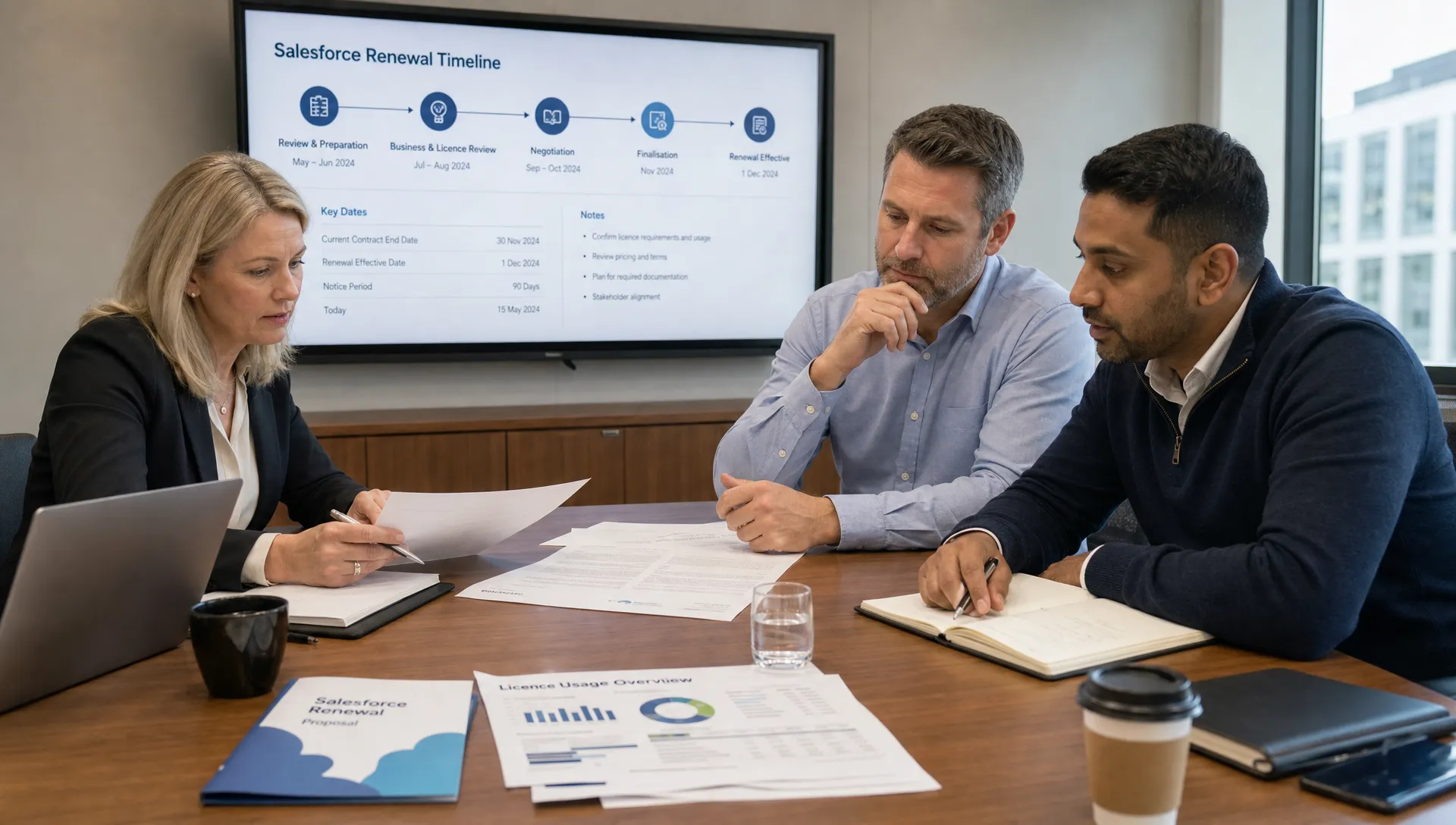
For a large Salesforce estate, a sensible rhythm often looks like this:
| Timing before renewal | What should happen | Why it matters |
|---|---|---|
| 12 to 9 months | Gather contracts, order forms, amendments and renewal dates | You need one reliable view of obligations and deadlines |
| 9 to 6 months | Review licences, SKUs, usage, adoption and business ownership | Waste and mismatch need time to prove, not guess |
| 6 to 4 months | Align finance, IT, procurement, legal and business sponsors | The supplier should not be the first party to discover internal disagreement |
| 4 to 2 months | Build negotiation scenarios and test trade-offs | You need options before you ask for concessions |
| Final 60 days | Negotiate terms, commercials and governance with evidence | The final discussion should be disciplined, not improvised |
The exact timeline depends on contract size, complexity and business dependency. But the principle holds: negotiation starts when you begin shaping your options, not when you first ask for a better number.
Contract work begins with evidence, not opinions
A strong contract negotiation starts with the factual record.
That record should include the current agreement, all order forms, renewal terms, amendments, pricing schedules and any documents that define usage rights or restrictions. Salesforce customers should also understand the supplier’s standard legal framework. The official Salesforce agreements and terms are a useful reference point, although your own signed documents and negotiated amendments are what matter most.
The commercial record should then be matched against usage. This is where many organisations find the first gap between what is being paid for and what is being used. It may be unused licences. It may be a premium edition adopted by a small number of users. It may be an add-on bought for a project that changed direction. It may be a support tier that no longer reflects operational reality.
None of this automatically means the spend is wrong. Some unused capacity may be deliberate. Some headroom may support growth. Some licences may be assigned but underused because the business process has not matured. The point is not to assume waste. The point is to know.
That distinction matters in the room. A supplier can push back against a vague complaint. It is harder to dismiss a measured review of entitlement, use, business need and future demand.
Internal negotiation comes before supplier negotiation
One of the least discussed parts of contract work is the negotiation inside the customer organisation.
Before you can negotiate well with a supplier, you need agreement on what matters. That is not always simple. The CFO may be focused on run-rate reduction. The CIO may be focused on continuity and architecture. Sales leadership may want more flexibility. Procurement may be trying to reduce commercial exposure. Legal may be concerned about renewal mechanics and liability.
These are not competing agendas in a negative sense. They are normal tensions in a serious buying decision.
The mistake is leaving them unresolved until the supplier conversation. When that happens, the negotiation becomes crowded with uncertainty. The account team may receive mixed signals. Internal stakeholders may reopen decisions late. Procurement may be asked to deliver savings without a mandate to change scope.
Early contract work brings those tensions into the open while there is still time to deal with them.
A useful internal question is simple: “What are we prepared to change?”
If the answer is “nothing”, then the negotiation is mostly about price and terms. If the answer includes licence mix, renewal term, growth assumptions, unused products, support levels or future purchasing commitments, then there is more room to work. Our piece on Salesforce negotiation tactics that improve leverage goes deeper into how that fact base changes the tone of the discussion.
The renewal term is not an admin detail
Many teams underestimate the renewal term because it looks procedural. It is not.
Renewal language can shape timing, pricing, notice obligations and future flexibility. If the contract renews automatically, the practical negotiation window may close earlier than the commercial calendar suggests. If price uplifts are built in, the next negotiation starts from a higher base. If minimum quantities are locked, reductions may be difficult even where usage falls.
That is why renewal review belongs near the beginning of the process. You do not want to discover notice requirements or renewal mechanics after the internal business case has already been approved.
A good renewal review answers basic but important questions:
- When does the current term end, and are there notice deadlines before that date?
- Which subscriptions, products and order forms are co-termed, and which are not?
- What price changes apply at renewal, including uplifts or changes to discounts?
- Can quantities be reduced, and if so, under what conditions?
- Are there future purchase commitments, minimums or assumptions embedded in the deal?
- Which terms would create problems if the business needed to change direction during the next cycle?
These questions are not legal housekeeping. They are commercial preparation. If you need a deeper look at this point, see our guide on using the renewal term without losing ground.
Earlier work gives you better trade-offs
Suppliers respond better to clear trade-offs than to broad requests for savings.
A weak late-stage ask sounds like: “We need a bigger discount.”
A stronger early-prepared position sounds like: “We have reviewed adoption and future demand. These products are business-critical, these are underused, and these quantities do not reflect the next term. We are prepared to commit here, but not there. Let’s discuss a structure that reflects that.”
That difference is not cosmetic. It changes the nature of the conversation.
Good negotiation in contract work is rarely about winning every point. It is about knowing which points are worth trading. You may accept a longer term in exchange for stronger price protection. You may keep a strategic product but reduce unused add-ons. You may agree to a growth path, but only if the contract includes clearer governance and less exposure to automatic uplift.
Those trade-offs require time. They also require a clear view of operational dependency. If Salesforce is supporting revenue-critical workflows, the business may not have appetite for disruption. That is fine, provided everyone understands the consequence. A low appetite for change does not remove negotiation power, but it changes where the power sits.
Early does not mean adversarial
Starting earlier is sometimes misunderstood as taking a combative stance with the supplier. It should not be.
Most good negotiations are calmer when the customer has done the work. There is less theatre. Fewer vague claims. Less pressure on both sides to invent concessions at the end.
The supplier also benefits from clarity. If you can explain what is valuable, what is unused, what is changing in the business and where the contract creates concern, the account team has a more coherent case to take through its own approval process. That matters because large software vendors rarely make commercial decisions through one person alone.
This is where preparation connects to psychology. Anchoring, framing and timing all affect outcomes, but they work best when grounded in evidence. Harvard’s Program on Negotiation has a useful explanation of anchoring in negotiation, and the same principle applies in software renewals: the first credible frame can influence the rest of the conversation.
The key word is credible. An aggressive anchor without facts is noise. A disciplined anchor supported by contract analysis, usage data and internal alignment is harder to ignore.
The same principle applies beyond Salesforce
Although SaaSed focuses on Salesforce, the timing lesson applies across complex software and platform purchases.
Any system with modular pricing, compliance requirements, payment flows, integrations, user roles or long-term operational dependency will punish late contract work. A company assessing a CRM renewal faces a different business problem from a gaming operator reviewing a white-label platform, but both need to understand scope, risk and future flexibility before the commercial conversation narrows. Even in specialist categories, such as a modular iGaming platform, the buyer’s best protection is early clarity on what the platform must support, what the contract commits them to, and how easily the operating model can change later.
That is the broader lesson. Contract negotiation is not just a buying event. It is part of how an organisation protects future choices.
A practical early-start checklist
If your Salesforce renewal is not yet urgent, that is the best time to begin.
Start with the documents. Make sure you have the master agreement, order forms, amendments and any renewal notices in one place. Then map what you bought against how it is used. Do not rely only on licence counts. Look at adoption, role fit, business ownership and whether each SKU still serves a clear purpose.
Next, separate the estate into categories. What is essential? What is valuable but negotiable? What is lightly used? What is no longer aligned with the business plan? This categorisation helps avoid a common problem: treating every line item as equally important.
Then bring the right people into the discussion early. Finance, IT, procurement, legal and business owners do not need to attend every meeting, but they do need a shared view of the facts and decisions. Silence is not alignment.
Finally, decide what you want the next contract to protect. Cost is one part of that. Flexibility, renewal control, price certainty, product fit and governance may be just as important.
Frequently Asked Questions
When should Salesforce contract negotiation start? For a meaningful Salesforce renewal, the preparation should often begin 9 to 12 months before the renewal date. The supplier conversation may start later, but contract review, usage analysis and internal alignment need more time.
Is early negotiation only necessary for large Salesforce contracts? No. It matters most where the contract is complex, business-critical or hard to change. A smaller agreement with automatic renewal, minimum quantities or unused products can still create avoidable cost.
What is the biggest mistake teams make in contract negotiation? The biggest mistake is treating negotiation as a final pricing discussion. By then, the organisation may have missed notice dates, accepted the wrong baseline or failed to align stakeholders on what can change.
Does starting early damage the supplier relationship? It should not. Done well, early preparation creates a clearer and more professional conversation. The supplier gets better information, and the customer avoids rushed, emotional decision-making.
What should procurement review first? Start with renewal dates, order forms, licence quantities, SKU mix, price uplift language, reduction rights and any commitments that limit future flexibility. Then compare the contract to actual usage and business need.
Start before the renewal starts speaking for you
The best time to improve a Salesforce negotiation is before it feels like one.
That is when there is space to test assumptions, gather evidence, align stakeholders and decide what the next contract should really do for the business. Waiting until the quote arrives may still leave room to move, but it usually leaves less room than you think.
If you want an independent view before the renewal window tightens, SaaSed offers a complimentary Salesforce audit conversation. We will help you understand where your contract, usage and negotiation position deserve a closer look, without turning the process into theatre.
Want this kind of intel on your renewal?
Don’t head into your next software negotiation alone
Contact Us