What to Include in Salesforce Reviews Beyond Usage
Seat utilisation is only one part of a proper Salesforce review. This guide shows CFOs, CIOs and procurement leaders what else to test before renewal talks begin.
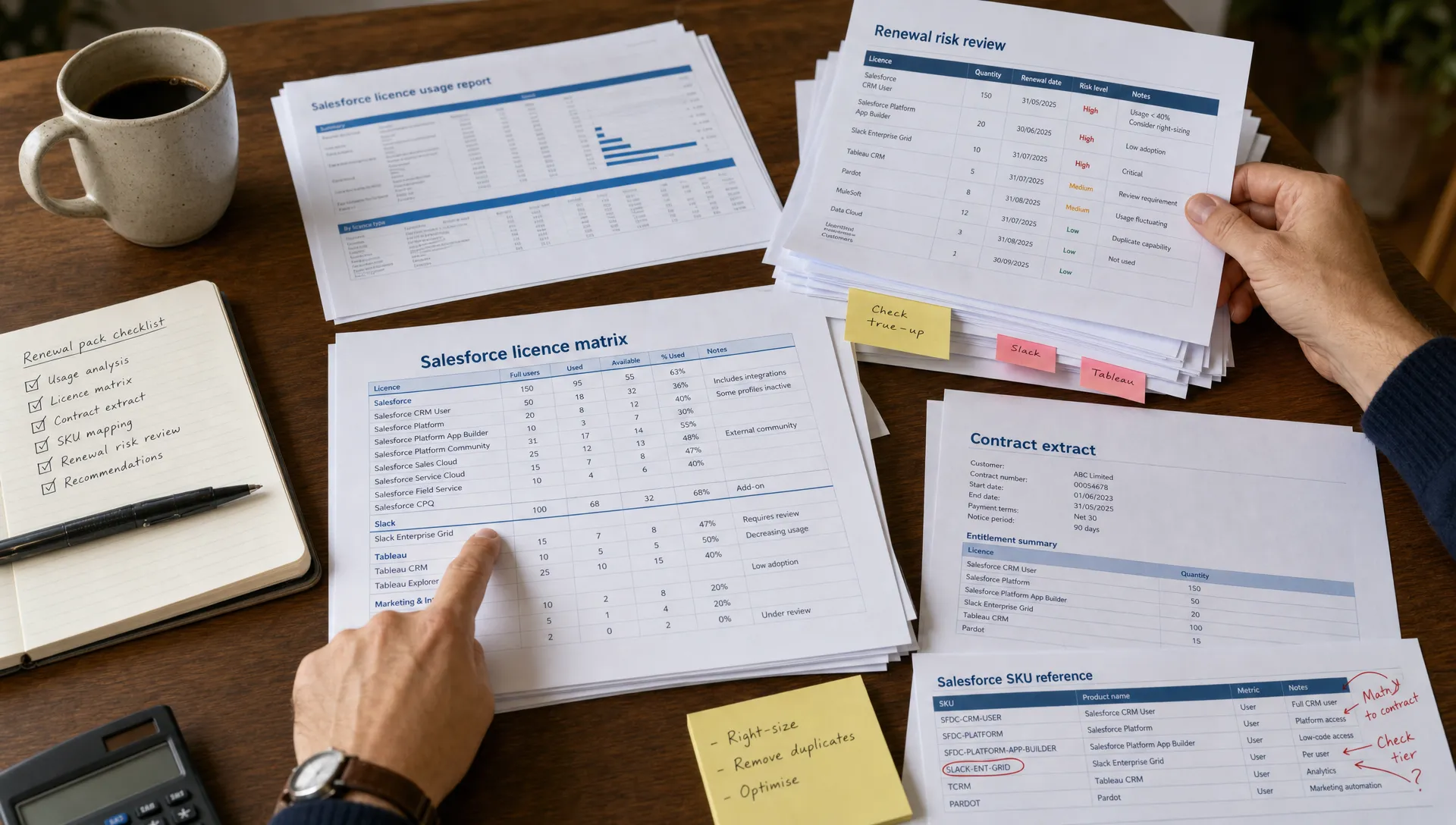
Usage data is a sensible starting point for Salesforce reviews. It is rarely a fair ending point.
A user who logs in every day may still be sitting on the wrong licence. A team with low usage may depend on a small feature buried inside a larger SKU. An add-on that looks idle in the admin console may be tied to a contract term, integration or bundled discount that changes the renewal maths.
For CFOs, CIOs, IT leads and procurement teams, the real question is not simply, “Are people using Salesforce?” It is, “Are we paying for the right Salesforce estate, on the right terms, with a clear reason to keep each part?”
That requires Salesforce reviews to go beyond usage and look at contract mechanics, SKU fit, business value, technical dependency and commercial leverage before renewal talks begin.
Why usage alone gives a thin picture
Usage metrics can tell you whether people are logging in, creating records or accessing certain features. They are useful because they replace guesswork with evidence. But they do not explain whether the licence model is appropriate, whether purchased products overlap or whether your contract gives you room to reduce spend.
A pure usage review also risks rewarding the wrong behaviour. Heavy activity can indicate strong adoption, but it can also signal manual workarounds, poor automation or weak process design. Low activity can point to shelfware, but it can also reflect seasonal usage, specialist roles or technical accounts that do not behave like normal users.
A better review separates what usage can prove from what it cannot.
| What usage can show | What usage cannot prove on its own |
|---|---|
| Login frequency and broad user activity | Whether the assigned licence is the right licence |
| Feature access patterns | Whether the feature creates measurable business value |
| Assigned versus active users | Whether unused licences can actually be removed at renewal |
| Trends by department or region | Whether the SKU is contractually tied to a bundle or commitment |
| Obvious dormant accounts | Whether a lower-cost configuration would support the same process |
Usage matters. It should sit inside a wider commercial review, not replace one.
Contract architecture and renewal mechanics
The first layer of any serious Salesforce review is the contract set. Not just the latest quote, but the full chain of master terms, order forms, amendments, add-on orders, renewal documents and any side letters that affect commercial rights.
This is where many organisations lose leverage. The business sees a list of licences. Salesforce sees a set of commitments, renewal dates, product dependencies, minimum quantities, pricing rules and approval thresholds.
Your review should answer practical questions. Which products renew when? Are order forms co-termed or staggered? Is there an auto-renewal or notice deadline? Do any discounts depend on keeping a bundle intact? Are uplift caps, price protections or renewal assumptions clearly documented? Can quantities reduce at renewal, and if so, under what conditions?
Salesforce publishes official legal materials through its Salesforce agreements and terms page, but the key work is interpreting how your signed documents interact with your actual estate.
If your review finds complex commercial wording, broad enterprise commitments or bundles that are difficult to explain, those documents deserve more than a quick scan. SaaSed has covered this in more detail in its guide to Salesforce agreements that deserve a harder review.
SKU and entitlement mapping
Once the contract picture is clear, the next step is to turn commercial language into a working SKU map. This is where finance, IT and procurement often discover they have been using different versions of the truth.
A good SKU review should show what was bought, what was assigned, what is active, what is technically required and what may be duplicated elsewhere in the Salesforce estate. It should include core clouds, editions, add-ons, sandbox capacity, storage, platform licences, integration-related licences and specialist products where relevant.
At minimum, the SKU map should include:
- Product or SKU name as written in the order form
- Quantity purchased, assigned and materially used
- Owning business function or system owner
- Renewal date and current commercial exposure
- Dependency on other Salesforce products, integrations or processes
- Initial view on whether to keep, reduce, replace, consolidate or challenge
Do not assume that unassigned means reducible. A licence may be unassigned because deployment was delayed, because an implementation partner has not completed configuration or because the business changed direction after the purchase. Equally, do not assume that assigned means needed. Many environments carry inherited permissions, outdated roles and licences kept active because no one wants to disturb the setup before renewal.
The aim is not to create a perfect taxonomy. It is to give decision-makers a clean enough view to spot waste, risk and negotiation options.
Business value by cloud and process
Usage explains activity. Value explains whether that activity is worth paying for.
Salesforce reviews should connect each material product to the business process it supports. For Sales Cloud, that may mean pipeline governance, forecasting discipline, account planning or renewal management. For Service Cloud, it may mean case routing, service level reporting, knowledge management or channel consolidation. For Marketing Cloud, Account Engagement, Data Cloud or other products, the value case will differ again.
The review should ask for evidence, not anecdotes. Which reports does leadership rely on? Which workflows would break if the product was removed? Which teams use Salesforce as their system of record rather than a parallel system? Which capabilities were promised but never adopted?
This matters because different stakeholders see value differently. A CFO may focus on cost per outcome and avoidable spend. A CIO may focus on architecture, resilience and integration load. Procurement will want a clear negotiation position. Business leaders will care whether any proposed reduction damages performance.
The best Salesforce reviews bring those views together rather than letting the renewal become a debate between “cut cost” and “protect the platform”. For a product-by-product lens, SaaSed’s article on which Salesforce services are driving real value is a useful companion piece.
Adoption quality, not just activity
Activity is not the same as adoption.
A sales team may create opportunities but still manage forecasting in spreadsheets. A service team may log cases but avoid knowledge workflows. Marketing users may export lists because segmentation is not trusted. In each case, the usage dashboard shows life, but the operating model shows friction.
A proper review should look at process completion, not only access. Are users completing the intended workflow inside Salesforce? Are managers using Salesforce data to make decisions? Are automations reducing manual work or adding more admin? Are teams asking for more licences because adoption is growing, or because the current design is inefficient?
This is especially important where Salesforce has been expanded over several years. Multi-cloud estates often collect different configuration choices, overlapping tools and inherited permissions. You do not need to solve every design issue before a renewal, but you do need to know which issues are driving cost.
Data, integration and architecture debt
Salesforce spend can rise when licences are used to compensate for messy architecture. That is not a criticism of IT teams. It is a common result of fast growth, acquisitions, regional deployments, changing business ownership and years of add-on purchases.
A review beyond usage should therefore examine integration patterns and data dependencies. Which systems feed Salesforce? Which systems receive Salesforce data? Are there service accounts, middleware tools, custom objects or third-party applications that make certain licences harder to remove? Are sandboxes, storage or API-related needs being handled efficiently?
This part of the review often explains why apparent shelfware is harder to cut than expected. A product may have low direct user activity but still support reporting, integration or downstream operations. The opposite can also be true: high-cost licences may be kept because no one has checked whether a lower-cost licence type or process redesign would be enough.
Commercial leverage and vendor timeline
A Salesforce review should prepare the organisation for negotiation, not just describe the estate.
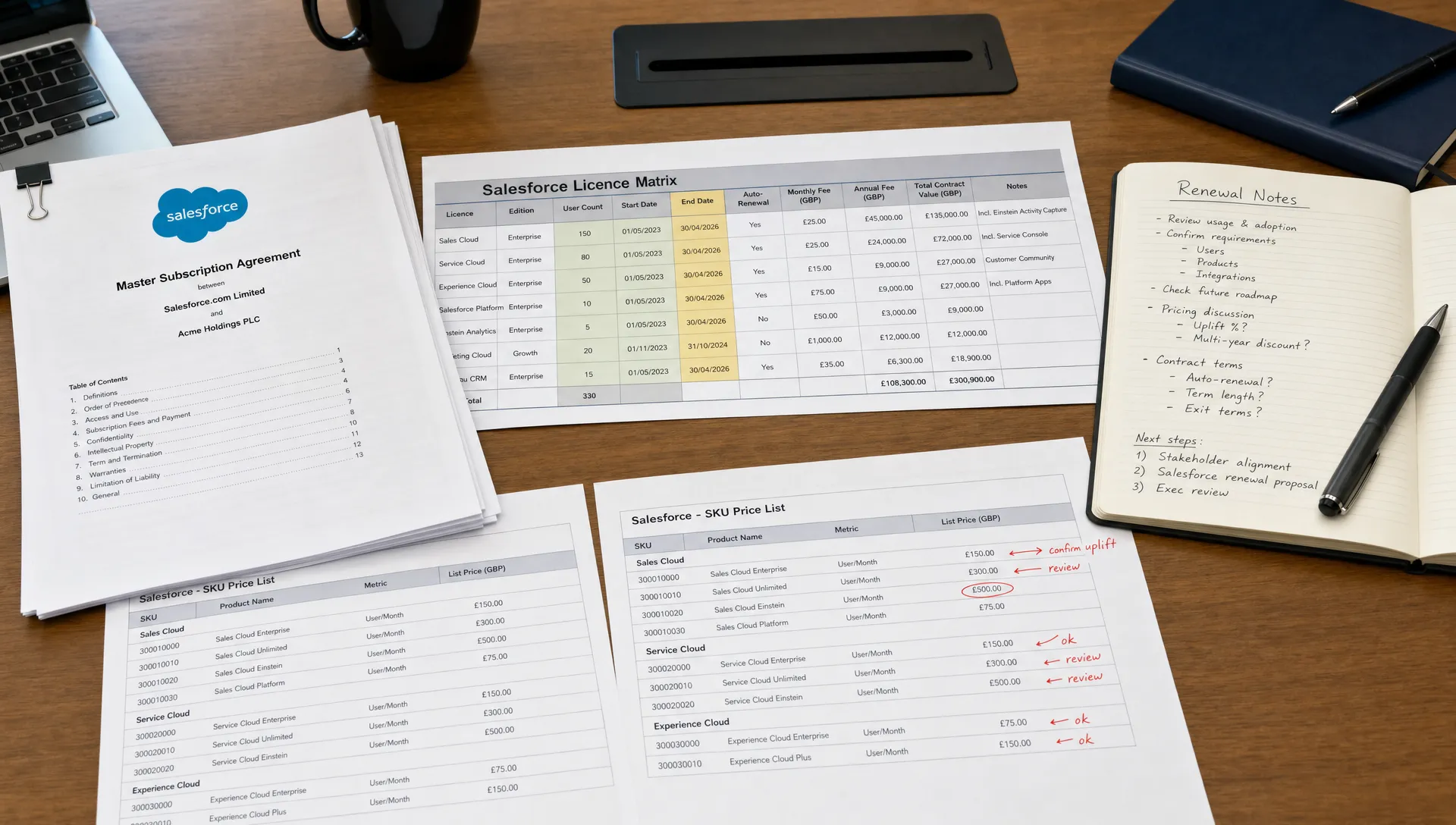
That means turning findings into a renewal position. Which products are business critical? Which licences can be reduced with low risk? Which products need better commercial terms because they are strategic? Which purchases should be deferred until the use case is clearer? Which concessions, protections or structural changes matter more than a headline discount?
Timing matters. If the review starts after the renewal quote arrives, the organisation is usually forced into a narrow discussion about discount. If it starts months earlier, finance, IT, procurement and business owners have time to test assumptions, clean up data, assess alternatives and decide what they actually want to buy.
This is why contract analysis should start well before the formal renewal cycle. SaaSed explains the timing issue in why contract review should start months before renewal.
The output should be simple enough for senior stakeholders to use. A good commercial summary might split the estate into four groups: keep as is, keep but renegotiate, reduce or remove, and investigate before committing. That structure gives procurement a cleaner mandate and gives IT a fair chance to protect what genuinely matters.
Risk, ownership and decision rights
Salesforce reviews can become weak when every finding is treated as a technical issue. Many findings are ownership issues.
Who owns the cost of a licence that one department uses but another department funds? Who approves a reduction that may affect reporting? Who decides whether an underused product gets another year to prove value? Who is accountable for retiring old permissions, unused integrations or inherited configurations?
A good review should name the decision owner for each material issue. It should also separate operational risk from commercial risk. Operational risk includes disrupted workflows, data access problems, integration failures and user disruption. Commercial risk includes missed notice dates, price exposure, bundled commitments and unclear renewal assumptions.
Security and compliance should also be included where relevant. Dormant users, excessive permissions, unmanaged integrations and unclear admin ownership are not just hygiene issues. They can affect audit readiness and internal trust in the platform.
A practical framework for Salesforce reviews
The most useful Salesforce reviews are structured enough to drive action, but not so complex that the business ignores them. The following framework gives CFOs, CIOs, IT leads and procurement teams a common way to assess the estate.
| Review area | Key question | Evidence to collect | Likely owner |
|---|---|---|---|
| Contract terms | What have we committed to, and when can we change it? | Order forms, amendments, notice dates, price protections | Procurement and legal |
| SKU fit | Are we paying for the right products and editions? | SKU map, entitlement list, licence assignments | IT and procurement |
| Usage quality | Are users completing meaningful processes? | Usage reports, workflow data, role analysis | IT and business owners |
| Business value | Which products support measurable outcomes? | Management reports, process KPIs, stakeholder evidence | Finance and business owners |
| Technical dependency | What would break if we removed or reduced this? | Integration map, data flows, app dependencies | CIO, IT architecture and admins |
| Commercial leverage | What can we credibly ask for at renewal? | Reduction candidates, growth plans, risk register | Procurement and finance |
| Governance | Who decides, funds and owns each action? | RACI, budget ownership, approval route | Executive sponsor |
This table is not a substitute for detailed analysis. It is a way to stop the review from becoming a set of disconnected findings.
Warning signs your review is too narrow
Some Salesforce reviews look thorough because they contain a lot of data. The real test is whether the findings change the buying decision.
Common warning signs include:
- The review starts and ends in the admin console
- The renewal quote is treated as the baseline rather than a proposal to test
- Unused licences are identified, but contract rights are not checked
- Business owners are asked for opinions, but not evidence
- Bundled products are accepted because no one can explain them quickly
- Finance, IT and procurement each maintain a different licence view
- The review produces savings ideas, but no decision owner
If several of these are present, the organisation may still be exposed even if it has a decent usage report.
Frequently Asked Questions
What should Salesforce reviews include besides usage? They should include contract terms, SKU mapping, renewal dates, business value, licence fit, integration dependencies, ownership, security considerations and a clear commercial position for renewal.
How early should we start a Salesforce review before renewal? For a material enterprise renewal, start several months before the renewal date. The exact timing depends on complexity, but waiting until the quote arrives usually leaves too little room to change scope or build evidence.
Is low usage always a reason to remove Salesforce licences? No. Low usage may indicate shelfware, but it may also reflect specialist roles, seasonal work, technical dependencies or delayed deployment. Check contract rights, process value and operational risk before cutting.
Who should own a Salesforce review? Procurement can coordinate the commercial work, but the review needs input from finance, IT, legal, security and business owners. The strongest reviews have one accountable sponsor and clear decision owners for each finding.
Conclusion: make the review useful before the renewal makes it urgent
Salesforce usage data is helpful, but it is only one piece of the buying decision. The stronger review asks harder questions: what did we commit to, what do we actually need, what creates value, what carries risk and what can we credibly change before renewal?
That work takes discipline, but it does not need to be theatrical. A clean contract set, a sober SKU map, evidence from business owners and a clear renewal position will usually do more than another round of generic dashboard checks.
If you want a second pair of eyes on your Salesforce estate before renewal talks begin, you can book a complimentary Salesforce audit conversation with SaaSed.
Want this kind of intel on your renewal?
Don’t head into your next software negotiation alone
Contact Us