How Agentic Enterprise Licence Agreement Pricing Really Works
AELA pricing is not just a bigger Salesforce bundle. Learn how usage, scope, overages and renewal baselines shape the real cost before you sign.

Agentic Enterprise Licence Agreement pricing sounds simple from a distance: one enterprise agreement, one commercial framework, broader access to Salesforce’s agentic AI stack.
In practice, it is not simple. It is a shift from buying predictable seats to buying the right to deploy, scale and consume AI-assisted work across the enterprise. That changes the questions finance, IT and procurement need to ask.
With a traditional Salesforce renewal, the core debate is often user count, edition, discount and uplift. With an Agentic Enterprise Licence Agreement, commonly discussed as AELA, the debate moves closer to capacity planning, usage governance and risk allocation. You are no longer only asking, “How many people need a licence?” You are asking, “How much work will agents do, which systems will they touch, what usage metric applies, and what happens if adoption is higher or lower than expected?”
That is where pricing gets interesting.
What an Agentic Enterprise Licence Agreement is really pricing
An Agentic Enterprise Licence Agreement is not just a bulk discount wrapper for Agentforce. It is a commercial structure designed around enterprise-wide AI adoption. The promise is broader access and simpler scaling. The risk is that simplicity at signature can become ambiguity later.
At a practical level, AELA pricing tends to be shaped by five things:
- The scope of Salesforce clouds, orgs, agents and use cases covered by the agreement.
- The expected volume of agentic activity, such as conversations, actions, requests, tokens or another defined unit.
- The level of included capacity and the commercial treatment of usage above that capacity.
- The term, ramp profile, renewal mechanics and any committed spend floor.
- The related dependencies, especially Data Cloud, integrations, storage, sandboxes, premium support and implementation effort.
The exact model will depend on your Salesforce estate and negotiated paper. That last phrase matters. Public pricing pages can tell you the current list-price logic for certain products, and Salesforce’s own Agentforce pricing information is a useful reference point, but your actual exposure is governed by your order forms, usage definitions, rate cards and amendment language.
For a deeper grounding in the agreement concept itself, SaaSed’s guide to what enterprise buyers need to know about Salesforce AELA is a useful companion. This article goes narrower: how the pricing mechanics behave once you are in the negotiation.
The pricing model starts with a usage story
Salesforce will not price an AELA in a vacuum. The commercial discussion usually starts with a usage story. That story may include service agents handling customer queries, sales agents preparing account plans, marketing agents generating campaign workflows, IT agents resolving employee requests, or industry-specific agents supporting regulated operational work.
The more credible the story, the easier it is to price. The less credible the story, the more likely the agreement becomes a bet.
This is the first trap. Many buyers treat the usage story as a technical roadmap. Salesforce treats it as commercial evidence. Every assumption can influence deal size, discount posture and perceived upside.
A useful internal question is: would we be comfortable defending this usage model to our CFO twelve months after signature?
If the answer is no, it is not ready to anchor pricing.
A good AELA usage model should separate three cases. The base case covers use cases with budget, ownership and realistic deployment timelines. The upside case covers use cases that might scale if the early pilots work. The risk case shows what happens if adoption is slow, integrations take longer, or governance blocks certain automations.
This is not pessimism. It is procurement hygiene.
The visible price is rarely the full cost
The headline number in an AELA can be seductive because it appears to simplify a messy future. One agreement. Broad entitlement. Enterprise AI strategy neatly funded.
But the true cost sits in the boundaries.
Does the agreement include all relevant Salesforce orgs? Are subsidiaries, acquired entities and new business units included? Which agents are covered? Which environments count? What usage is included, and what triggers incremental charges? Are Data Cloud credits separate? Is there a rate card for overage? Can unused capacity roll over? Can usage be reallocated across departments?
These questions decide whether the agreement behaves like a genuine enterprise framework or a narrow bundle with a larger invoice.
Here is a simple way to read the pricing architecture.
| Pricing element | What it means commercially | What to test before signing |
|---|---|---|
| Committed spend | The minimum value you are agreeing to pay over the term | Is the commitment tied to realistic adoption or vendor growth expectations? |
| Included capacity | The amount of usage bundled into the agreement | Is the unit of consumption clearly defined and measurable by you? |
| Overage rate | The price paid when usage exceeds included capacity | Is there a pre-agreed cap, tiered rate or approval process? |
| Scope of use | Which clouds, orgs, users, agents and regions are covered | Are future acquisitions, shared services and subsidiaries included? |
| Dependencies | Related products needed to make agents work properly | Are Data Cloud, integration and storage costs separately budgeted? |
| Renewal baseline | The reference point used for the next negotiation | Can temporary peaks become the new commercial floor? |
The AELA price is therefore not a single number. It is a set of behaviours. Those behaviours either protect you as adoption changes, or expose you as adoption changes.
Why agentic pricing is harder to forecast than seat-based licensing
Seat-based licensing is imperfect, but most organisations understand its failure modes. You overbuy, you underuse, you carry shelfware, you negotiate too late, or you accept a renewal uplift without enough leverage.
Agentic pricing introduces different uncertainty.
A user licence is attached to a person. Agentic usage is attached to work. Work can scale quickly once a use case performs well. It can also remain stubbornly low if the business does not trust the output, if integrations are incomplete, or if governance slows deployment.
That means the same agreement can be risky in two opposite ways.
If adoption is lower than forecast, you may be paying for unused capacity. If adoption is higher than forecast, you may face overages, dependency costs, or a more expensive renewal baseline. In both cases, the underlying issue is the same: the organisation signed a commercial model before it had a reliable operating model.
This is why AELA pricing belongs in the same conversation as architecture, data readiness and process ownership. It is not just a procurement exercise.
For example, a financial services firm using agents for internal knowledge retrieval will have a very different usage curve from a healthcare provider, a retailer, or a local care organisation offering personalised support. The work pattern, safety requirements, hand-off rules and data controls all affect how much agentic activity is practical, not just desirable.
The four levers that usually move the price
AELA pricing is account-specific, but the commercial levers are usually familiar. The names may change. The mechanics rarely do.
1. Scope
Scope is the fastest way for a vendor to increase perceived value. A broader agreement may include more clouds, more teams, more geographies and more future use cases.
That can be useful if your organisation genuinely wants an enterprise framework. It can be expensive if the scope is aspirational.
Procurement should ask each business owner a blunt question: what will you deploy within the contract term, not what could you imagine deploying one day?
Future optionality has value, but it should not be priced as guaranteed adoption unless the delivery plan is real.
2. Commitment
Commitment is where the economics sharpen. Salesforce may offer more attractive pricing if you agree to a larger multi-year commitment. That is not inherently bad. Enterprise agreements can work well when the buyer has a clear roadmap and the contract gives enough flexibility.
The danger is a spend floor that quietly replaces usage discipline.
If the agreement commits you to a level of consumption or platform spend before adoption has been proven, you are funding the vendor’s certainty with your uncertainty. The price may look better on paper, but the risk-adjusted cost may be worse.
3. Consumption metric
This is the clause finance should read twice.
Agentic usage can be measured in different ways depending on the product, SKU and commercial structure. It may relate to conversations, actions, requests, credits, tokens or other usage units. Small wording differences matter because they determine when value is consumed and when additional charges apply.
The contract should answer practical questions. What exactly counts as a billable event? Are failed responses charged? Are test environments excluded? Are internal and external interactions priced differently? How are retries, escalations and multi-step workflows treated?
If your team cannot explain the metric in plain English, the business cannot govern it.
4. Renewal baseline
The renewal baseline is often the most expensive part of the agreement, even though it is not always discussed with enough care.
If your organisation signs a three-year AELA, what happens in year four? Does the final-year committed value become the new floor? Does peak usage become the reference point? Are discounts conditional on renewing the same or higher scope? Can you reduce capacity if some use cases fail?
AELA pricing should be assessed not only by the first-term cost, but by the exit cost. In many Salesforce negotiations, the real commercial pressure arrives at renewal, not signature.
SaaSed has written separately about how Salesforce commercial structures compare across standard agreements, SELA and AELA. The short version is this: each structure creates a different kind of leverage, and you need to know which leverage you are giving up.
How to model AELA pricing before negotiation
The best time to model AELA pricing is before Salesforce presents the final commercial proposal. Once the number is anchored, the conversation becomes narrower.
A disciplined model does not need to be complicated. It needs to be honest.
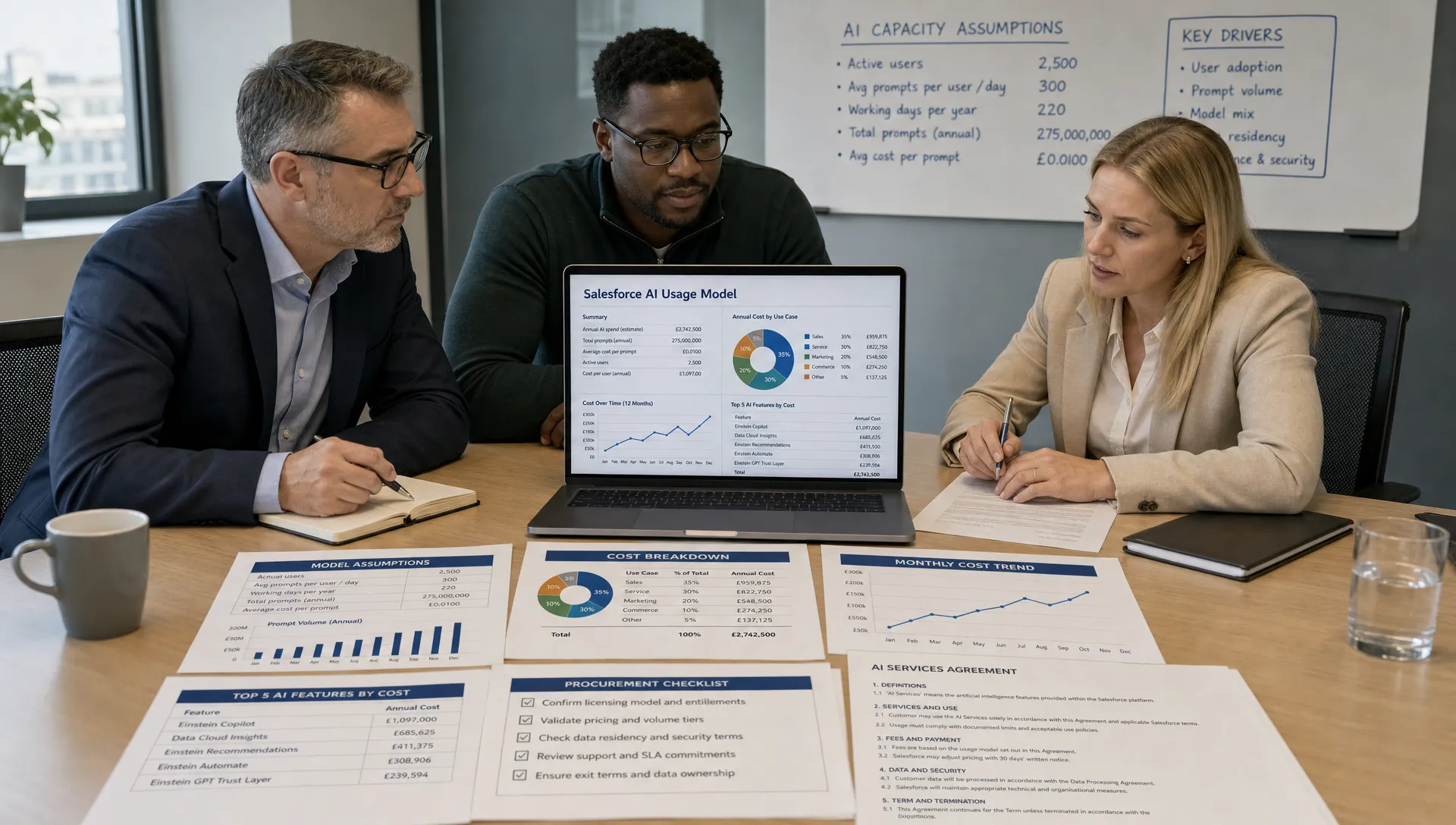
Start with current Salesforce spend and current utilisation. Then map the agentic use cases that have named owners, delivery funding and realistic timelines. For each use case, estimate expected activity, dependency costs and business value. Then run sensitivity cases for adoption being slower or faster than expected.
A practical model should include:
- Current annual Salesforce run-rate by product, SKU and business unit.
- Existing shelfware, duplicate licences and underused functionality.
- Proposed agentic use cases with clear owners and deployment dates.
- Expected usage units by month or quarter, with assumptions documented.
- Dependency costs for Data Cloud, integrations, storage, support and implementation.
- Contract scenarios showing base case, low adoption and high adoption outcomes.
The point is not to predict the future perfectly. The point is to avoid negotiating blind.
If your model shows that only two use cases are likely to scale in the first year, do not price the agreement as if ten will scale. If your model shows high upside in customer service but uncertainty in sales and marketing, negotiate flexibility to move capacity rather than locking each function into a fixed allocation.
For organisations already assessing Agentforce usage mechanics, SaaSed’s breakdown of how Flex Credits and tokens can affect your Salesforce bill gives a more detailed view of the consumption side.
What good AELA pricing protection looks like
Good pricing protection is not about squeezing every last pound out of the vendor. That approach often backfires. The goal is to make the deal durable, measurable and fair under different adoption outcomes.
The strongest protections tend to be simple.
First, define the usage metric clearly. If a unit of consumption is central to the price, it should be measurable, auditable and understood by finance, IT and the business owner.
Second, agree overage treatment upfront. If usage exceeds included capacity, you want pre-agreed rates, approval thresholds and reporting. Surprise usage bills rarely produce good internal conversations.
Third, preserve flexibility across use cases. Agentic AI adoption is still maturing. Some use cases will disappoint. Others may work better than expected. The agreement should allow capacity to follow value.
Fourth, avoid letting aspirational scope harden into renewal obligation. If a region, subsidiary or business function never deploys the technology, you should not have to defend its cost forever.
Fifth, insist on reporting rights. Your team should be able to see consumption, trends and remaining capacity in time to govern behaviour. A quarterly retrospective is useful. A bill after the fact is not governance.
Where buyers lose leverage
Most AELA pricing problems start before the commercial negotiation. They start when the buyer has not aligned internally.
Salesforce account teams are skilled at finding enthusiasm inside the business. That is normal. It is their job. If sales, service, marketing and IT each tell a different adoption story, the vendor can build a larger commercial narrative than finance would have built on its own.
The buyer loses leverage when enthusiasm is not tied to ownership.
Before entering pricing talks, agree internally which use cases are funded, which are experimental and which are out of scope for now. Decide who can approve usage growth. Decide how costs will be allocated. Decide what success means after six, twelve and twenty-four months.
The cleanest negotiations happen when the buyer can say: this is our roadmap, this is our expected usage, this is the flexibility we need, and this is the commercial risk we will not accept.
That tone is hard to argue with because it is grounded in evidence.
A simple AELA pricing checklist for CFOs, CIOs and procurement leads
Before signing an Agentic Enterprise Licence Agreement, make sure you can answer the following questions without needing a translator.
| Question | Why it matters |
|---|---|
| What exact usage unit drives consumption? | Prevents hidden exposure and unclear internal chargeback. |
| Which products and environments are included? | Avoids paying separately for assumed dependencies. |
| What happens if adoption is 50% lower than expected? | Tests shelfware risk. |
| What happens if adoption is 200% higher than expected? | Tests overage and renewal risk. |
| Can capacity move between teams and use cases? | Protects you when the roadmap changes. |
| Is there a committed renewal floor? | Shows whether today’s discount creates tomorrow’s constraint. |
| Do we have independent usage reporting? | Allows governance before spend becomes irreversible. |
| Have we removed waste from the current estate first? | Stops old shelfware being rolled into a new AI story. |
That last point is often overlooked. If your current Salesforce estate already contains unused licences, redundant SKUs or weak discount discipline, an AELA can preserve the waste inside a larger structure. Clean the baseline before pricing the future.
Frequently Asked Questions
Is AELA pricing the same as Agentforce pricing? Not exactly. Agentforce pricing refers to the product-level commercial model, which may include usage-based elements such as credits or other consumption units. AELA pricing is the enterprise agreement structure that may bundle, commit or govern that usage across a wider Salesforce estate.
Is an Agentic Enterprise Licence Agreement always cheaper than buying separately? No. It can be cheaper if you have credible enterprise adoption, strong governance and negotiated flexibility. It can be more expensive if the agreement prices aspirational usage, locks in a high commitment, or carries unclear overage terms.
What is the biggest pricing risk in an AELA? The biggest risk is not one clause. It is uncertainty being priced as certainty. If adoption, usage metrics, dependencies and renewal baselines are unclear, the buyer can end up carrying both underuse risk and overuse risk.
Should finance lead the AELA negotiation? Finance should be closely involved, but not alone. The best negotiation team usually includes finance, IT, procurement, legal, enterprise architecture and the business owners of the proposed agentic use cases.
When should we start preparing for an AELA negotiation? Ideally six to nine months before renewal or before any major commercial event. You need enough time to audit current usage, challenge the roadmap, model consumption and build negotiation leverage before the vendor anchors the proposal.
The quiet truth about AELA pricing
Agentic Enterprise Licence Agreement pricing works best when it is treated as a risk-sharing design, not a discount chase.
The buyer needs flexibility because agentic AI adoption is still uneven. Salesforce wants commitment because enterprise AI is a strategic growth area. A fair agreement sits somewhere between those positions: enough commitment to earn value, enough protection to avoid funding uncertainty blindly.
If you are considering AELA, the most useful first step is not asking for a better discount. It is understanding your current Salesforce baseline, your real AI adoption path and the clauses that could turn future usage into future cost.
SaaSed helps organisations do that work before the negotiation hardens. If you would like a second set of eyes on your Salesforce estate, renewal position or AELA proposal, you can book a complimentary Salesforce audit conversation.
Want this kind of intel on your renewal?
Don’t head into your next software negotiation alone
Contact Us