How to Run a Software Licence Compliance Audit Calmly
A licence compliance audit does not have to become a fire drill. This guide shows finance, IT and procurement teams how to control scope, protect evidence and turn Salesforce usage data into a calm commercial position.
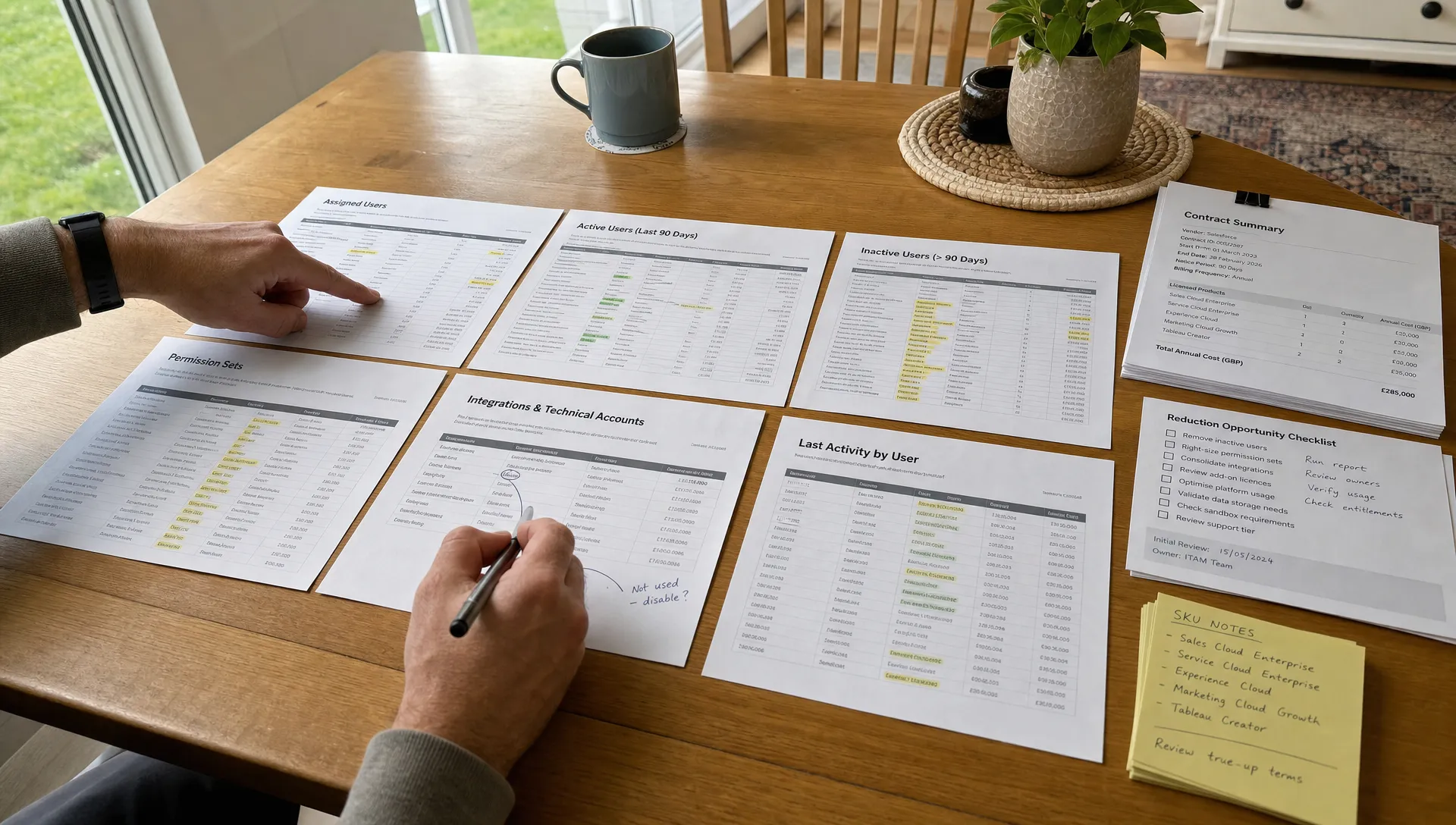
A software licence compliance audit can feel tense before anyone has opened a contract. A vendor notice lands, a renewal date is close, or Finance asks why spend has climbed while headcount has not. People move quickly, which is understandable. They also start guessing, deleting noise from reports or arguing over who approved what. That is where audits become expensive.
A calm audit is not passive. It is controlled. It separates facts from opinion, entitlement from usage and compliance risk from renewal leverage. Some supplier notices still use the US wording, software license compliance audit. Whatever the label, the work is the same: understand what the organisation is allowed to use, what it is actually using and what needs to be corrected before a supplier or internal stakeholder turns uncertainty into pressure.
For Salesforce, that work matters because the contract rarely maps neatly to how the platform is now used. Products get added, teams change, integrations keep running and old licences sit quietly in the estate. A good audit gives CFOs, CIOs, IT leads and procurement teams one version of the truth before any commercial conversation starts.
Start with the right audit posture
The first decision is tone. Treat the audit as a reconciliation exercise, not a hunt for blame. If the first meeting becomes a debate about who caused the issue, the team will lose time and evidence will become scattered.
Set a simple frame: the audit will establish the contractual position, the technical position and the business position. The contractual position tells you what you bought and what rights or limits attach to it. The technical position tells you what has been deployed, assigned or consumed. The business position tells you what is still needed.
Those three positions are often different. That is not automatically a compliance failure. It may be normal drift, weak administration, historical shelfware or poor alignment between buying and operating teams. The point is to know which one you are dealing with.
If the audit was triggered by a supplier notice, involve Legal early and avoid informal back-and-forth until scope is clear. If it is internal and renewal-led, treat it with the same discipline. The findings may still affect future negotiation, budget and risk disclosure.
Stabilise the first 48 hours
The first two days should be about control, not volume. Pulling every possible report before anyone understands the scope usually creates more confusion. Start by naming a single accountable owner, ideally someone who can coordinate Finance, IT, Legal and procurement without turning every detail into a committee discussion.
Ask four questions before collecting evidence:
- What products, entities, regions and time periods are in scope?
- Is this audit contractual, internal, renewal-led or part of a wider risk review?
- Who is allowed to speak to the supplier or auditor?
- What systems, reports and contract documents will be treated as source evidence?
Do not delete users, reassign licences or change permission structures before taking a baseline snapshot. Remediation is often needed, but if changes happen before evidence is captured, the team may struggle to explain the prior state. Date-stamped exports, contract copies and admin screenshots can prevent later arguments about what the position was at the time of review.
Procurement leaders already use this discipline in other categories. If the business is comparing fleet arrangements or property options, the buying question is still grounded in facts: what are we acquiring, under what terms and does actual demand support the commitment? Software feels less tangible, but the audit logic is no different.
Build the contract-led baseline
A licence compliance audit should not start in the admin console. It starts with the contract stack. For Salesforce, that usually means the master agreement, order forms, amendments, renewal documents, product terms and any special terms negotiated over time. If the contract stack is incomplete, the audit will rest on assumptions.
The contract-led baseline should answer three questions. What products and quantities are licensed? What restrictions apply? What happens if usage exceeds entitlement or if the company wants to reduce, reassign or terminate part of the estate?
Salesforce keeps public contractual materials on its legal agreements and product terms page, but your signed order forms and negotiated amendments control the commercial detail. Do not rely only on generic terms if your business has bespoke language.
If you want a deeper method for reading renewal clauses, uplift language and flexibility terms, SaaSed has a practical guide on how to read a software contract before it costs you. For a compliance audit, the point is narrower: identify the clauses that define entitlement and the consequences of variance.
| Contract item | What to check | Why it matters |
|---|---|---|
| Order forms | Product names, quantities, start dates and end dates | This forms the entitlement baseline |
| Amendments | Added SKUs, removed SKUs and changed commercial terms | Later documents may override earlier assumptions |
| Product terms | Usage limits, restrictions and definitions | Platform reports rarely explain contractual meaning |
| Renewal terms | notice periods, uplifts and reduction rights | Compliance findings can affect renewal leverage |
| Entity language | Affiliates, regions and permitted users | Use by the wrong legal entity can create risk |
A calm audit does not try to interpret every clause in one sitting. It identifies the clauses that affect the current question and records where Legal judgement is needed.
Gather usage data without contaminating it
Once the contract baseline is clear, move to usage data. In Salesforce this will normally include assigned licences, active users, login history, permission set licences, managed packages, integrations, storage and relevant feature usage. The exact list depends on your estate and contract.
Be careful with the word usage. A licence can be assigned but not used. A user can be inactive but still counted commercially. An integration user may look dormant because no human logs in, yet it may be business-critical. Permission assignments may imply access without proving meaningful adoption.
This is where IT and Finance can misread each other. IT sees operational risk if access is removed too quickly. Finance sees waste if licences are paid for but quiet. Both views can be true. The audit should separate compliance exposure from optimisation opportunity.
For renewal planning, the same data can support a wider review of waste, demand and negotiation readiness. SaaSed has covered that broader angle in what a software audit should find before renewal, but during a compliance review the key discipline is evidence quality.
Good evidence is repeatable. If someone else reran the extract next week using the same method, they should understand why numbers changed. Record report names, export dates, filters, admin roles and any manual adjustments.

Reconcile entitlement, deployment and business need
The reconciliation stage is where the audit becomes useful. You are not just counting licences. You are testing whether the organisation has the right to use what has been deployed and whether the deployed estate still supports the business.
Work product by product. Compare contract entitlement to assigned quantities, active use and known demand. Then mark each variance as compliance risk, commercial waste, admin clean-up or business-critical exception.
| Finding | Likely meaning | Calm next step |
|---|---|---|
| More users assigned than contracted | Possible over-deployment | Verify contract scope, user type and timing before engaging the supplier |
| Many paid licences inactive | Shelfware or delayed adoption | Confirm whether demand is real before renewal |
| High-tier licences used for low-complexity work | Misaligned licence mix | Test whether lower-tier access would meet the business need |
| Integration users poorly documented | Operational dependency risk | Identify owner, purpose and required access level |
| Access assigned to leavers or movers | Process control gap | Fix joiner, mover and leaver controls after capturing baseline |
This is also the right time to remove folklore. Every organisation has some inherited beliefs about its software estate. We cannot reduce that product. That team needs full access. The vendor will not allow that change. Those statements may be true, but they need evidence.
A calm audit gives each claim a place to live: contract evidence, usage evidence, business owner confirmation or legal interpretation. Anything else is only opinion.
Remediate in the right order
Remediation should be sequenced. If you start by cutting access, you may break operations or lose evidence. If you start by buying more licences, you may solve the wrong problem and weaken your renewal position.
A practical order works better. First, confirm the baseline. Second, classify the variance. Third, agree business ownership. Fourth, remediate clean administrative issues. Fifth, decide whether any commercial discussion is needed.
For example, leaver accounts and duplicate assignments may be internal control issues, not supplier negotiation points. Unused licences may support a reduction request at renewal. A genuine over-deployment may require a commercial remedy, but only after you have verified product definitions, user scope and timing.
This distinction matters. Suppliers may naturally frame variance as a need to buy more. Finance may naturally frame variance as waste. IT may naturally frame variance as operational necessity. The audit should keep all three honest.
Keep roles clear between Finance, IT, Legal and procurement
Calm audits have clear lanes. They do not require everyone to become a licensing specialist, but they do require each function to own its part of the truth.
Finance should own spend visibility, budget impact and forecast scenarios. IT should own platform evidence, user context and operational risk. Legal should own contract interpretation and external communications where a formal audit notice exists. Procurement should own the commercial path, supplier engagement plan and negotiation implications.
This does not need a heavy governance model. A short weekly working session, a shared evidence log and a named decision owner are usually enough. The main risk is not lack of meetings. It is unclear authority.
Where the renewal date is close, keep the compliance audit and renewal negotiation linked but not muddled. A compliance finding may affect renewal strategy, but do not let a supplier use audit uncertainty to rush the buying decision. If the renewal itself needs earlier attention, SaaSed explains the timing problem in software renewals that need attention earlier than you think.
Know when outside support is worth it
Many internal audits can be handled well by disciplined teams. Outside support becomes more useful when the contract is large, the Salesforce estate has grown through several buying cycles, the renewal is close or there is disagreement between functions about what the data means.
It can also help when supplier language feels more confident than your evidence. A calm second opinion can test whether the claimed gap is contractual, technical or commercial. That distinction is often worth more than another spreadsheet.
SaaSed has written separately about when software audit services are worth bringing in. The short version is this: get help when the decision value is high enough that uncertainty is expensive.
Frequently Asked Questions
What is a software licence compliance audit? A software licence compliance audit compares what your organisation is contractually entitled to use with what is actually deployed, assigned or consumed. It can be supplier-led, internal, renewal-led or part of a wider risk review.
How is a compliance audit different from a renewal audit? A compliance audit focuses on whether use matches entitlement. A renewal audit also tests waste, demand, licence mix, future need and negotiation options. The evidence often overlaps, but the decisions are different.
Should we remove unused Salesforce licences before the audit is complete? Capture the baseline first. Once evidence is preserved, you can remove or reassign access in a controlled way. Changing the estate too early can make it harder to explain what happened and why.
Who should own the audit internally? One person should coordinate it, usually from procurement, IT asset management or a similar commercial operations role. Finance, IT, Legal and procurement should each own their part of the evidence and decisions.
What is the biggest mistake during a licence compliance audit? The biggest mistake is starting with assumptions. Teams often jump to buying more licences, cutting access or arguing with the supplier before they have reconciled the contract, usage data and business need.
A quieter way to handle Salesforce audit risk
A calm software licence compliance audit is built on simple habits: protect the baseline, read the contract, gather clean evidence and separate compliance risk from commercial opportunity. It does not remove every difficult decision, but it stops avoidable noise from shaping those decisions.
If your Salesforce renewal is approaching or you have concerns about licence exposure, SaaSed can help you review the contract, usage data and negotiation position before talks become rushed. For a measured second opinion, book a complimentary Salesforce audit conversation.
Want this kind of intel on your renewal?
Don’t head into your next software negotiation alone
Contact Us