How SKU SaaS Mapping Reveals Hidden Commitments
A Salesforce line item can carry obligations that its product name never reveals. Learn how to connect purchases, usage and contract evidence so finance and procurement can separate real commitments from assumptions before renewal.

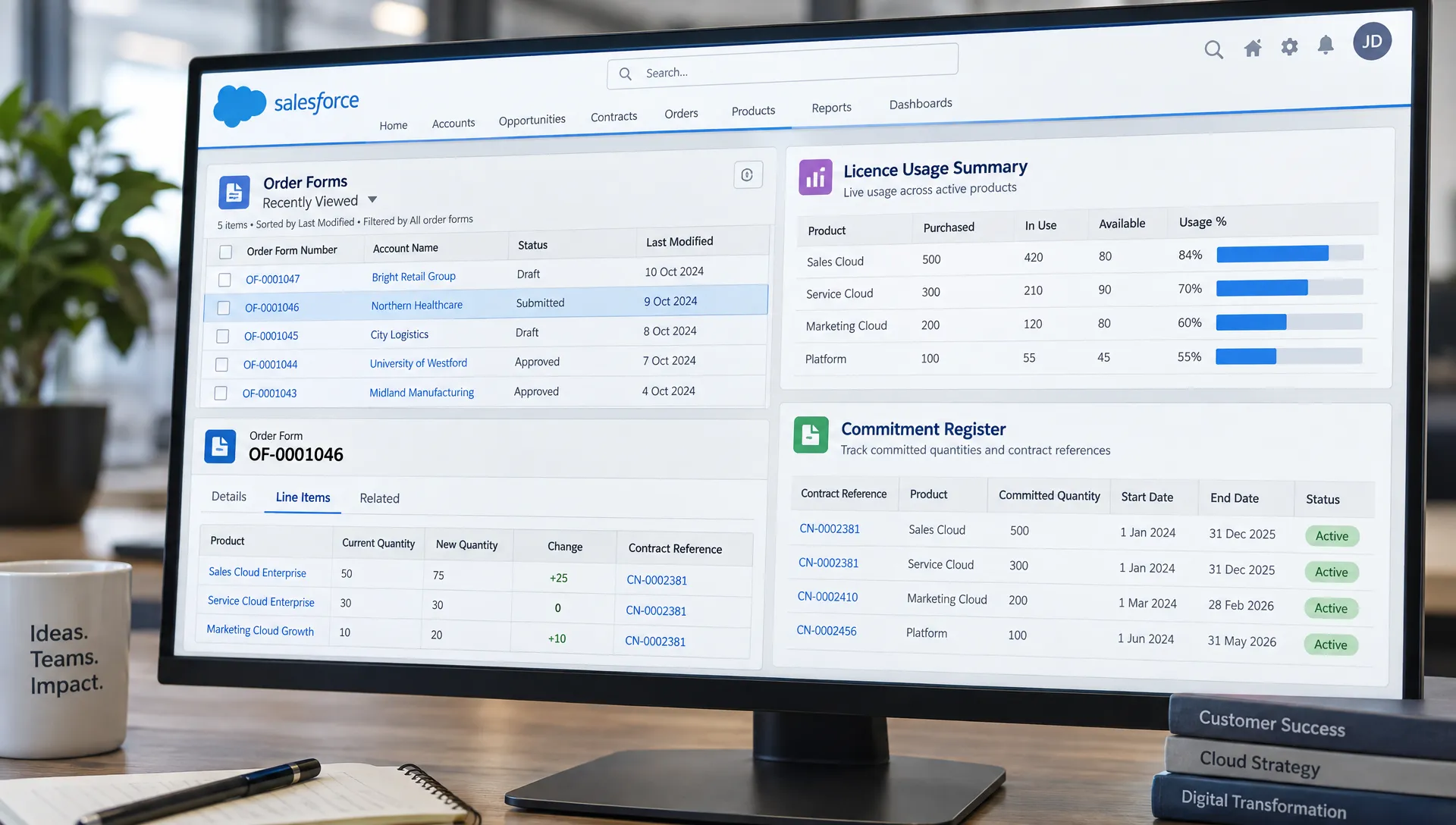
A Salesforce contract can look straightforward until you try to change it. A licence reduction may affect a discount elsewhere. An add-on may depend on an edition you planned to remove. A future quantity increase may already be agreed. sku saas mapping connects purchased line items to the commitments attached to them, so those relationships become visible before renewal discussions begin.
The useful output is not another product list. It is a traceable view of what your organisation has bought, what it must pay for, what it can change and which decisions require further agreement.
What sku saas mapping reveals beyond an inventory
A SKU, or stock keeping unit, identifies a purchasable item. In enterprise software, that item might represent a subscription, an add-on, a support offering or a consumption allowance. Its label alone rarely explains the full commercial position.
An inventory answers, “What do we own?” A commitment map goes further: “What obligations and dependencies sit behind each purchase?”
For each line item, connect four things:
| Mapping layer | What it records | What it helps reveal |
|---|---|---|
| Purchased item | SKU, product, quantity and charging unit | Exactly what the order covers |
| Contract evidence | Order form, amendment and relevant clause | Where the obligation comes from |
| Operational evidence | Assignments, usage and product dependencies | Whether the purchase supports a current need |
| Commercial consequence | Term, scheduled increases and change conditions | What happens if you keep, reduce or remove it |
This is different from interpreting a product code. If the item itself is unclear, first establish what a Salesforce SKU actually includes. Mapping then connects that item to the wider agreement and your operating environment.
Build the map from evidence, not product names
Reliable sku saas mapping starts with signed documents and dated usage records, not a renewal quote treated as the definitive baseline.
Collect the executed order forms, amendments, applicable master agreement and any incorporated product terms. Add invoices and the proposed renewal quote, but distinguish a billed amount or proposed condition from an agreed obligation.
Salesforce’s official agreements page provides access to its published contractual materials. Use it to locate relevant documents, then confirm which versions apply to your organisation. A currently published agreement is not automatically the agreement governing an older purchase.
Next, connect each purchased item to administrative records and business ownership. Record the relevant Salesforce org, assigned users or service entitlement, available usage evidence and the team responsible for the purchase. Keep the evidence date alongside the finding.
The join will not always be one-to-one. A bundle may cover several capabilities, while multiple orders may contribute to one entitlement. Preserve those relationships rather than forcing every contract line into a single administrative licence label.
Keep purchased rights separate from observed activity. An assigned licence does not prove meaningful use, and a permission setting does not by itself establish a purchased entitlement.
Separate obligations, dependencies and unanswered questions
Useful sku saas mapping distinguishes three kinds of finding: a contractual obligation, an operational dependency and a point that still needs confirmation.
A contractual obligation has a supporting document reference. For example, an executed order may specify a subscription term or a scheduled quantity increase.
An operational dependency explains why removing something could disrupt the business. An integration may rely on a capability associated with the current edition. That can make removal difficult without making it contractually prohibited.
An unanswered question is neither. If someone believes a discount depends on retaining another product, record the claim and request evidence. Do not turn an account-team comment into a confirmed contractual restriction.
This distinction matters to finance. A verified payment commitment, a migration cost and an unresolved pricing assumption should not all appear in the same column as “unavoidable spend”. Legal counsel should confirm disputed interpretations and the applicable order of precedence between documents.
Trace the relationships that hide commitments
Quantity changes across the contract term
The most valuable sku saas mapping often follows a line item across time rather than examining it at one date.
Check whether quantities, prices or allowances change during the term. A first-year invoice can understate later obligations if an executed order contains a scheduled increase. Record the effective date and the relevant charging unit, not just the current annual amount.
Also distinguish additional purchases already signed from growth assumptions in a proposal. Only the former belong in the confirmed commitment baseline. Proposed growth belongs in a separate scenario until agreed.
Pricing conditions across products
Where documents contain cross-product pricing conditions, link the affected items. Otherwise, a team may calculate savings from removing one product while overlooking a possible change to the retained package.
Do not assume all bundles behave this way. Establish whether the condition exists, when it applies and what it actually says. A restriction during the current term is different from uncertainty over the supplier’s next renewal offer.
If pricing is opaque, request separate options for retaining the package and changing its composition. The comparison should show quantities, scope, term and total charges on the same basis.
Dependencies across teams and charging units
A product that looks unused to one team may support another team’s workflow. Ask the business owner to validate the dependency, including what would need to change before removal.
For consumption-based purchases, map the allowance and measurement period separately from user subscriptions. Where applicable, record expiry, additional consumption charges and any contracted minimum. These are different exposures, and combining them into a single licence count hides the distinction.
The same discipline applies to support: identify its scope and any documented pricing relationship rather than assuming it can be reduced independently.
A worked example: low use, higher future spend
Consider an illustrative agreement, not a Salesforce price benchmark. An organisation buys 200 subscriptions at £80 per user per month in year one. Its signed order schedules 240 subscriptions in year two at the same rate. Usage evidence identifies 150 users with meaningful activity during the review period.
Here, sku saas mapping separates three figures that could otherwise be confused:
| Measure | Calculation | Illustrative amount |
|---|---|---|
| Year-one subscription charge | 200 × £80 × 12 | £192,000 |
| Year-two subscription charge | 240 × £80 × 12 | £230,400 |
| Year-one spend associated with 50 subscriptions without observed meaningful activity | 50 × £80 × 12 | £48,000 |
The £48,000 is a review opportunity, not an immediately recoverable saving. Some users may have legitimate occasional needs, and the current agreement may not permit a unilateral reduction.
The scheduled increase adds £38,400 to the second-year annual charge. That exposure exists separately from current underuse. Removing inactive assignments in the administration console would not, by itself, amend the signed purchase.
The practical response is to validate demand, establish what change rights exist and prepare a request to revise future quantities. Any supplier agreement to change the commitment should be documented. Until then, finance should retain the signed position in its forecast and show the proposed reduction as a separate scenario.
Turn findings into decisions with owners
A usable sku saas mapping record should tell the reader what needs to happen next. A finding without an owner or decision date tends to survive unchanged into the next renewal.
Keep a unique reference for each purchased line and include its source document, clause or page, term dates, quantity and charging unit. Alongside those facts, record the business owner, usage evidence, linked products and proposed action.
Four status labels are enough to keep the review honest:
- Confirmed commitment: Supported by applicable executed documents.
- Validated requirement: Supported by a business owner and operational evidence.
- Change candidate: Worth reducing, removing or restructuring, subject to rights and dependency checks.
- Unresolved: Missing evidence or an interpretation requiring confirmation.
Avoid recording an internal cost allocation as though it were supplier pricing. If finance divides a bundle cost across departments, label that allocation clearly. It does not establish what Salesforce will charge if part of the package is removed.
Assign ownership according to the question. IT validates technical dependencies and usage evidence. Business owners confirm demand. Procurement tests commercial options. Finance models the outcomes, with legal support for contractual interpretation.
For complex arrangements, this record can support a closer review of enterprise agreement restrictions, but it should not replace that review. The map identifies the issue and its evidence; the applicable documents determine the rights.
Use the map to prepare a specific renewal request
Before negotiations, sku saas mapping should produce a short set of decisions, not a spreadsheet full of unexplained flags.
For each change candidate, state the requested outcome and its supporting evidence. “Reduce this quantity to match validated demand” is more useful than “improve the discount”. “Provide separate pricing for the retained products” is more actionable than “make the bundle transparent”.
Model the retained configuration, the proposed configuration and any transition requirement. Use equivalent terms and quantities so a lower headline price does not disguise a longer commitment or reduced scope. Show one-off transition costs separately from recurring subscription charges.
Start early enough to complete dependency checks and document any negotiated changes before relevant contractual deadlines. Verify those deadlines against the agreement rather than assuming a standard notice period.
The strongest outcome is sometimes a lower charge. It may also be a cancelled future increase, clearer product-level pricing or an agreed route to change the mix later. Record the outcome precisely. Do not count an unconfirmed request as a saving, and do not count the same reduction twice across licence and bundle analyses.
Frequently asked questions
Is SKU mapping the same as a licence audit? No. A licence audit examines entitlement, assignment and use. A commitment map connects that evidence to contract terms, pricing relationships and future obligations. The two should inform each other.
Does low usage mean we can reduce the contract immediately? Not necessarily. Low usage supports a commercial request, but change rights depend on the applicable agreement. Removing an assignment does not itself reduce the purchased quantity or payment obligation.
Who should own sku saas mapping? Procurement can coordinate the record, but it needs contributions from IT, finance, business owners and legal counsel. Ownership should be explicit for each finding, rather than left with whichever team first spotted it.
How often should the map be updated? Update it when an order, amendment or material deployment change occurs, then reconcile it before renewal planning. Scheduled increases and relevant contractual deadlines should remain visible between reviews, not only when a renewal quote arrives.
Make the next renewal easier to judge
The purpose of mapping is to make the commercial position clear enough to act on: what is committed, what is needed, what can change and what still requires evidence.
SaaSed supports Salesforce contract and SKU reviews, software usage audits and renewal negotiation preparation. If your current records do not connect purchased products to their obligations, book a complimentary Salesforce audit conversation to discuss where a review would be useful.
Want this kind of intel on your renewal?
Don’t head into your next software negotiation alone
Contact Us