How to Decode a Salesforce SKU Before You Buy
A Salesforce SKU is more than a product code. Learn how to read each line before you buy, test its renewal impact and avoid turning uncertain value into long-term cost.
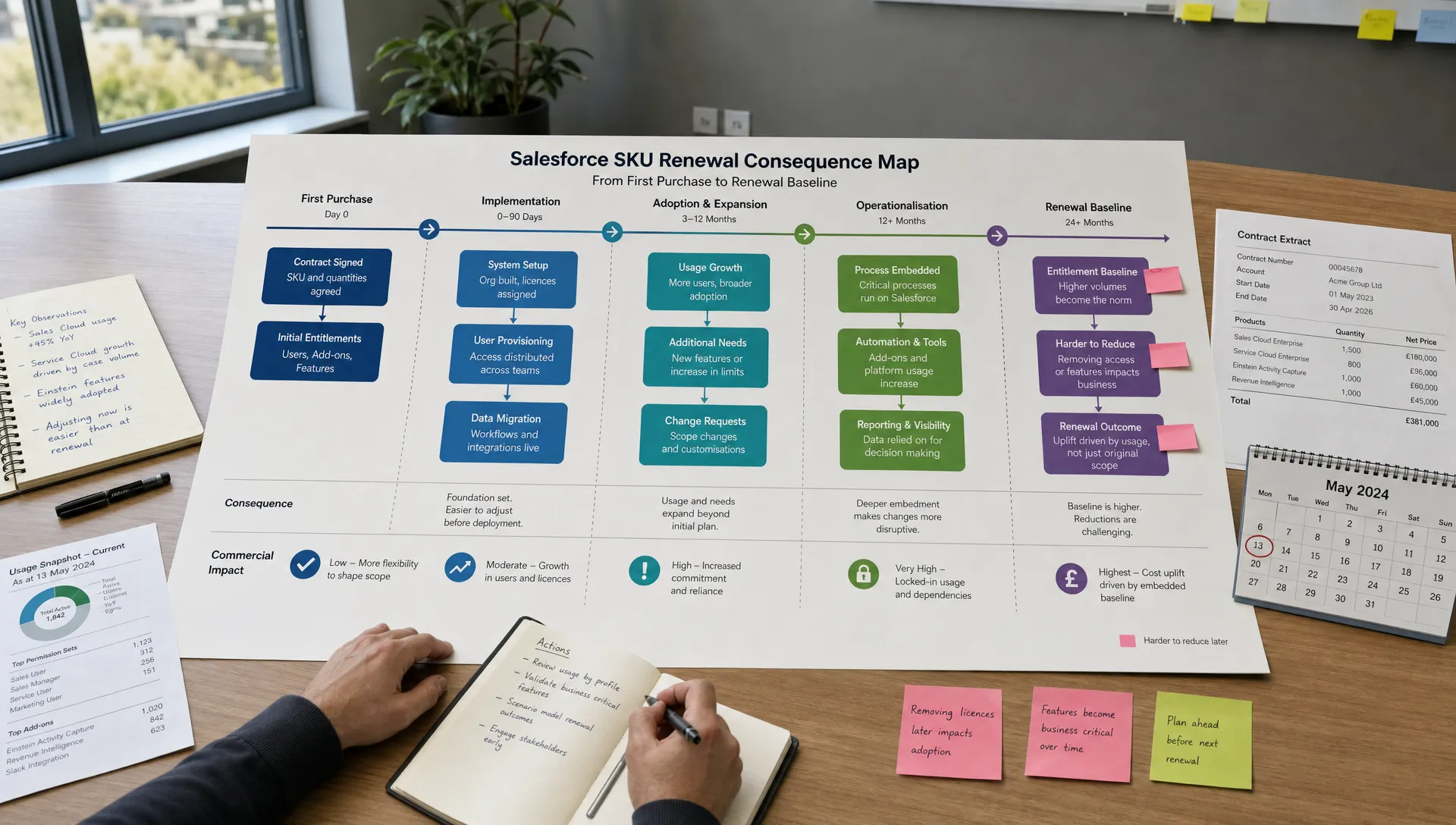
A Salesforce SKU can look like a harmless line item. In practice, it is one of the smallest places where large commercial consequences hide.
For CFOs, CIOs and procurement leaders, the problem is not usually the acronym itself. A SKU in Salesforce is simply a stock keeping unit, a vendor product identifier used to describe what is being sold. The harder question is what that line actually entitles you to, what it depends on and how it will behave at renewal.
That matters because Salesforce buying rarely stays still. A first purchase can become a platform commitment. A tactical add-on can become part of the renewal floor. A bundled concession can make a later reduction harder than expected. If the SKU is not decoded before signature, the organisation often discovers the real economics only when the next renewal is already framed.
This is not about mistrusting Salesforce. It is about buying with enough precision that the contract reflects how your organisation will use the platform, not how the quote happened to be assembled.
What a SKU in Salesforce actually tells you
A Salesforce SKU is a commercial identifier attached to a product, licence, add-on, cloud, support component, consumption entitlement or bundle. It helps Salesforce quote, transact and renew the product. It does not automatically tell you whether the product is necessary, correctly sized or economically sound.
A single SKU line may carry several commercial meanings at once:
- The product family or cloud it belongs to
- The edition or tier being purchased
- The unit of measure, such as users, capacity, credits, messages or records
- The quantity and term
- The price before and after discount
- The relationship to other products in the stack
- The renewal treatment and any uplift mechanics in the contract
Salesforce publishes public product and pricing information, including on its official UK pricing pages, but your actual SKU economics live in the quote, order form, master agreement, product terms and renewal history. The public page is a useful reference point. It is not a substitute for contract-level analysis.
The key point: the SKU name is the label, not the full commercial truth.
Why decoding SKUs before purchase changes the negotiation
Most Salesforce cost problems begin before the renewal. They begin when the buying team accepts a quote structure without translating it into future obligations.
A SKU can be perfectly legitimate and still be commercially wrong for your organisation. It may be too broad for the use case, too early for adoption readiness or too tightly bound to another product. It may be discounted heavily in year one, then become expensive once it is embedded in the renewal baseline.
Pre-purchase SKU decoding helps you answer four questions before you lose leverage:
- Do we understand what this line entitles us to?
- Can we connect it to a funded business requirement?
- Do we know what happens if we need less of it later?
- Are we creating dependencies that will weaken a future negotiation?
That last point is often underweighted. Commercial leverage is not just about the discount percentage. It is about optionality. The more unclear the SKU structure, the harder it becomes to remove unused products, challenge renewal baselines or separate core infrastructure from nice-to-have capability.
If you are evaluating a broad Salesforce footprint, it is worth reading this alongside SaaSed's guide to separating core infrastructure from unnecessary SKUs in a Salesforce multi-cloud strategy. The same discipline applies whether you are buying one cloud or several.
The anatomy of a Salesforce SKU
A good SKU review does not start with price. It starts with meaning.
Before asking whether the discount is acceptable, decode the commercial structure behind each line. The table below gives procurement, finance and IT teams a practical way to inspect a Salesforce SKU before the purchase is approved.
| SKU element to inspect | What it may reveal | Question to ask before buying |
|---|---|---|
| Product family | Whether the line belongs to a core cloud, add-on or adjacent product | Is this product central to the operating model, or is it being added because it is convenient to bundle? |
| Edition or tier | Whether you are buying more functionality than the user group needs | Which capabilities justify this tier, and who will use them in the first 12 months? |
| Unit of measure | Whether cost scales by users, capacity, transactions, credits or another metric | What operational behaviour will increase spend over time? |
| Quantity | Whether the purchase is based on real demand or a growth assumption | What evidence supports this volume, and what is the adoption ramp? |
| Dependency | Whether the SKU only works, or only makes sense, with another product | If we remove the linked product later, what happens to this one? |
| Discount | Whether year-one pricing is masking a larger renewal problem | Is the discount protected, time-bound or linked to a wider bundle? |
| Term | Whether the commitment matches implementation reality | Are we paying for months before the organisation is ready to use it? |
| Renewal treatment | Whether the SKU becomes part of the future baseline | Can we reduce, swap or retire this line at renewal without penalty or loss of unrelated concessions? |
This is where many buying teams find the first warning signs. Not because the quote is wrong, but because the quote is often optimised for the sale. Your job is to translate it into operational and financial reality.
Do not confuse a product name with a buying decision
Salesforce product names can be broad. A cloud, edition or add-on may sound aligned to a business goal, but that does not prove the specific SKU is the right commercial vehicle.
For example, a sales team may genuinely need better forecasting, pipeline hygiene or account planning. That does not automatically mean every user needs the same edition, the same add-ons or the same support wrap. A service organisation may need better case routing or knowledge management, but the correct SKU mix depends on user roles, process maturity and implementation timing.
This is why SKU decoding should involve IT, finance, procurement and the business owner. Each group sees a different risk:
- IT sees implementation dependencies and technical fit
- Finance sees baseline growth and budget exposure
- Procurement sees negotiation structure and contractual lock-in
- The business owner sees whether the product solves the actual operating problem
When only one of these perspectives is present, the SKU review is incomplete.
Watch for bundled value that cannot be unbundled later
Bundling is not inherently bad. It can simplify procurement and create legitimate commercial value. The risk is accepting a bundle without understanding which SKUs are essential, which are speculative and which are included mainly to improve the shape of the deal.
A bundled Salesforce proposal can make the headline discount look attractive while reducing transparency. If the bundle includes products you are not ready to deploy, the organisation may be paying for theoretical value. Worse, once those lines enter the contract, they can influence future renewal expectations.
Before approving a bundle, ask for SKU-level clarity. You want to know the individual list price, net price, quantity, term and renewal treatment for each component. If the commercial model relies on keeping everything together, make sure that constraint is visible to the approval committee.
SaaSed has written separately about software add-ons that quietly inflate Salesforce spend, because these lines often look small at purchase and become awkward later. The same pattern appears in many enterprise agreements: the initial decision feels tactical, but the renewal impact is strategic.

Build your own SKU register before the vendor version becomes the truth
The most useful SKU register is not a spreadsheet copied from the quote. It is a buyer-owned interpretation of what each line means.
For each proposed SKU, create a simple internal record covering:
- Business owner
- Intended user group
- Use case
- Required go-live date
- Quantity logic
- Dependencies
- Contractual constraints
- Renewal risk
- Decision status
Keep it plain. If the team cannot explain the SKU in ordinary language, it is not ready for approval.
This register becomes especially valuable when multiple Salesforce conversations are happening in parallel. Sales, service, marketing, data, analytics and platform teams may each be discussing needs with different vendor contacts. Without a central SKU view, the organisation can end up approving overlapping capability without realising it.
A buyer-owned register also gives procurement a clean basis for challenge. Instead of asking for a better price in general, you can ask sharper questions: Why is this tier needed for this user group? Why does this quantity exceed the deployment plan? Why is this add-on included now rather than after proof of adoption?
Translate each SKU into a renewal consequence
A purchase decision should be judged not only by first-year cost, but by what it does to the next renewal.
Some SKU lines are easy to expand but hard to shrink. Some are introduced at attractive pricing and later become embedded in the baseline. Some depend on discounting that may not survive a contract restructure. Others create operational dependency because teams build processes around functionality before the commercial model has been tested.
A useful internal question is: if we had to renew this SKU in 24 or 36 months with less budget pressure tolerance, would we still want it?
If the answer is unclear, do not necessarily reject the SKU. Instead, negotiate the conditions around it. That may mean a shorter initial term, a phased ramp, clearer reduction rights, separate pricing or a pilot structure that does not contaminate the main renewal baseline.
The principle is simple. Do not let a product trial become a permanent commercial obligation by accident.
Separate adoption risk from commercial risk
A Salesforce SKU can fail commercially even if the product is good. This usually happens when the purchase runs ahead of the organisation's ability to adopt it.
Common adoption gaps include unready data, unresolved process ownership, limited admin capacity, delayed integration work or business teams that have not committed time to change management. If these issues are present, a large upfront SKU purchase can create shelfware before the platform has a fair chance to succeed.
Commercial risk is different. It relates to whether the contract lets you adjust once reality appears. A well-structured deal accepts that adoption will not be perfectly linear. It gives the buyer room to scale, pause or reallocate without punishing the whole relationship.
This distinction is worth making in approval papers. Executives are often comfortable with adoption risk if it is visible and actively managed. They are less forgiving when the commercial structure removes options before the business has proved usage.
The same procurement discipline applies well beyond software. In specialist categories such as workplace noise control, a buyer would not approve a line item without knowing whether it covers panels, barriers, anti-vibration mounts or an expert site assessment. Salesforce SKUs deserve the same level of specificity, because the label alone rarely tells you enough.
Questions to ask Salesforce before approving the SKU
Good questions change the tone of a buying conversation. They move the discussion away from generic discounting and towards fit, flexibility and accountability.
Before approving a Salesforce SKU, ask:
- What exact entitlement does this SKU provide? Confirm the functional scope, eligible users, usage limits and any exclusions.
- Which business process depends on it? If nobody can name the process, the SKU is probably not ready.
- What must already be in place for it to deliver value? Look for data, integration, platform, admin and process prerequisites.
- Is it dependent on another SKU? Understand whether removal, reduction or replacement is possible later.
- How does the price change at renewal? Confirm whether discounts, ramping, uplift terms or bundle conditions alter the economics.
- Can we buy less now and expand later on the same commercial basis? This tests whether the vendor is asking you to pre-commit before adoption is proven.
- What happens if usage is lower than expected? The answer will tell you how much flexibility the contract really gives you.
Document the answers. Verbal reassurance is useful for context, but the buying decision should rest on written terms.
Red flags in a Salesforce SKU review
Not every red flag is a deal-breaker. Some simply indicate that the organisation needs better terms or more internal evidence before approval.
Be cautious when you see any of the following:
- A SKU nobody internally owns
- A quantity based on future ambition rather than funded deployment
- A bundle where individual SKU economics are not visible
- A product added late in the sales cycle to improve the commercial package
- A discount that appears strong, but only if several uncertain products are included
- A contract term that starts before implementation capacity exists
- A renewal baseline that assumes all SKUs remain in place
- Add-ons described as small, strategic or low-risk without a usage plan
These are not reasons to walk away. They are reasons to slow down and decode the line before it becomes part of your Salesforce estate.
The internal decision rule: no orphan SKUs
A practical rule for Salesforce buying is simple: no orphan SKUs.
An orphan SKU is a line item without a clear owner, use case, adoption plan or renewal logic. It may have been added for a valid reason at the time, but if the reason is not documented, it becomes hard to defend later.
Before signature, every SKU should have a named business owner and a plain-English purpose. This is not bureaucracy. It is future leverage. When renewal time arrives, you will know which lines support real value, which need resizing and which should be challenged.
If you are preparing for a first enterprise-scale purchase, SaaSed's guide on what to know before you get Salesforce at enterprise scale gives a wider view of the operating and commercial choices that sit around SKU selection.
Frequently Asked Questions
What does SKU mean in Salesforce? A SKU in Salesforce is a commercial product identifier used on quotes, order forms and contracts. It identifies what is being sold, but the SKU name alone does not explain the full entitlement, dependencies, usage limits or renewal treatment.
Why should procurement review Salesforce SKUs before purchase? Procurement should review SKUs before purchase because the initial quote structure often shapes future renewal leverage. A small or bundled SKU can become expensive if it enters the renewal baseline without clear usage, ownership or flexibility.
Is a Salesforce SKU the same as a licence? Not always. Some SKUs relate to user licences, but others may cover add-ons, support, capacity, consumption, platform capability or bundled products. Treat each SKU as a commercial line that needs its own review.
How do I know if a Salesforce SKU is unnecessary? A SKU is suspect if there is no named business owner, no near-term use case, no adoption plan or no clear link to a funded business priority. It may still be useful later, but that does not mean it should be bought now.
Can Salesforce SKUs be removed at renewal? Sometimes, but it depends on the contract, bundle structure, minimum commitments and renewal terms. This is why reduction rights and SKU-level pricing should be understood before signing the original purchase.
Buy the SKU you can explain
The best Salesforce buyers are not the ones who memorise every product code. They are the ones who insist that each SKU has a reason, an owner, a usage path and a renewal logic.
Before you buy, decode the SKU in commercial language. What is it? Who will use it? What does it depend on? What happens if you need less of it later? If those answers are weak, the deal is not ready, even if the discount looks attractive.
SaaSed helps organisations review Salesforce contracts, SKU mixes, usage evidence and renewal exposure before commercial positions harden. If you would like a second pair of eyes on an upcoming purchase or renewal, you can book a complimentary Salesforce audit conversation.
Want this kind of intel on your renewal?
Don’t head into your next software negotiation alone
Contact Us