How to Scope SFDC Services Without Creating Licence Drift
Salesforce service scopes can quietly reshape your renewal baseline. This guide shows CFOs, CIOs and procurement leads how to keep licence assumptions visible before delivery decisions become recurring spend.
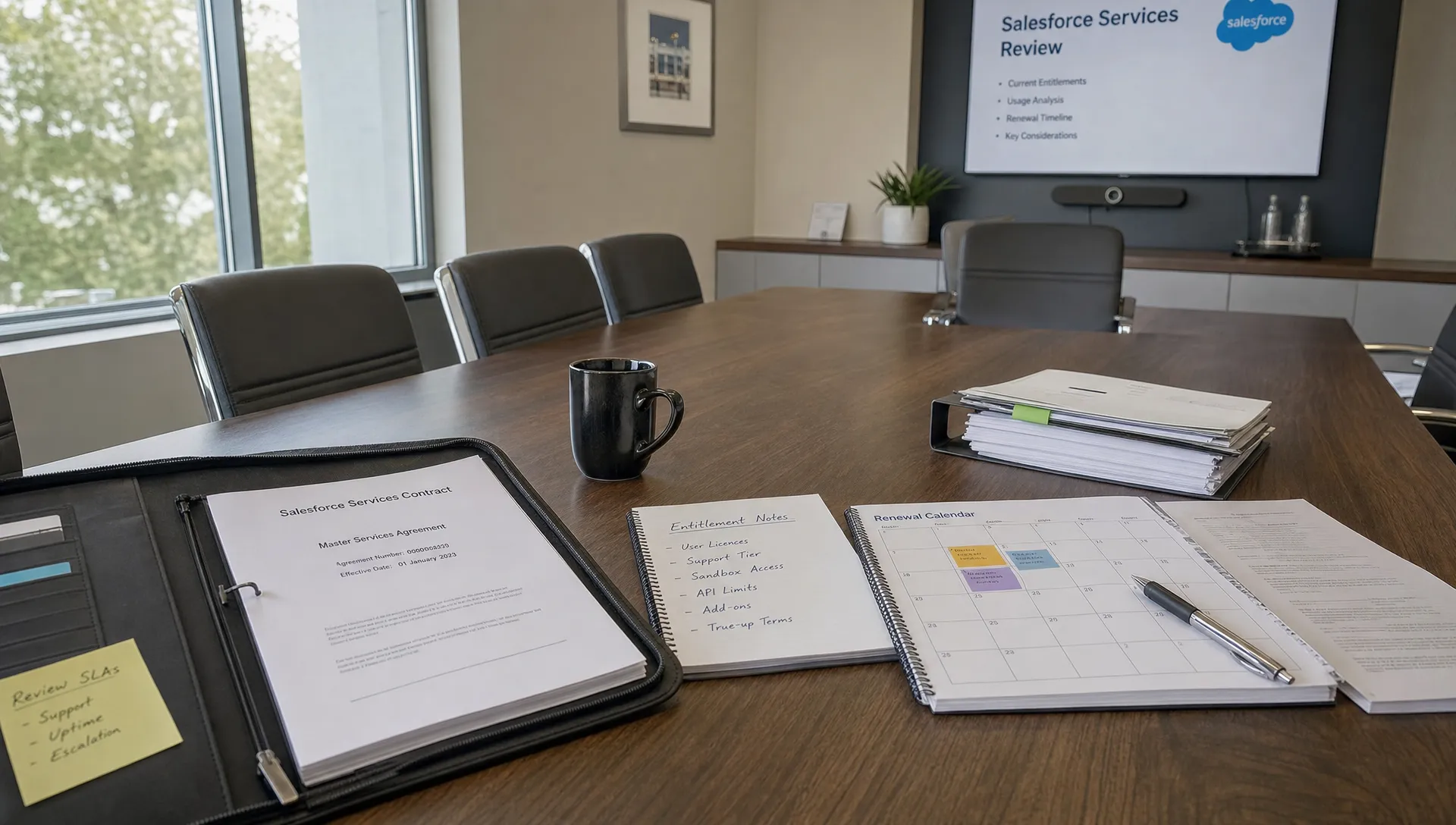
Scoping sfdc services is not just a delivery exercise. For CFOs, CIOs and procurement leads, it is one of the earliest points where Salesforce spend either stays controlled or starts to drift. The work may begin as a clean implementation, optimisation or managed service scope, but small choices about users, features, integrations and access can quietly become a larger licence base at renewal.
Licence drift is rarely caused by one reckless decision. It is usually the result of sensible delivery decisions made without a clear commercial frame. A team adds access for testing, extends a pilot, broadens a process design or buys an add-on to unblock delivery. Each move may be justified. Together, they reshape the commercial baseline.
What licence drift looks like when scoping sfdc services
When scoping sfdc services, licence drift appears in the gap between what the service team is asked to deliver and what the licence estate can support. If that gap is not visible early, delivery teams solve it in the fastest way available: more licences, broader editions, extra products or temporary purchases that never quite disappear.
The risk is higher when the service scope is written around activity rather than entitlement. Phrases such as “support the rollout”, “enable additional users” or “extend capability to new teams” sound harmless. They may hide specific commercial implications, including new full users, platform users, permission set licences, integration users, storage increases or additional cloud products.
This is why scope should not only describe the work. It should describe the licence assumptions behind the work.
Start with what you already own
A good scope starts with the current contract, not the future workshop. Before approving sfdc services, ask for a plain inventory of contracted products, quantities, renewal dates, key restrictions and current assignment. This does not need to become a months-long audit, but it must be clean enough to separate actual need from convenient expansion.
Salesforce product names and user rights can be hard to compare across old contracts, amendments and renewal documents. Salesforce maintains official guidance on Salesforce user licence types, which is useful as a reference point, though your signed contract should remain the commercial source of truth.
For a practical baseline, group the estate into three views: what is contracted, what is assigned and what is active. The gaps between those views often reveal unused licences, misaligned access and shelfware before a new service scope adds further noise. If the licence mix itself looks unclear, it is worth reviewing how to right-size your Salesforce user licence mix before the next statement of work is signed.
Separate service outcomes from licence assumptions
The cleanest way to control licence drift is to scope outcomes in business terms, then test the licence impact separately. For example, “give regional sales managers better pipeline visibility” is an outcome. “Give every manager a full Sales Cloud licence” is a licensing assumption. Sometimes that assumption is correct. Sometimes a narrower role design, existing entitlement or different configuration approach will do the job.
This separation matters because sfdc services often involve several parties: internal platform owners, procurement, finance, a Salesforce account team, implementation partners and sometimes managed service providers. Each party sees a different slice of the decision. Unless licence impact is made explicit, nobody owns the full commercial consequence.
A disciplined service scope should state which user groups are in scope, what they need to do, what licence type is assumed and whether that assumption has been checked against the contract. This keeps the delivery discussion practical. It also stops licence choices being treated as minor technical details when they are recurring cost decisions.

Build a licence impact statement into every scope
Every scope for sfdc services should include a short licence impact statement. It does not need to be elaborate. Its purpose is to force the right questions before delivery momentum makes them harder to ask.
A useful licence impact statement covers four areas: the licences already available, the extra licences assumed, the time period those licences are needed for and the decision owner if the assumption changes. This last point is often missed. If nobody owns the decision, the project will usually choose speed over cost control.
Here is a simple structure that works well in renewal-sensitive environments.
| Scope area | Drift risk | Control to add before approval |
|---|---|---|
| New user group | More full users than forecast | Map tasks to required access before licences are assigned |
| Pilot or proof of concept | Temporary licences become permanent baseline | Set an end date, success criteria and removal plan |
| Integration work | Extra users, API capacity or middleware assumptions | Document technical access needs and contract impact |
| Process expansion | One team’s design becomes the default for all teams | Confirm which roles are in scope and which are future phase |
| Add-on feature | New SKU added to solve a delivery issue | Require a commercial review before purchase or activation |
This table is deliberately plain. The point is not to slow delivery with paperwork. It is to make spend consequences visible while there is still room to choose.
Watch the words that create hidden licence commitments
Some scope language is almost designed to create ambiguity. Procurement and finance teams should pay close attention to broad verbs such as extend, enable, optimise, automate, scale and support. These words are not wrong, but they need boundaries.
For example, “extend Service Cloud capability to the customer operations team” should prompt several questions. Which users? Which tasks? Which region? Which licence type? Is this part of the current renewal baseline or a time-limited project assumption? The commercial risk is not in the phrase itself. It is in approving the phrase without asking what it means in licences.
The same applies to managed services. A backlog item may look small, but if it changes who can access Salesforce or which product features are used, it can alter the estate. This is one reason the wider Salesforce ecosystem can create hidden cost pressure, especially where advisory, implementation and support work is not tied back to entitlement. SaaSed has covered this in more detail in its guide to advisory, implementation partners and hidden costs.
Put governance where decisions actually happen
Governance does not need to mean a large steering group. In most organisations, a small commercial gate is enough. The gate should sit at the points where sfdc services change user access, product scope or renewal assumptions.
The best gates are simple. They ask whether the change uses existing entitlement, whether it creates new recurring spend, whether it affects the next renewal and whether a lower-cost route has been considered. If the answer is unknown, the change should pause for a short commercial review, not disappear into the delivery backlog.
Architecture decisions also matter. Salesforce’s Well-Architected guidance is a useful reminder that good platform design depends on clear choices about security, performance, data and operations. For commercial leaders, the parallel point is simple: design choices often have licence consequences. Those consequences need to be seen before they are embedded.
Do not let pilots become the new baseline
Pilots are a common source of licence drift because they often sit outside normal governance. A senior sponsor wants to test a capability. A team needs quick access. Salesforce offers a commercial path to move fast. None of that is inherently wrong, but every pilot should have an exit route.
Before approving pilot-related sfdc services, define what happens if the pilot succeeds, stalls or fails. Success may justify a wider purchase, but the business case should be refreshed using real adoption data. A stalled pilot should not sit in the estate until renewal. A failed pilot should trigger removal, not a quiet rollover.
This is where finance and procurement can add value without blocking the platform team. Ask for a pilot register with start date, end date, owner, licence assumption and renewal treatment. If a pilot will land inside the next renewal window, treat it as a commercial item from day one.
Tie service scope to the renewal calendar
Licence drift is harder to reverse once renewal discussions are live. By then, additional users or products may be treated as established demand. The earlier a service scope lands in the renewal cycle, the more room you have to test whether it should become part of the long-term estate.
A sensible rule is to review major Salesforce service scopes at least six months before renewal where possible. That gives the CIO time to validate technical need, procurement time to assess commercial terms and the CFO time to understand run-rate impact. If the renewal is closer than that, the review becomes more urgent, not less useful.
This is also where a licence decision register earns its keep. It records the decisions made during delivery, the reasons behind them and whether each decision is permanent, time limited or still under review. Without that record, renewal teams have to reconstruct months of choices from emails, tickets and invoices.
Questions to ask before signing the scope
You do not need a large checklist, but you do need a few hard questions. These are the ones that usually expose whether the scope is commercially safe.
- Which contracted licences and SKUs does this scope assume are available?
- Which users, roles or teams will receive new or changed access?
- Does the work require any new Salesforce product, add-on, permission set licence or integration capacity?
- Are any licences temporary, and who is responsible for removing them?
- Will this scope affect the renewal baseline, forecast or negotiation position?
- Has the licence impact been reviewed by someone outside the delivery team?
If the answers are vague, the scope is not ready. That does not mean the project is wrong. It means the commercial shape is still unfinished.
FAQ
What does licence drift mean in Salesforce? Licence drift means the Salesforce estate gradually moves away from the original commercial plan. It can show up as unused licences, broader access than required, extra products, pilot licences that remain in place or a renewal baseline that no longer reflects actual business need.
Why do sfdc services cause licence drift? sfdc services can cause licence drift when delivery scope changes access, features, integrations or user groups without a separate commercial review. The service work may be valid, but the recurring licence impact can be missed until renewal.
Who should own licence impact during Salesforce service scoping? Ownership should be shared, but not blurred. IT should confirm technical need, finance should understand run-rate cost, procurement should test commercial terms and the business owner should confirm value. One named decision owner should approve any new recurring licence commitment.
Can licence drift be fixed after renewal negotiations start? It can be improved, but it is harder. Once renewal talks begin, current usage and contracted quantities often shape the negotiation. The better approach is to review service scopes, licence assignments and pilot activity before renewal pressure builds.
Keep the scope clean before the spend hardens
Good Salesforce delivery and good cost control are not in conflict. The problem starts when service scope, licence assumptions and renewal planning run on separate tracks. Bring them together early, and you give the organisation more choice: what to keep, what to change, what to remove and what to negotiate.
If you are scoping Salesforce work and want a second commercial view before it becomes part of the renewal baseline, SaaSed can help you review the contract, SKU position and licence impact with care. For a complimentary Salesforce audit conversation, contact SaaSed here.
Want this kind of intel on your renewal?
Don’t head into your next software negotiation alone
Contact Us