Which Salesforce Services Merit Budget Protection
Not every Salesforce line item deserves equal defence. This guide helps finance, IT and procurement teams protect the services that keep revenue, customers, data and controls working.

Salesforce budgets are rarely cut by one clean decision. They drift, they swell, and then, usually near renewal, someone has to decide what should be defended and what should be challenged.
That is where budget protection matters. Not every Salesforce service deserves the same treatment. Some services are part of the operating fabric of the business. If you weaken them, revenue reporting, customer support, compliance or integrations suffer. Others are useful, but not essential. A few are simply underused, over-bundled or waiting for a project that keeps slipping.
For clarity, this article uses Salesforce services to mean both Salesforce product services, such as Sales Cloud, Service Cloud, Data Cloud and platform add-ons, and the paid support or implementation services that sit around them.
The question is not whether Salesforce is important. In many organisations, it plainly is. The sharper question is which Salesforce services merit budget protection when finance, IT and procurement need to defend spend with evidence.
If you are still mapping which parts of your estate matter most, it helps to first look at which Salesforce services are driving real value. Budget protection should come after value assessment, not before it.
The short answer: protect what the business cannot safely pause
The Salesforce services most likely to merit budget protection are the ones that meet three tests. They support a critical process, they are actively used, and removing or weakening them would create a cost or risk larger than the saving.
That sounds simple. In practice, it needs discipline, because many services are sold as strategic but used as optional.
| Salesforce service area | Usually protect when | Challenge when |
|---|---|---|
| Sales Cloud and core CRM | It is the source of truth for pipeline, customer records, forecasting and account ownership | Forecasting still happens in spreadsheets and user adoption is weak |
| Service Cloud, Field Service or Experience Cloud | Case handling, entitlements, customer portals or field operations depend on it daily | It supports low-volume processes with cheaper alternatives available |
| Integration and data services | They connect Salesforce to finance, ERP, product, identity or reporting systems | They duplicate data without clear ownership or cost controls |
| Security, identity and audit services | They support compliance, access control, monitoring or regulated operations | They were bought as part of a bundle but are not configured or monitored |
| CPQ, billing or revenue lifecycle tools | Quotes, approvals, contracts or renewals cannot run reliably without them | The process is simpler than the toolset, or usage sits with a narrow group |
| Marketing, commerce and journey services | They support measurable acquisition, retention, consent or customer communications | Activity is high but attribution, deliverability or ownership is poor |
| AI and automation services | There is a live, governed workflow with measurable time, cost or quality benefit | They are pilots without clear process owners, consumption controls or data readiness |
| Premium support and advisory services | Incident history, internal capacity or project risk justifies the cover | The team rarely uses the service or cannot name outcomes it improved |
The point is not to cut everything outside the first column. The point is to stop granting protected status to services whose only defence is that they were included in the last deal.
Budget protection is not a sacred cow
A protected Salesforce service should still be negotiated hard. Protection means the business intends to keep the capability. It does not mean accepting the same edition, volume, bundle, term or renewal floor.
This distinction matters. Suppliers often benefit when buyers confuse business criticality with commercial inevitability. A service can be essential and still overpriced. A licence type can be needed, while the quantity is wrong. A cloud can be strategically important, while a bundled add-on has little value.
Good budget protection has four qualities.
It is tied to a named process, not a vague ambition. It has an accountable business owner. It is supported by usage and risk evidence. It remains open to commercial redesign.
In other words, protect the capability. Do not automatically protect the commercial construct around it.
A practical test for deciding what merits protection
Before protecting any Salesforce budget line, ask five plain questions.
- Does this service support a process that would break, slow down or become riskier if funding were reduced?
- Is usage broad, consistent and tied to work that leadership actually relies on?
- Is the service difficult to replace before renewal without operational disruption?
- Are the volumes, licence types and editions still aligned with actual need?
- Is there a credible owner who can defend outcomes, not just preferences?
A service that answers yes to the first three questions probably deserves some level of protection. A service that fails the last two may still be needed, but its commercial shape needs work.
This is where many renewals go wrong. Teams debate whether to keep a service without first separating function from spend. A cleaner conversation is: we need this capability, but do we need it in this quantity, at this tier, in this bundle, under these terms?
Salesforce services that usually merit protection
Core CRM and sales execution
Sales Cloud often deserves budget protection when it is the daily operating layer for sales and account teams. If pipeline, account ownership, renewal dates, activities, forecast calls and management reporting depend on it, blunt cuts can be costly.
The evidence should be concrete. Look for active users by role, opportunity hygiene, forecast reliance, integration with finance or quoting systems, and whether senior leaders use Salesforce data in operating reviews. If the board pack depends on Salesforce numbers, that is a sign of operational importance.
But core CRM protection should not extend to every licence and add-on around it. Dormant users, mismatched editions, duplicate sales tools and unused productivity features still deserve scrutiny. Protecting Sales Cloud does not mean protecting waste inside Sales Cloud.
Customer service operations
Service Cloud, Field Service and customer-facing portal services can merit strong protection when they carry customer obligations. Case routing, escalation, entitlement checks, knowledge workflows, service level reporting and field dispatch are not easy to disturb without consequences.
For a CIO, the concern is resilience. For a CFO, it is the cost of failed service, manual workarounds and customer churn. For procurement, it is whether the service volume and package still reflect reality.
This is one area where usage data alone can mislead. A smaller group of service agents may support a very high-value customer base or regulated process. Low user count does not always mean low importance.
Integration and data foundations
Integration services, platform capabilities and data layers often deserve protection because they sit below the visible workflows. When Salesforce connects to ERP, finance, identity, product usage, data warehouses or customer communication systems, the value is not always obvious from licence reports.
Here, architecture quality matters as much as product name. Salesforce's own Salesforce Well-Architected guidance is a useful reference point because it frames reliability, security and scalability as design concerns, not afterthoughts.
Data Cloud and related data services need especially careful treatment. They may be important, but they can also create cost exposure if storage, data duplication and consumption are not governed. If Data Cloud is central to segmentation, identity resolution, AI readiness or customer insight, protect the use case. Then inspect the consumption model. The two decisions should not be merged.
For a deeper look at this risk, SaaSed has covered the Data360 storage trap and why uncontrolled data growth can turn into a renewal problem.
Security, identity and audit services
Security related Salesforce services often merit protection, particularly in regulated or audit-heavy environments. This can include identity controls, encryption, event monitoring, audit trails and related platform security capabilities.
The business case is rarely glamorous, and that is fine. The point is risk reduction. A service that supports access control, incident investigation or compliance evidence should not be removed simply because it is less visible than a sales tool.
That said, security services should be configured, owned and reviewed. Paying for an audit or monitoring capability that no one checks is not protection. It is shelfware with a serious label. Teams should also keep an eye on official service status and trust information through Salesforce Trust when assessing operational dependency.
Revenue lifecycle tools
CPQ, billing, contract and revenue lifecycle services deserve protection when they support quote accuracy, pricing approvals, order handoff, renewals or revenue recognition processes. If sales teams cannot quote correctly without them, or finance relies on them for control, they sit close to revenue quality.
The warning is complexity. Some organisations buy a sophisticated revenue toolset before their process is ready. Others keep customisations alive long after the original business model has changed. In those cases, protect the revenue process, but review whether the current Salesforce configuration is still the right way to support it.
Marketing, commerce and customer journey services
Marketing and commerce-related Salesforce services merit protection when they are tied to measurable customer outcomes. That might mean consent management, lifecycle communications, lead nurture, customer retention, ecommerce journeys or segmentation that sales and service teams actually use.
Budget protection should follow the operating model. A B2B manufacturer may protect account planning, service workflows and partner channels. A consumer brand, for example an ecommerce cosmetics business, may place more emphasis on customer journeys, service response, consented data and repeat purchase communication.
The same principle applies across sectors. Protect the services that support how the business wins, serves and retains customers. Challenge the services that merely create activity.
Salesforce services that need proof before protection
Some services are not obvious cuts, but they should not receive automatic protection either. They need proof.
AI and automation services
AI services can be worth protecting when they are attached to a real workflow, governed properly and measured against a baseline. Examples might include case summarisation, sales activity assistance, service knowledge retrieval or internal process automation.
They are harder to defend when they remain pilots. AI budgets are particularly exposed when no one can explain consumption, data readiness, security controls or the business process being improved.
A useful rule is simple: do not protect AI because it is AI. Protect it because it is improving a process that matters, with controls you can explain.
Premium support and success services
Premium support, advisory packages and success services can be sensible if the organisation has limited internal Salesforce capacity, a complex estate, a history of serious incidents or a critical programme in flight.
They are weaker candidates for protection when the team cannot point to cases resolved faster, risks avoided, releases improved or internal capability built. Ask for evidence. If the service is genuinely valuable, that evidence should not be hard to find.
Extra environments, sandboxes and testing services
Additional sandboxes and development environments can be essential for large estates, regulated change processes and complex release management. They can also sit underused because a programme slowed down or governance was never built.
Protect environment capacity when it reduces release risk. Challenge it when it exists because someone once expected a larger delivery team.
AppExchange and specialist add-ons
Some AppExchange packages are mission critical. Others overlap with native Salesforce capability, legacy process decisions or tools already funded elsewhere.
The right test is operational dependency. If a package supports compliance, revenue, customer communications or integration, review it carefully before making cuts. If it serves a small user group and has weak adoption, do not let the Salesforce label shield it from normal scrutiny.
Signs a Salesforce service should not be protected
A service does not merit budget protection simply because it is familiar, bundled or difficult to discuss. The following signs should trigger a harder review.
- No named business owner can defend the outcome.
- Usage is low, irregular or concentrated in a group that no longer has the same remit.
- The service was included to secure a discount elsewhere.
- The team cannot distinguish must-have features from nice-to-have features.
- A cheaper edition, smaller volume or different term would meet the same need.
- The service depends on a project that has been delayed more than once.
- Reporting shows activity, but not business impact.
This is not a case for aggressive cutting. It is a case for adult budgeting. If a service cannot survive basic questions, it should not be protected from renewal pressure.
How to protect budget without weakening negotiation
Budget protection is an internal decision. It should not be handed to the supplier as a blank cheque.
The safest approach is to create three internal categories before commercial talks begin. First, services to protect because the capability is critical. Second, services to reshape because the capability is needed but the commercial model is wrong. Third, services to remove, reduce or defer because evidence is weak.
This gives procurement a cleaner position. Instead of saying the business needs everything, procurement can say the business has made disciplined choices and now expects the contract to reflect them.
The negotiation risk is revealing too early that a service is untouchable. A better stance is to keep business criticality separate from commercial acceptance. You can be clear internally that Service Cloud must stay, while still challenging edition mix, licence volume, uplift, term length, renewal floors and bundled dependencies.
This is also why timing matters. If the review starts weeks before signature, the supplier has more control. If the review starts months earlier, the buyer can test alternatives, remove dormant users, clarify owners and gather data. That improves the negotiation without pretending the organisation can walk away from everything.
For practical preparation steps, the guide to Salesforce negotiation tactics that improve leverage sets out how to build a stronger fact base before renewal pressure arrives.
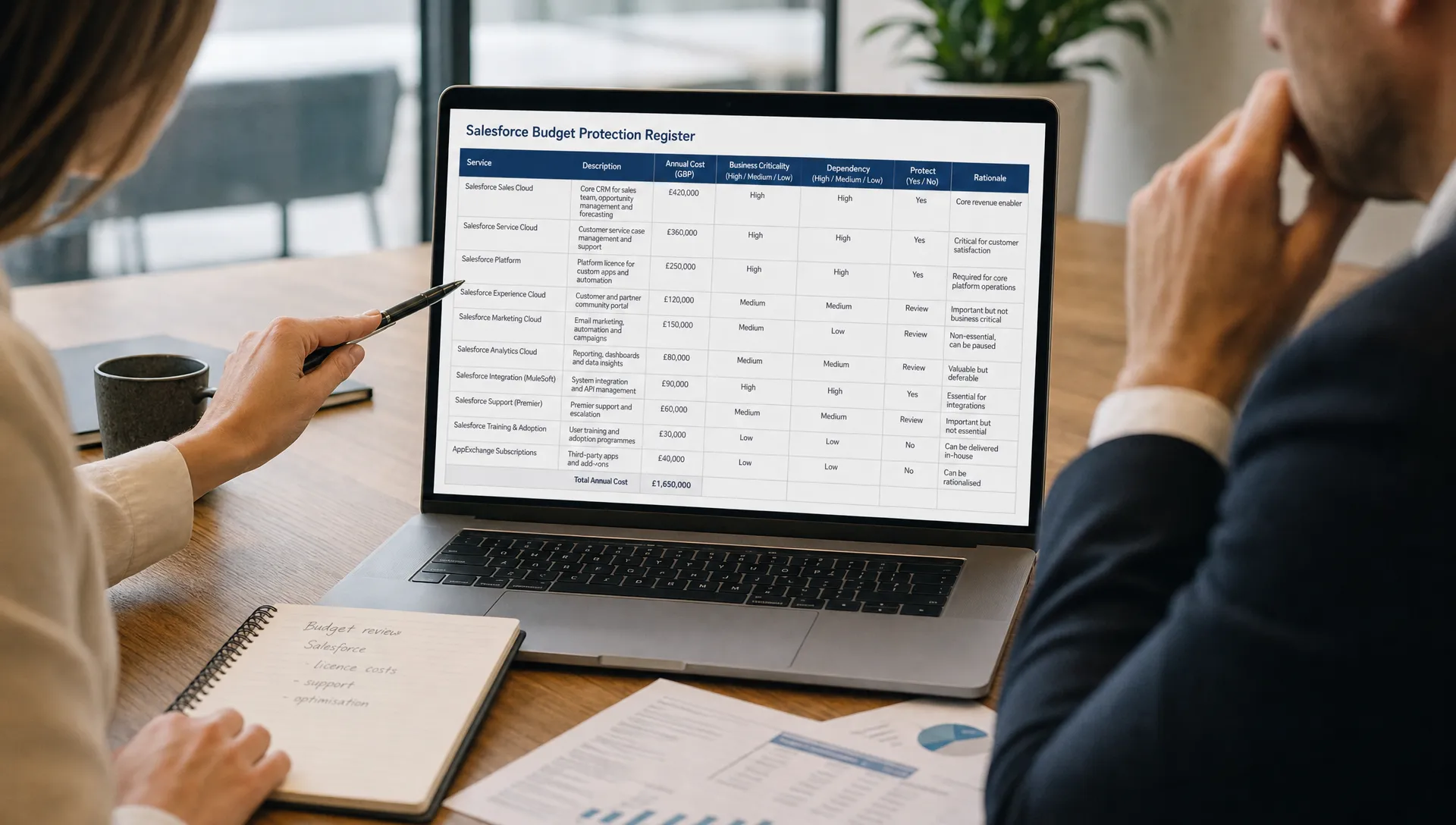
Build a budget protection register
A simple register is often enough. It does not need to be elaborate. It needs to force clarity.
| Field | Why it matters |
|---|---|
| Service or SKU | Identifies what is being protected, reshaped or challenged |
| Business owner | Stops orphaned spend from hiding in the contract |
| Critical process supported | Links spend to an operating need |
| Usage evidence | Shows whether the service is active and adopted |
| Risk if reduced | Makes the cost of disruption visible |
| Commercial issue | Separates need from price, volume, bundle or term problems |
| Renewal action | Defines protect, reduce, remove, renegotiate or defer |
The register should be owned jointly. Finance brings cost discipline. IT brings architecture and operational risk. Procurement brings commercial pressure. Business owners bring process reality.
When one function does this alone, the result is usually lopsided. Finance may cut too bluntly. IT may protect too much. Business owners may defend comfort. Procurement may miss operational risk. Together, the conversation becomes more useful.
What CFOs, CIOs and procurement leaders should watch
CFOs should watch for protected budgets that are not tied to measurable risk or value. The phrase business critical should come with evidence.
CIOs should watch for proposed cuts that weaken architecture, data quality, security or release stability. Some savings look good only because the downstream cost has not been counted.
Procurement leaders should watch for bundles that make important and weak services hard to separate. If a supplier has joined several services into one commercial structure, ask for line-level clarity. Even when decoupling is not fully possible, visibility improves the next negotiation.
The best renewal teams are not anti-Salesforce. They are anti-waste. That difference matters. Salesforce can be essential and still need a tougher commercial review.
Frequently Asked Questions
Which Salesforce services should usually be protected first? Core CRM, customer service operations, security and identity controls, critical integrations, and revenue lifecycle tools usually deserve first review for protection. The final decision should depend on adoption, process dependency and replacement risk.
Does budget protection mean we should accept Salesforce renewal pricing? No. Budget protection means the capability is important. Pricing, licence quantities, editions, bundles, uplift and contract terms should still be challenged.
Should AI services in Salesforce be protected? Only when they support a live workflow with measurable benefit, clear ownership, data readiness and consumption controls. AI pilots without these basics should be treated as conditional spend.
How early should we decide which Salesforce services to protect? Ideally, several months before renewal discussions become commercial. Early review gives time to validate usage, remove shelfware, test assumptions and build a stronger negotiating position.
Who should own the decision? No single function should own it alone. Finance, IT, procurement and the relevant business owners should agree the protection list together, because each sees a different part of the risk.
A calmer way to defend the right Salesforce budget
The strongest Salesforce budget reviews are neither defensive nor slash-and-burn. They are specific. They protect services that keep the business running, reshape services where the commercial model is wrong, and stop funding lines that no longer have a clear job.
If you are approaching a renewal and want an independent view of what deserves protection, what needs reshaping and where negotiation pressure should be applied, SaaSed can help with a focused review of your Salesforce estate.
You can start with a complimentary Salesforce audit conversation and bring a sharper fact base into the next renewal discussion.
Want this kind of intel on your renewal?
Don’t head into your next software negotiation alone
Contact Us