What a Salesforce Support Partner Should Actually Do
A Salesforce support partner should do more than close tickets. This guide explains what CFOs, CIOs and procurement leaders should expect from support, from usage evidence and SKU review to renewal preparation.

A Salesforce support partner should make Salesforce easier to run, easier to govern and easier to renew. That sounds obvious until the renewal window opens and everyone realises support has become a mix of admin tickets, technical fixes, unused licences, vague roadmap conversations and commercial pressure.
For CFOs, CIOs, IT leads and procurement teams, the question is not simply whether a partner can “support Salesforce”. Many can. The better question is what support should mean in a mature Salesforce estate, especially when the platform carries material spend, operational risk and a long list of dependent teams.
A good Salesforce support partner should not behave like a ticket queue with a logo. Nor should they act as a permanent dependency that keeps internal teams in the dark. Their job is to bring clarity: what is being used, what is not, what is fragile, what is costing more than it should and what must be fixed before the next commercial conversation.
Start with the actual job, not the label
“Salesforce support partner” can mean several things. Some partners focus on managed services and admin work. Some specialise in configuration, integrations or development. Others focus on commercial advisory, licence analysis, contract review and renewal preparation.
The risk is assuming one partner can cover every need equally well. Salesforce is broad, and partner capability varies sharply by discipline. A strong support model starts by separating the work into clear lanes:
- Operational support: user access, configuration fixes, reports, dashboards, minor changes and incident triage.
- Technical support: integrations, Apex, data model issues, release management, security controls and architecture decisions.
- Commercial support: contract review, SKU analysis, licence usage, renewal strategy, discount structure and negotiation readiness.
- Adoption support: process alignment, training gaps, user behaviour, change management and value tracking.
These lanes overlap, but they should not be blurred. When support is undefined, expensive technical people end up handling low-value admin tasks, procurement receives late and incomplete usage evidence, and the business keeps paying for products that nobody has challenged.
If you are still deciding what type of partner you need, SaaSed has also written about how to choose the right partner for Salesforce support. This article goes one step further: once a partner is in place, what should they actually do?
They should make the Salesforce estate legible
The first responsibility of a serious support partner is to turn a complicated Salesforce environment into something leadership can understand.
That does not mean oversimplifying the platform. It means creating a reliable picture of the estate: clouds, editions, licences, add-ons, integrations, users, permissions, automations, storage, data flows and dependencies. Without that baseline, support is reactive and renewal planning becomes guesswork.
Salesforce itself provides extensive guidance on support and success resources through its Success Plans, which can be useful context for understanding what is available from the vendor. A partner, however, should help you interpret what matters inside your own estate. Vendor resources explain the menu. Your support partner should help you decide what you actually need.
At minimum, they should help you answer:
- Which Salesforce products are in contract?
- Which ones are actively used?
- Which business processes depend on them?
- Which licences are assigned but idle?
- Which features are paid for but not adopted?
- Which integrations would create risk if changed or removed?
- Which renewal commitments are based on old assumptions?
This is where support becomes a management discipline rather than a helpdesk function. A partner who cannot produce a clear baseline will struggle to help you make sound technical or commercial decisions.
They should challenge shelfware before Salesforce does
Shelfware is not always obvious. A licence may be assigned but barely used. A product may be technically live but no longer tied to a business-critical process. A premium edition may have been bought for features that were never implemented. Add-ons may remain in the contract because they were bundled into a previous deal.
A Salesforce support partner should identify these issues early, not when the renewal quote arrives.
This matters because renewal pressure tends to compress decision-making. If usage data is messy or incomplete, the vendor has a cleaner story than the customer. The conversation quickly shifts from “what value are we getting?” to “how do we avoid disruption?” That is an expensive place to negotiate from.
Good support partners look for the mismatch between entitlement and reality. They review licence allocation, permission sets, login activity, feature adoption and business ownership. They also speak to the teams using the platform, because raw usage data rarely tells the whole story. Low activity may mean waste, but it can also mean seasonal use, a broken process or a team waiting for another system change.
The output should not be a long spreadsheet nobody reads. It should be a decision-ready view of what to keep, reduce, reassign, retire or investigate.
They should protect the renewal timeline
A Salesforce renewal is not an event. It is a process that starts well before the account team sends a proposal.
Your support partner should know this. If they only engage after pricing has landed, their usefulness is limited. By then, internal stakeholders may already be aligned to the wrong assumptions, budget expectations may be set and the commercial leverage may have narrowed.
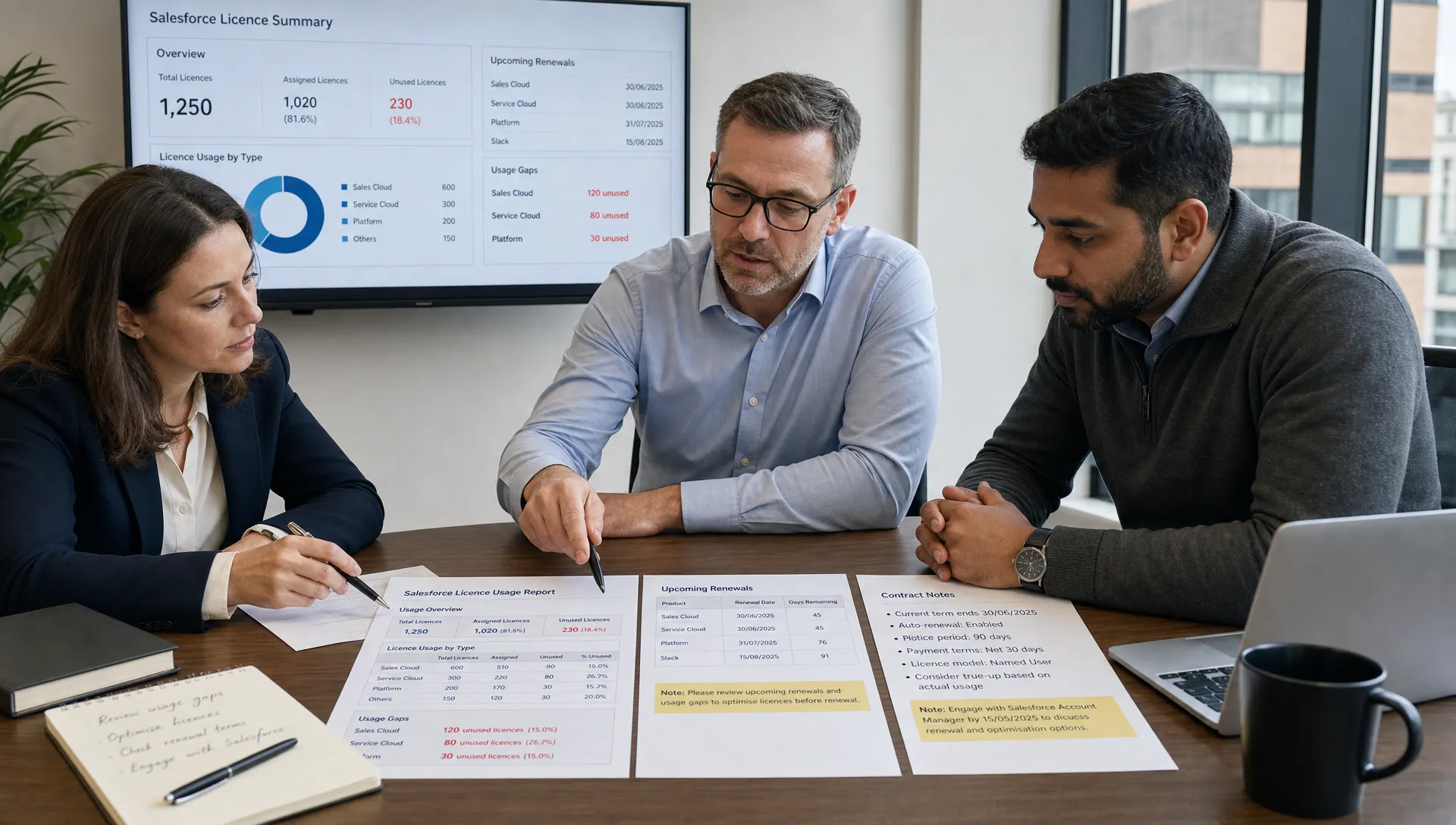
A disciplined support partner helps you prepare earlier by creating a renewal calendar, mapping evidence gaps and clarifying who owns each decision. That includes the CIO or IT lead for platform continuity, procurement for sourcing strategy, finance for budget and value assessment, legal for contract exposure and business owners for demand.
This is one reason support strategy should be built before renewal activity accelerates. If you want a deeper view of that preparation work, see SaaSed’s guide on building a support strategy before Salesforce renewal.
| Partner responsibility | What good looks like | What poor support looks like |
|---|---|---|
| Usage review | Clear evidence of active, low and unused licences | Licence exports with no interpretation |
| Contract review | Identification of risky terms, bundles and renewal constraints | Focus only on headline discount |
| Stakeholder alignment | Finance, IT, procurement and business owners working from one version of the facts | Late meetings with conflicting assumptions |
| Renewal preparation | Options built before the proposal arrives | Reactive response to vendor pricing |
| Value assessment | Products linked to business processes and measurable use | General statements about platform importance |
They should know where technical support ends and commercial support begins
A common weakness in Salesforce support relationships is the assumption that technical competence automatically produces commercial discipline. It does not.
A partner may be excellent at fixing configuration issues but weak at reading contract structures. Another may understand architecture but avoid challenging licence quantities because it could affect future implementation work. A third may be responsive on tickets but unable to explain whether a SKU still makes sense for the business.
None of this makes the partner bad. It means their role should be clear.
For a large Salesforce estate, commercial support should include:
- Reviewing current agreements, order forms and renewal terms.
- Mapping products and SKUs to actual business usage.
- Identifying duplication across Salesforce products and adjacent SaaS tools.
- Testing the commercial logic of uplift, bundles and multi-year proposals.
- Preparing negotiation positions based on evidence, not preference.
- Highlighting timing risks before internal approvals become rushed.
This is where SaaSed’s work typically sits: helping organisations optimise Salesforce renewals through contract analysis, SKU review, usage audits, shelfware analysis and negotiation support. It is not a replacement for every technical or managed service partner. It is a way to ensure the commercial side of Salesforce support is not left until too late.
They should reduce dependence, not increase it
A good Salesforce support partner leaves the client better informed. They should document decisions, explain trade-offs and make internal owners sharper over time.
That includes clear handover notes, readable governance documents and plain-English explanations of why a change matters. It also means resisting the temptation to make everything seem more complex than it is. Salesforce can be complex enough without a partner adding fog.
The same principle applies well outside software. If a building owner hires a specialist roofing and cladding contractor, they expect a clear scope, evidence of competence and a practical view of risk. Salesforce support should be held to the same standard: specialist input, clear boundaries and accountability for the work being done.
For CIOs and IT leads, this means support should strengthen internal governance. For procurement, it means the partner should create better evidence for sourcing and negotiation. For finance, it means fewer surprises and clearer links between spend, risk and value.
They should be honest about what Salesforce is worth to you
Not every Salesforce product in your contract is waste. Not every unused licence should be removed immediately. Not every high-cost product is a bad investment.
A useful Salesforce support partner can hold those truths at the same time. They should avoid the lazy answer of cutting everything that looks underused. Some capacity may be needed for growth, resilience or future rollout. Some low-adoption products may be strategically important but poorly implemented. Some expensive functionality may support a high-value revenue or service process.
The question is whether the spend is justified by evidence.
That evidence should combine system data, contract terms and business context. A support partner should be able to say, with reasonable confidence, which areas deserve protection, which deserve challenge and which require more investigation before any renewal decision is made.
A strong partner will also be comfortable telling you when the issue is not Salesforce. Sometimes the problem is internal ownership, poor process design, weak adoption, unclear reporting or a backlog of unresolved data issues. A commercial review can expose these problems, but it cannot solve all of them alone.
They should help you avoid false savings
Some Salesforce savings look good in a spreadsheet but create operational pain later. Cutting licences without understanding user groups can disrupt sales or service teams. Removing add-ons without checking dependencies can break reporting or integrations. Rejecting a multi-year offer may be sensible, but only if the alternative pricing and risk profile are understood.
A proper support partner helps separate real savings from fragile savings.
Real savings come from evidence: unused licences, redundant products, misaligned editions, duplicated capability, poor bundling or contractual commitments that no longer match demand. Fragile savings come from blunt cuts made under time pressure.
This is why support should include commercial risk assessment, not only price challenge. The goal is not to spend the least possible amount in isolation. The goal is to pay for what the organisation can justify, protect what the business genuinely needs and avoid being boxed into terms that reduce future flexibility.
Procurement leaders will recognise this pattern from other strategic supplier categories. The earlier the facts are gathered, the more options exist. The later the review starts, the more negotiation becomes damage control.
They should give leadership a decision pack, not noise
By the time senior stakeholders are asked to approve a Salesforce renewal or support decision, they should not be reading raw exports or debating basic facts. The support partner should have turned the work into a concise decision pack.
That pack should include the current contract position, key dates, usage findings, shelfware risks, business-critical products, proposed actions, negotiation options and open decisions. It should also show where evidence is strong and where assumptions remain.
For larger estates, this is often the difference between a renewal that is controlled and one that is merely processed.
A partner who only reports activity is not enough. “We closed 74 tickets” may be useful operational data, but it does not tell the CFO whether Salesforce spend is right-sized, the CIO whether platform risk is managed or procurement whether the next proposal is commercially fair.
If the organisation is reviewing broader agreement exposure, SaaSed’s article on Salesforce agreements that deserve a harder review gives useful context on the types of contracts and commitments that often need closer scrutiny.
What to ask a Salesforce support partner before you rely on them
Before placing too much trust in any Salesforce support partner, ask direct questions. Their answers will tell you whether they are set up to help with real decisions or only day-to-day tasks.
Ask how they distinguish assigned licences from active usage. Ask which contract documents they need before forming a view. Ask whether they are comfortable challenging SKU mix and commercial structure. Ask how early they prefer to start renewal preparation. Ask what evidence they would provide to finance, procurement and IT before a renewal negotiation.
Also ask what they do not do. A confident partner will be clear about boundaries. If every answer sounds like “yes, we cover that”, probe harder. Salesforce estates need specialists, but they also need honesty about where each specialist adds value.
Good support is not about having one partner for everything. It is about having the right support in the right places, with clean ownership and no gaps at the moments that matter.
Frequently Asked Questions
What is a Salesforce support partner? A Salesforce support partner is an external specialist that helps an organisation manage, improve or govern its Salesforce environment. Depending on the partner, this may include admin support, technical development, adoption work, licence analysis, contract review or renewal preparation.
Should a Salesforce support partner help with renewals? Yes, if they have the right commercial capability. Renewal support should include usage evidence, SKU review, shelfware analysis, contract assessment and negotiation preparation. A purely technical partner may not be equipped to handle all of that work.
How early should we involve a support partner before renewal? For material Salesforce estates, start several months before the renewal date. The earlier you build the usage baseline and contract view, the more time you have to align stakeholders, test options and avoid rushed decisions.
What should CFOs expect from Salesforce support? CFOs should expect clear evidence on spend, usage, waste, risk and options. They do not need every platform detail, but they do need enough clarity to judge whether the renewal is commercially justified.
What is the warning sign of a weak support partner? A weak partner gives activity updates without decision value. If they cannot explain what is used, what is wasted, what is risky and what should change before renewal, they are not providing the level of support a strategic Salesforce estate needs.
A practical next step
A Salesforce support partner should bring discipline to the parts of Salesforce that are easy to overlook: usage evidence, contract structure, licence fit, renewal timing and internal decision quality.
If your renewal is approaching, or if your Salesforce estate has grown faster than your governance around it, SaaSed can help you create a clearer commercial picture before the next negotiation. For a practical, no-pressure starting point, book a complimentary Salesforce audit conversation.
Want this kind of intel on your renewal?
Don’t head into your next software negotiation alone
Contact Us