Is Salesforce Becoming What It Once Replaced?
Agentforce is not just another Salesforce add-on. It changes the commercial logic from predictable seats to consumption, creating new risks for CFOs, CIOs and procurement teams before the renewal quote even lands.

“Tech didn’t beat us. Incentives did.”
What Agentforce Buyers Are Missing.
A former Siebel Systems executive once said that to Anders, SaaSed’s co-founder. Siebel did not lose because the product was useless. It lost because the way it was sold created unhappy customers at scale.
Two decades later, the Agentforce push creates a familiar commercial pattern. Agentforce is not just another Salesforce add-on. It marks a structural shift in the Salesforce SaaS model, from relatively predictable per-seat economics to workload-driven consumption pricing.
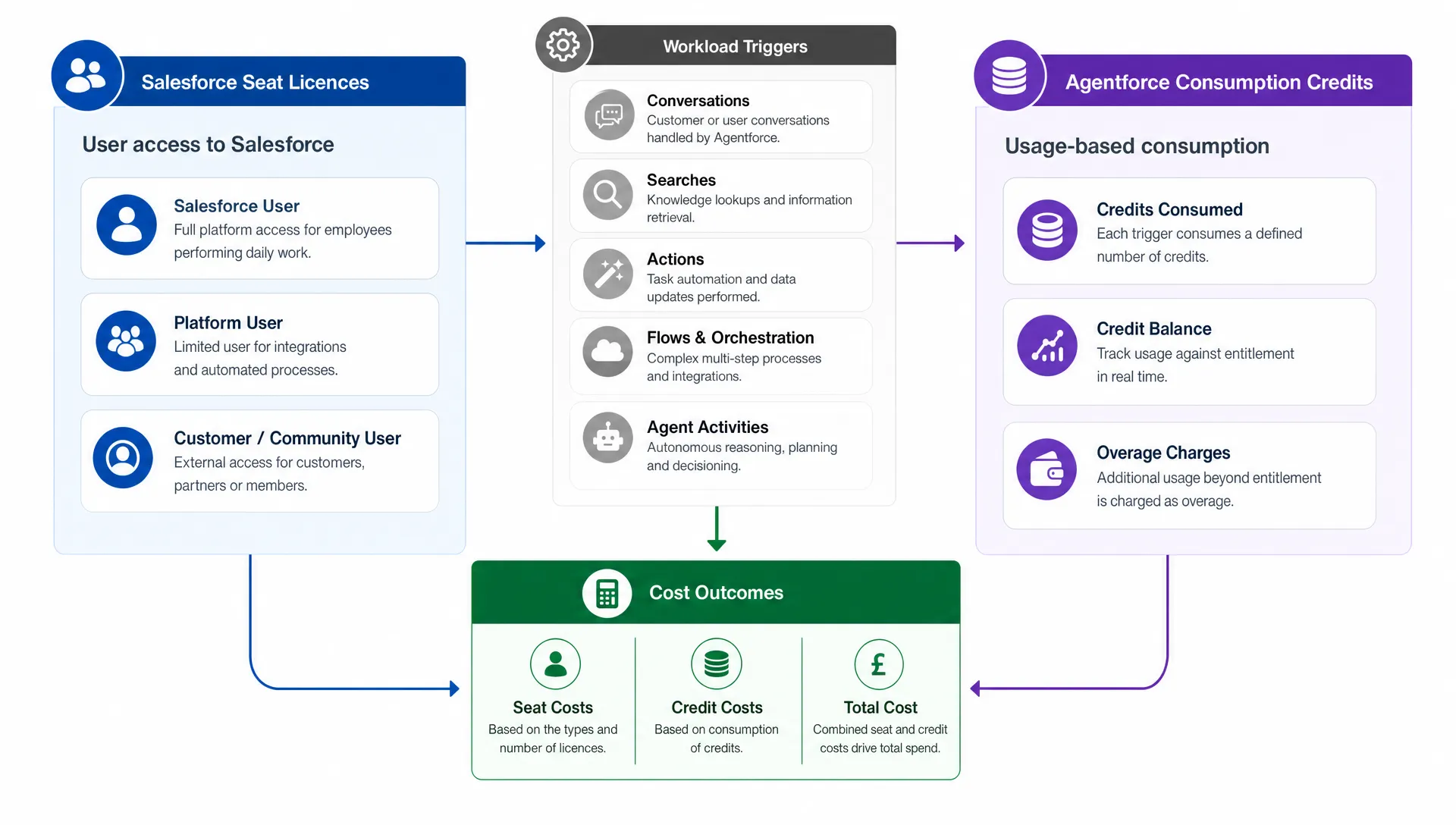
In a seat-based model, Finance can forecast spend from headcount, licence mix and negotiated unit price. In a consumption model, cost follows the volume, frequency and design of agent activity. The new equation is simple to write and hard to govern:
workload → agent action → credit usage → cost
That is where the risk begins. Most organisations cannot yet map that chain with confidence. Many Salesforce account teams cannot either. Complexity is a tax on the unknown. If they cannot convince you, they will confuse you, often without meaning to.
The Hidden Pricing Shift: Seat-Based vs Consumption
For most large Salesforce estates, the commercial centre of gravity has historically been seats. Sales Cloud users. Service Cloud users. Platform users. Add-ons layered by role, geography or business unit.
This model is imperfect. It creates shelfware, over-provisioning and renewal pressure. But it is still relatively legible. A CFO can ask how many users need access. A CIO can challenge whether a role needs a full licence. Procurement can benchmark unit pricing, discount logic and uplift exposure.
Agentforce changes the control surface.
The question is no longer only, “Who needs a licence?” It becomes, “Which work is being delegated to agents, how often does that work run, which systems does it touch, and what does each interaction consume?”
That is a very different procurement muscle.
A seat is assigned. A workload behaves. It changes with adoption, process design, data quality, integrations, customer demand, seasonality and internal governance. The commercial risk is not simply that people use Agentforce. The risk is that nobody can explain, before scale, how usage turns into spend.
This is why consumption pricing needs to be treated as a risk model, not a modernity badge. It can be efficient when the organisation understands the unit economics. It can be expensive when the organisation buys credits before it understands the work.
The problem is rarely the technology in isolation. Agentforce may prove technically strong. The issue is the commercial structure wrapped around it, especially when AI agents, Data Cloud and flex credits arrive inside a renewal conversation that already has time pressure.
The Incentive Problem: Why Salesforce AEs Push Agentforce
Sales incentives do not need bad intent to create bad outcomes.
If a sales organisation is trained to maximise annual contract value, and it is given a strategic AI product with board-level attention, the direction is obvious. Bring Agentforce into the renewal. Attach it to transformation language. Bundle it with adjacent products. Create urgency before the customer has evidence.
At the time Anders wrote the original note in late 2025, Salesforce was reporting roughly 9,500 customers live on Agentforce, while Agentforce represented around 1.3% of total revenue. Those numbers matter less as a static snapshot than as a signal. Adoption was visible, but revenue contribution was still early. For a strategic AI narrative, that creates internal pressure.
For current board papers, procurement teams should refresh those figures against Salesforce’s own Investor Relations materials before using them in negotiation strategy.
The buyer-side implication is plain. When a vendor needs a product category to grow quickly, the renewal becomes the cleanest distribution channel. Existing customers already have security reviews, procurement routes, executive relationships and dependency on the platform. That makes the AI upsell much easier to introduce than a net-new sale.
Again, this is not a claim that Salesforce AEs are acting maliciously. It is a claim that incentives behave exactly as designed.
If the account team is rewarded for early ACV commitment, the temptation is to sell future usage before actual usage is understood. If the customer is rewarded internally for AI progress, the temptation is to approve the commercial structure before the operating model is ready.
That is the Siebel problem in new clothes.
How the Agentforce Risk Manifests in Your Renewal
From the client side, Agentforce risk rarely arrives as a single dramatic line item. It usually arrives as a set of small framing moves that make the eventual quote feel natural by the time it lands.
The pattern is familiar to anyone who has managed a large Salesforce renewal: the commercial frame gets set before the commercial document appears.
- Bundled Expansions: Agentforce and Data Cloud can appear inside broader renewal or expansion narratives, making it hard to isolate what is driving the uplift. This is the SELA Bundle Trap: a broad commercial wrapper makes the customer feel they are buying flexibility, while the real effect may be reduced price transparency. If your organisation is considering this structure, first get clear on what a Salesforce SELA actually is and where AI-related commitments sit inside it.
- The Flex Mirage: Flex credits can look efficient because they promise adaptability. The risk is the Flex Credit Mirage, where flexibility is presented as control even though nobody has modelled the workload, trigger volume or governance path. Credits are not inherently bad. Unmodelled credits are the issue.
- Premature Commercials: Commercial structures are often discussed before the customer has proven value with baseline entitlements, pilots or included credits. This creates a negotiation built on aspiration rather than evidence. Once the quote lands, the conversation has already moved from “Should we?” to “How much?”
There is a fourth pattern that deserves its own name: Agentic Integration Gravity.
AI agents become more commercially sticky as they connect deeper into CRM records, service processes, sales workflows, customer data, case routing, knowledge content and downstream systems. The more useful the agent becomes, the harder it may be to unwind later. That is not just technical lock-in. It is process lock-in, data lock-in and behavioural lock-in.
This is why procurement should not treat Agentforce as a small add-on if the use case touches core revenue, service or operational workflows. The first commitment may look modest. The second order effect is what matters.
The Structural Divergence
The difference between traditional Salesforce licensing and Agentforce consumption pricing is not cosmetic. It changes the questions Finance, IT and Procurement need to ask.
| Dimension | Traditional Seat-Based Pricing | Agentforce Consumption Pricing |
|---|---|---|
| Predictability | Spend is usually forecast from user counts, licence types, contract terms and known growth assumptions. | Spend depends on workload volume, agent triggers, automation design, data calls and adoption patterns. |
| Primary risk | Shelfware, over-licensing, renewal uplifts, unnecessary editions and unused add-ons. | Runaway usage, poorly governed triggers, unclear credit burn, premature commitments and weak value evidence. |
| Vendor incentives | Increase seat count, expand editions, attach clouds and protect renewal uplift. | Seed AI usage, bundle credits, expand consumption commitments and create future dependency. |
| Buyer control point | Licence assignment, user governance, role mapping and SKU rationalisation. | Workload modelling, trigger governance, usage telemetry, pilot design and commercial guardrails. |
| Best negotiation evidence | Current users, assigned licences, login activity, business unit demand and historical discounting. | Use-case economics, baseline usage, observed credit consumption, avoided labour or service cost, and scenario modelling. |
This divergence also affects contract architecture. A standard agreement, SELA or AELA can each behave differently once consumption and AI commitments are added. Before treating these as interchangeable wrappers, compare the consequences of each in Salesforce commercial structures such as standard agreements, SELA and AELA.
The table points to a simple truth: the old problem was often paying for people who did not use what they had. The new problem may be paying for work you did not fully understand before you automated it.
That does not make consumption wrong. It makes it less forgiving.
The SaaSed Blueprint: A Smarter Agentforce Strategy
A smarter Agentforce strategy does not start with a quote. It starts with a clean operating and commercial view of the work you may delegate to agents.
The aim is not to block AI. The aim is to stop AI from becoming an unpriced promise inside a renewal you cannot easily unwind.
Treat consumption as a risk to model, not a buzzword to celebrate
Procurement teams should ask for the unit economics before committing to scaled spend. Not in theory. In your environment.
Start with a small set of candidate use cases. For each one, define the business process, expected trigger volume, escalation path, systems touched, data dependencies and success metric. Then ask how each of those variables affects credit usage.
The most important question is not whether Agentforce can do the task. It is whether the economics still work when the task runs at real enterprise volume.
A basic scenario model should include low, expected and high usage cases. It should also include failure scenarios, such as duplicate triggers, poor data quality, excessive agent handoffs or business units launching similar workflows independently.
If you cannot model the downside, you are not negotiating. You are hoping.
Prove value with what is already included before you scale
Many organisations already have unused or underused value inside the Salesforce estate. Before approving a new AI commitment, establish what is included today, what has been paid for but not adopted, and what baseline credits or capabilities can be used for controlled testing.
This is where Finance and IT should work together early. Finance needs evidence of measurable value. IT needs proof that the use case is safe, governable and maintainable. Procurement needs a commercial position that is based on observed usage rather than vendor forecasts.
A vendor forecast is not evidence. A pilot with controlled volume, defined success criteria and measured credit burn is evidence.
Run controlled experiments with guardrails, then negotiate from evidence
A controlled Agentforce pilot should not be a loose sandbox. It should have a defined business owner, a defined workload, a defined ceiling and a defined stop condition.
Set guardrails before usage begins. Decide who can create or modify agents. Decide which systems agents may touch. Decide what happens when a threshold is reached. Decide whether business units can launch their own use cases or must go through a central governance route.
Qualitative evidence also has a place. Support tickets, admin feedback, sales operations notes and user interviews can show where friction is real. Some teams monitor external customer or practitioner conversations as early signals too. Tools that surface public questions and community discussion may be worth reading, but those signals should remain context. Your negotiation should be anchored in your own workloads and your own economics.
Once you have measured results, you can negotiate differently. Instead of buying a broad AI story, you can buy capacity for use cases with known value, known constraints and known adoption paths.
Plan the Salesforce renewal and AI upsell as one strategy
The biggest mistake is treating the renewal, Data Cloud discussion, Agentforce pilot and commercial expansion as separate conversations.
Salesforce will not treat them separately. Neither should you.
If Agentforce appears six months before renewal, it is already part of the renewal strategy. If Data Cloud is positioned as a prerequisite or accelerator, it is part of the same commercial map. If flex credits are being offered as a way to keep options open, they belong in the same risk model as your core licences.
This is where timing matters. A strong renewal process gives you enough room to audit usage, test assumptions, align internal stakeholders and build alternatives before the quote frame hardens. SaaSed has written separately about what a strong SaaS renewal process looks like, and the same discipline applies here with more urgency because AI consumption adds moving parts.
The cleanest Agentforce negotiation is not the one with the loudest discount. It is the one where your organisation has already decided what it will use, how it will govern usage, what value is acceptable, and what risk it will not absorb.
What CFOs, CIOs and Procurement Leads Should Ask Before Signing
Before Agentforce is allowed to become a renewal line item, the buying team should be able to answer a few hard questions in plain English.
- What specific work will Agentforce perform? If the use case cannot be described without vendor language, it is not ready for a scaled commitment.
- What will trigger consumption? Identify the events, workflows, data calls or agent actions that create cost.
- Who owns usage governance? Consumption without ownership becomes everyone’s budget problem and nobody’s decision.
- What value has already been proven? Separate tested savings or productivity from projected savings or productivity.
- What happens if usage exceeds the model? The answer should be contractual, operational and financial, not just conversational.
These questions are deliberately simple. They are designed to cut through complexity. If a proposed commercial model cannot survive simple questions, it is not mature enough for a large commitment.
Frequently Asked Questions
Is Agentforce priced like normal Salesforce licences? Not exactly. Traditional Salesforce licensing is often seat-based, while Agentforce introduces consumption dynamics tied to agent activity, credits and workload volume. The commercial risk shifts from who has access to how much work the system performs.
What is the biggest procurement risk with Agentforce? The biggest risk is committing to consumption before understanding the workload. If the organisation cannot map workload to agent action to credit usage to cost, it cannot reliably forecast spend.
Are flex credits a bad idea? No. Flex credits can be useful when usage is governed and modelled. The problem is the Flex Credit Mirage: treating flexible credits as cost control when the organisation has not yet proven how fast credits will burn.
Should Agentforce be negotiated separately from the Salesforce renewal? Usually not. If Agentforce, Data Cloud or AI credits are being discussed near renewal, they should be part of one integrated commercial strategy. Otherwise the vendor controls the sequencing and the buyer loses leverage.
When should a company start preparing if Agentforce is appearing in account discussions? Start 6 to 12 months before renewal. That gives Finance, IT and Procurement time to audit the estate, test use cases, model consumption and set negotiation guardrails before the first formal quote lands.
Conclusion: Set the Frame Before the Quote Sets It for You
Agentforce may be technically brilliant. That is not the point.
The point is that the pricing model changes the commercial physics of the Salesforce relationship. Seat-based pricing made waste visible after the fact. Consumption pricing can make waste accelerate while everyone is still admiring the promise.
If you are 6 to 12 months out from a Salesforce renewal and Agentforce is starting to appear in conversations, this is the moment to act. Not after the first quote. Not after the bundle is framed. Not after the internal sponsor has already repeated the vendor’s numbers in a steering committee.
SaaSed helps CFOs, CIOs and procurement teams structure Salesforce renewals before the commercial frame hardens. If you want to map your renewal blueprint before the numbers lock in, book a complimentary Salesforce audit conversation and we will work through the pressure points with you.
Want this kind of intel on your renewal?
Don’t head into your next software negotiation alone
Contact Us