
Salesforce Data360 (Data Cloud) Optimization: Avoiding the Multi-Million Dollar Storage Trap
Data360 costs are not just a licence problem. This article shows where credit burn, duplicated data pipes and storage multipliers appear, and how procurement can cap exposure before the renewal quote hardens.
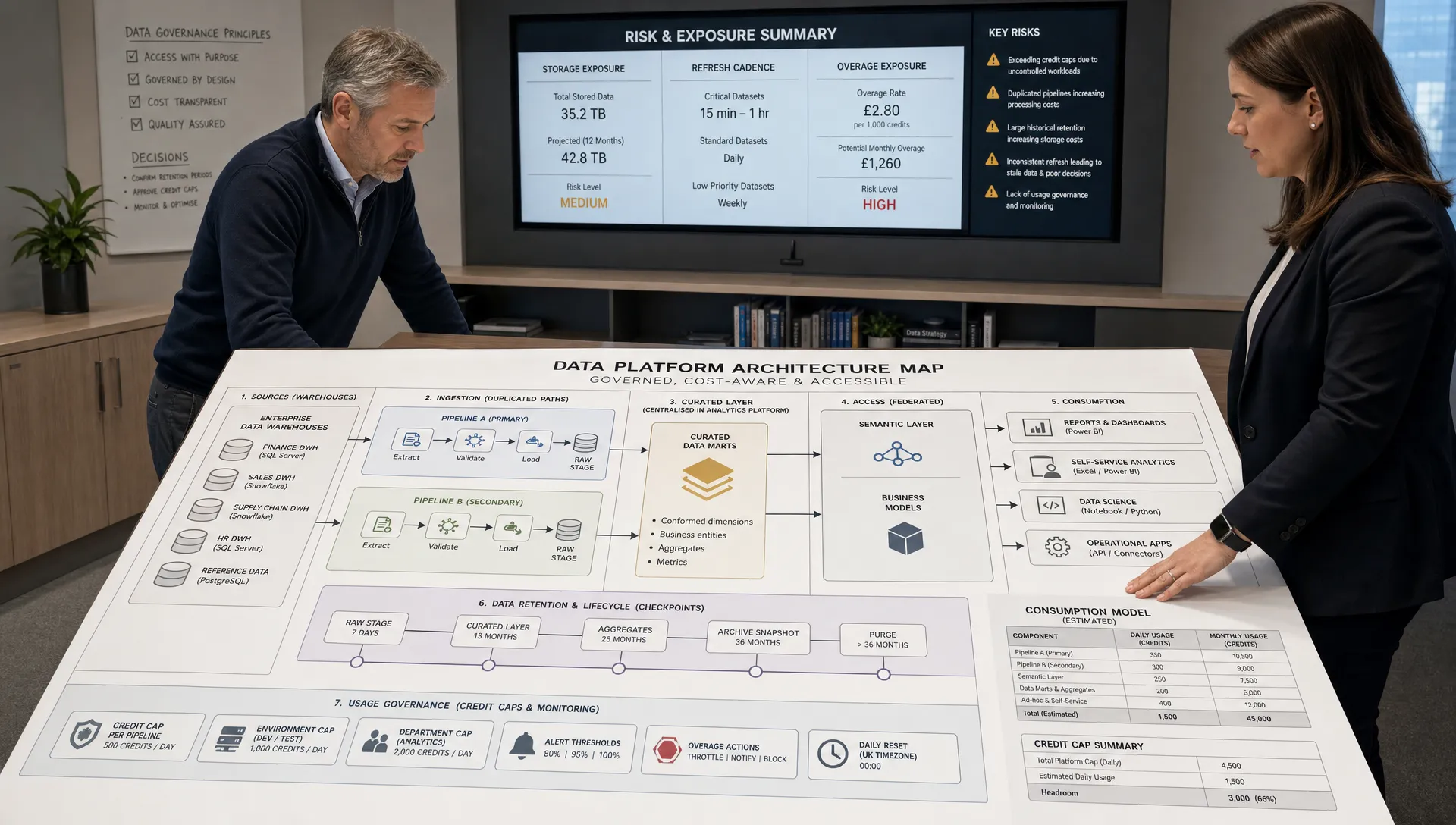
Strategic Framework to Reduce Storage Fees
The objective is not to starve AI of useful data. The objective is to reduce Salesforce data storage fees by making every copied dataset earn its place.
"The biggest mistake we see enterprise buyers make with Data 360 is treating it like a standard SaaS license, rather than a utility bill that scales against you."
That is the procurement lens. Data360 is not only a platform decision. It is a demand-management system with a Salesforce price book attached.
1. Audit unutilized data streams before renewal
Before any renewal conversation, ask for a data stream inventory that procurement, IT, finance, and data owners can all read. If the inventory can only be understood by the implementation team, it is not ready for negotiation.
At minimum, the audit should show source system, object, field count, monthly volume, refresh cadence, retention period, downstream activation, business owner, last meaningful use, and consumption impact. The point is not to embarrass the project team. The point is to separate valuable data products from orphaned pipes.
A useful test is to identify every stream that has no active segment, no AI use case, no dashboard dependency, and no business owner willing to defend it in budget terms. Those streams are candidates for pausing, reducing, summarising, or federating before renewal.
This is close to the broader renewal discipline we recommend in Salesforce contract renewal risk reviews: build the fact base before the commercial theatre begins. If Salesforce sees a buyer relying on vendor-provided consumption interpretation, leverage is already weaker.
2. Negotiate capped data service credits instead of open-ended pay-as-you-go models
Open-ended overage language is the quiet danger in consumption contracts. A team can make a reasonable implementation decision in March that creates an unreasonable invoice pattern by October.
For mid-to-large enterprises, capped data service credits should be part of the commercial design. Not just a verbal comfort. Contracted controls.
Practical controls include a defined annual consumption ceiling, written price protection for additional credit packs, alert thresholds at agreed utilisation levels, a true-forward process that requires buyer approval, and a right to review architecture before overage purchases are triggered. If possible, negotiate treatment for non-production consumption separately so testing does not silently cannibalise production capacity.
The cap should not be set by optimism. It should be set by a bottom-up consumption model. For each use case, model records, fields, refresh frequency, transformation runs, identity work, retention, environments, and activation destinations. Then add a governance buffer. If the model cannot be built, the architecture is not commercially mature.
This is also where bundling needs care. When Data360 is folded into a broad Salesforce agreement, the true unit economics can disappear. The same decoupling logic applies as in Salesforce SELA bundling traps: if you cannot isolate price and usage, you cannot govern value.
3. Leverage native federation before buying more storage
Zero-Copy architecture Salesforce options matter most when the enterprise already has a mature warehouse or lakehouse. If Snowflake, BigQuery, Databricks, or another governed data layer holds trusted data, do not assume Salesforce needs a full copy.
The better pattern is selective persistence. Keep detailed operational history in the system built to hold it. Bring into Data360 only the attributes, events, calculated features, or audience data that support a defined activation or AI workflow. Where Salesforce can query live sources through native federation or zero-copy patterns, use that route first and replicate only when the business case justifies it.
This helps reduce Salesforce data storage fees, but it also protects negotiating leverage. If every important AI workflow depends on a full Salesforce-resident copy of enterprise data, procurement is not entering renewal with options. It is entering with dependency.
Salesforce Data Cloud implementation pitfalls procurement teams should avoid
The most expensive Salesforce Data Cloud implementation pitfalls are set before go-live. Procurement often enters late, after architecture has hardened and the renewal baseline has been normalised. That timing benefits the seller.
A disciplined implementation review should challenge the assumptions below.
| Pitfall | Why it hurts | Procurement control |
|---|---|---|
| Full-source ingestion by default | Moves data because it is available, not because it is required | Require use-case mapping for every source and field group |
| Refresh cadence set by technical preference | Burns credits faster than the business process needs | Make cadence a business-owned decision with cost visibility |
| AI business case without consumption forecast | Creates enthusiasm without a run-rate model | Require unit economics for each Agentforce or AI use case |
| Sandboxes omitted from forecast | Understates implementation and testing cost | Separate production and non-production consumption views |
| Bundled commercial treatment | Hides Data360 unit cost inside a wider Salesforce package | Ask for decoupled pricing, usage reporting, and renewal protections |
None of this argues against Data360. It argues against vague Data360. There is a difference.
The best implementations have a simple operating rule: every data stream has an owner, a purpose, a retention logic, a cost profile, and a deletion or federation option. If one of those is missing, the stream is not production-ready from a commercial standpoint.
How to reduce Salesforce data storage fees without weakening the programme
Most companies try to reduce Salesforce data storage fees too late. They wait until a renewal quote arrives, then ask commercial teams to solve what architecture created.
A better sequence is to reduce waste before the quote is built. Start with the data estate, then the contract. Do not reverse the order.
The most effective reduction patterns are usually practical rather than dramatic. Shorten retention where the business only needs recent activity. Store summaries instead of raw events where detail adds little decision value. Remove fields that nobody uses. Replace full copies with federated access. Pause orphaned streams. Split must-have AI context from nice-to-have analytical depth.
This work is not only technical. It is political. Every dataset has a sponsor until someone asks who pays for it. CFOs and CIOs should insist on a shared consumption council before the next Salesforce renewal, small enough to decide and senior enough to say no.
If your organisation is also evaluating Agentforce, the same risk sits one layer higher. Consumption-based pricing changes the budget conversation from licences purchased to actions performed. We explored that shift in the move from seat-based Salesforce buying to consumption-based exposure, and Data360 is often the data layer that makes the exposure real.
What procurement should ask before signing or renewing
Good questions change the room. They force a seller, implementation partner, and internal sponsor to translate architecture into liability.
Use questions that are specific enough to produce evidence, not reassurance.
| Question | What a strong answer should include |
|---|---|
| Which data sources are physically copied into Data360, and why? | Named use cases, owners, volumes, and alternatives considered |
| Which sources can be served through zero-copy or federation? | A source-by-source decision record, not a generic architecture claim |
| What is the forecasted credit burn by use case? | Monthly model with assumptions for volume, cadence, transformation, activation, and environments |
| What happens if consumption exceeds plan? | Contracted caps, approval gates, price protections, and alert thresholds |
| What data can be removed without business impact? | A current list of dormant streams, unused fields, stale activations, and retention candidates |
If the answer is, the platform team will manage that, keep pressing. Platform teams can manage architecture. They cannot carry the full commercial risk alone.
The commercial posture that preserves leverage
By the time Salesforce presents a renewal proposal, the seller often knows which data streams have become operationally important. If the buyer does not know the same thing with equal clarity, the negotiation is unbalanced.
Leverage comes from credible alternatives and clean evidence. In Data360, that means knowing what can be paused, federated, reduced, delayed, or moved back to the warehouse without breaking the business. It also means knowing which use cases truly justify premium consumption.
The strongest buyer posture is calm and specific: here is our current utilisation, here is what is waste, here is what we will remove, here is what we may grow, here is the ceiling we will accept, and here is the architecture we will not pay to duplicate.
Discount-only negotiation is too thin for this category. You need usage truth, contractual ceilings, and implementation choices that give procurement a credible fallback.
Frequently Asked Questions
Is Salesforce Data360 expensive because of storage alone? No. Storage matters, but the larger risk is the combined effect of ingestion, refresh cadence, identity resolution, calculations, activations, environments, retention, and overage terms. Treat it as a consumption system, not a storage line.
What is the fastest way to reduce Salesforce data storage fees? Start by auditing data streams with no active business owner, activation, AI use case, or reporting dependency. Then reduce retention, summarise raw events, remove unused fields, and federate warehouse data where possible.
Does Zero-Copy architecture Salesforce remove all Data360 consumption? No. It reduces unnecessary data movement and persistent duplication. You may still consume credits for queries, activations, calculations, or other platform activity, depending on the design and contract.
When should procurement get involved in Data360? Before implementation choices are fixed. If procurement waits until renewal, the spend pattern may already be embedded in business processes, making reduction harder and more politically sensitive.
How should CFOs view Data360 Starter SKUs? As an entry point, not a forecast. A starter SKU around $60,000/yr can be sensible, but only if the buyer has modelled the consumption path that follows.
Final word: make the architecture earn the renewal
Data360 can support valuable AI and customer data use cases. It can also become a multi-million dollar storage and consumption trap if the organisation copies first and governs later.
The buyer's job is not to block innovation. It is to make the bill legible before it becomes permanent. That means auditing streams, capping credits, using zero-copy where it fits, and refusing commercial structures that monetise ambiguity.
If you suspect your Salesforce Data360 architecture is already architected to overspend, visit our contact page to schedule a direct, confidential commercial structure audit with Anders. It is a complimentary Salesforce audit conversation designed to help you regain leverage before your next renewal cycle.
Want this kind of intel on your renewal?
Don’t head into your next software negotiation alone
Talk to the team