
Which Services of Salesforce Are Driving Real Value
Not every Salesforce service earns its place equally. This guide helps finance, IT and procurement teams separate core value from shelfware before renewal talks begin.
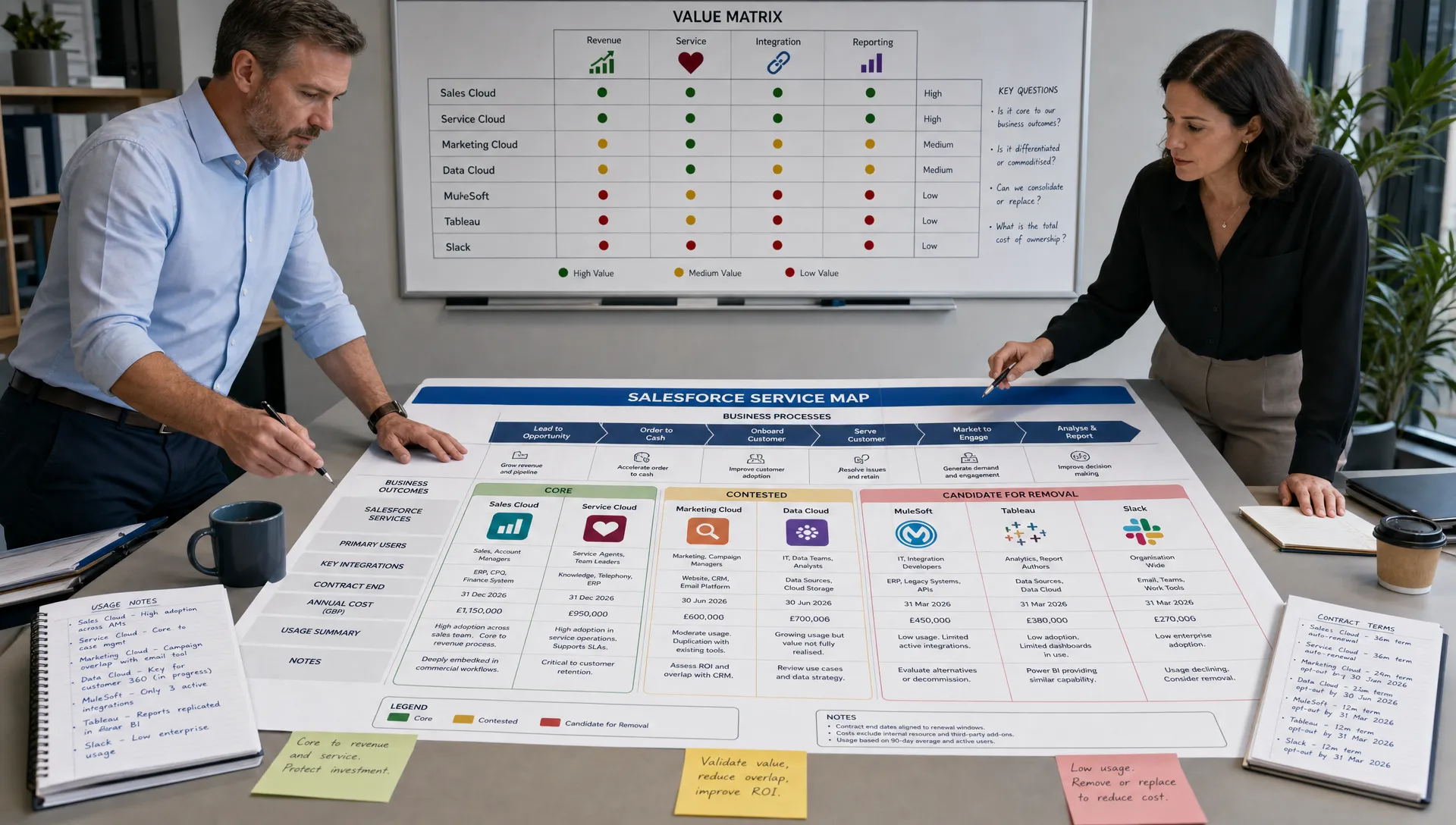
Four questions that expose whether value is real
A good Salesforce review is not just a usage report. Login data can mislead. A user may log in often and do little meaningful work. Another may log in rarely but perform a critical approval or governance function.
The better approach combines usage, workflow dependency, commercial structure and alternatives.
1. Is the service used by the people it was bought for?
Start with active users, but do not stop there. Review activity by role, region, business unit and licence type. Look for mismatches between paid access and practical need. Some users may need a lower edition, occasional access, platform access or no access at all.
Shelfware is rarely created by one poor decision. It builds gradually through hiring assumptions, bundled deals, project delays, acquisitions and renewal floors.
2. Does the service support a process that matters?
A licence used for a low-value task is still a weak investment. Map each major Salesforce service to a business process. Sales Cloud should map to pipeline and revenue management. Service Cloud should map to customer support and retention. Data Cloud should map to data activation and decisioning. MuleSoft should map to integration delivery and reuse.
If a service cannot be connected to a process owner and a measurable outcome, it belongs in the contested category until proven otherwise.
3. Is the commercial model aligned to the way value is created?
A service can be useful and still commercially misaligned. Common issues include over-tiered editions, minimum quantity commitments, bundle restrictions, automatic uplifts, consumption assumptions and renewal floors.
This is where contract review matters. SaaSed has written separately about SaaS contract clauses that drive up Salesforce costs, including terms that can make it difficult to reduce spend even when usage falls.
4. What would happen if the service were removed, reduced or replaced?
This question cuts through internal politics. If a Salesforce service is genuinely valuable, the organisation should be able to describe the operational consequence of reducing it. Revenue visibility would deteriorate. Case handling would slow. Engineers would lose service history. Compliance evidence would become harder to produce. Integration delivery would stall.
If no one can describe the consequence clearly, the service may still have potential, but the current value case is weak.
Do not confuse implementation value with renewal value
Many Salesforce services create value during transformation projects. They standardise processes, replace legacy tools and give teams a common data model. That implementation value is real.
But renewal value is different. At renewal, the question is not what the service made possible three years ago. The question is what value it is still producing now, and whether the current licence structure reflects that value.
This distinction is important because old business cases often survive long after operating reality has changed. A region may have stopped using a module. A team may have moved part of its work into another tool. A planned rollout may never have happened. A bundled SKU may remain because removing it would reopen a commercial conversation no one had time to manage.
A disciplined renewal process brings those facts forward early. If you need a structure for that work, SaaSed’s guide to what a strong SaaS renewal process looks like sets out the timing, evidence and stakeholder alignment needed before negotiation begins.
How to classify Salesforce services before renewal
Once the evidence is collected, each service should be placed into one of three categories: core, contested or candidate for removal.
Core services are active, measured and operationally important. They may still need price pressure, but the strategic aim is continuity on better terms.
Contested services have some value, but the scale, edition, bundle or consumption model needs scrutiny. These are often where the best negotiation leverage sits, because the buyer can make a credible case for resizing rather than simply asking for a discount.
Candidate-for-removal services have low adoption, weak ownership, duplicate functionality or unproven future use cases. They should not be left in the agreement just because they were part of the last deal.
This classification also helps internal alignment. Sales, service, marketing, IT and finance may all see Salesforce differently. A shared evidence base prevents the renewal from becoming a debate between anecdotes.
What real value looks like by stakeholder
Different leaders will view value through different lenses. That is healthy, provided the discussion is anchored in evidence.
| Stakeholder | What real value usually means | Evidence to bring |
|---|---|---|
| CFO | Cost aligned to measurable business contribution | Spend by service, avoided cost, productivity indicators, renewal exposure |
| CIO | Stable architecture, secure data, reduced complexity | Integration maps, system dependency, data quality, support burden |
| Procurement lead | Negotiable position supported by facts | Usage by SKU, contract terms, alternatives, renewal timeline |
| Sales or service leader | Better team performance and customer outcomes | Forecast accuracy, case metrics, adoption, process cycle times |
| IT lead | Manageable platform with clear ownership | Admin effort, technical debt, release impact, licence governance |
The strongest renewal positions usually come when these views are combined. Procurement alone cannot prove operational value. IT alone may not see the commercial exposure. Business owners alone may not know what the contract allows. Finance alone may see cost without understanding dependency.
The most common value leaks
Even well-run organisations lose value in Salesforce estates. The leaks are usually ordinary, not dramatic.
- Paid users remain assigned after role changes, project delays or reorganisations.
- Higher editions are used where lower editions would support the actual work.
- Bundled services are renewed because no one has separated must-have from nice-to-have.
- Consumption-based services grow without clear ownership of demand.
- Duplicate tools remain in place because different teams own different budgets.
- New capabilities are bought before adoption capacity exists.
None of these issues means Salesforce is failing. They mean the commercial model needs the same discipline as the implementation roadmap.
Turning the value review into negotiation leverage
Salesforce negotiations improve when the buyer can be precise. A broad request for savings is easy to resist. A fact-based position is harder to dismiss.
The strongest positions usually include a clear view of active usage, a service-by-service value assessment, a list of products to retain, resize or remove, and an internal agreement on walk-away points. Timing matters too. If the review starts too close to renewal, the organisation may have little room to act.
SaaSed’s article on Salesforce negotiation tactics that improve leverage covers this in more depth, especially the importance of starting early and building a fact base before commercial pressure rises.
The practical aim is not to turn every service into a fight. It is to stop weak value from being treated as unavoidable spend, and to make sure high-value services are renewed on terms that fit actual use.
Frequently Asked Questions
Which services of Salesforce usually create the most value? It depends on the organisation, but Sales Cloud, Service Cloud, Field Service, MuleSoft and analytics tools often show clearer value when they support core revenue, service, integration or decision-making processes. Marketing Cloud, Data Cloud and AI services can also be valuable, but they need stronger governance around adoption, data quality and measurable outcomes.
How can we tell whether a Salesforce service is underused? Look beyond logins. Review activity by role, business unit, licence type and process. Then compare paid access with actual workflow dependency. A service is underused when it has low meaningful activity, unclear ownership, duplicated functionality or no measurable business outcome.
Should we remove low-usage Salesforce licences before renewal? Not automatically. Some low-usage licences may support critical approvals, governance or exception handling. The better approach is to classify them by business need, then decide whether to retain, downgrade, reassign or remove them.
How early should a Salesforce value review start? For a material Salesforce renewal, start at least six months before the renewal date where possible. Large enterprise agreements, complex bundles or AI and consumption-based products may need more time because internal alignment and contract analysis can take longer than expected.
Can Salesforce be valuable and still overpriced? Yes. A service can be operationally important while the edition, quantity, bundle or commercial terms are misaligned. That is why value reviews and contract reviews should happen together.
A quieter way to prepare for the next Salesforce renewal
The useful question is not whether Salesforce is worth it. The useful question is which parts are earning their place, which parts need resizing, and which parts are being carried forward because no one has had the evidence to challenge them.
SaaSed helps organisations review Salesforce contracts, SKUs, usage, shelfware and renewal risk before negotiations begin. If you would like a calm, evidence-led view of your estate, you can book a complimentary Salesforce audit conversation through our contact page.
Want this kind of intel on your renewal?
Don’t head into your next software negotiation alone
Talk to the team