Should I Use a Consultant for My Salesforce Renewal?
Outside help earns its fee when it improves a decision your team cannot confidently make alone. See when to keep your Salesforce renewal in-house, what an adviser should deliver and how to judge independence, fees and timing.
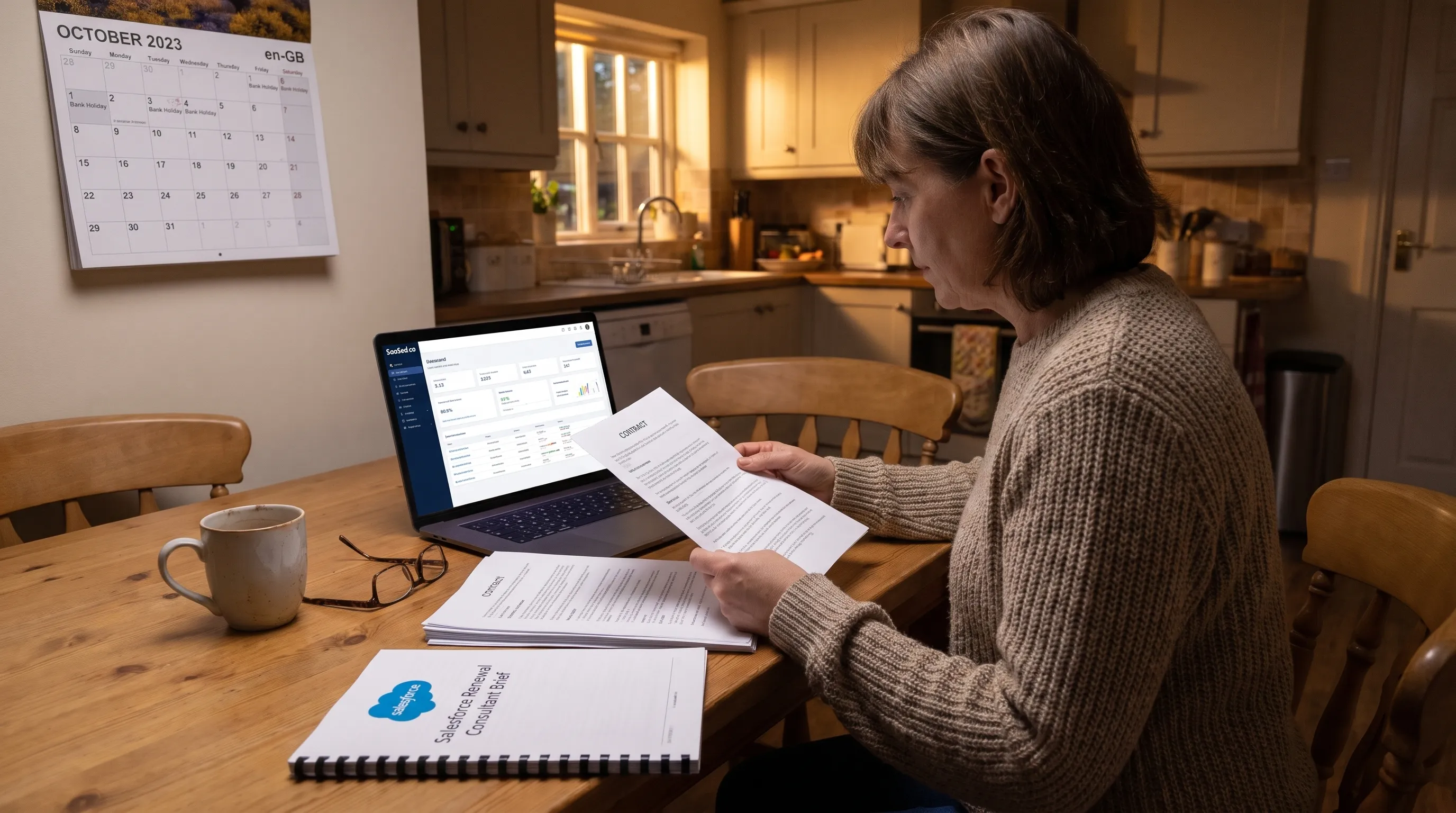
Should I Use a Consultant for My Salesforce Renewal?
Whether you need a Salesforce renewal consultant depends on the size and complexity of your estate, the time you have and whether someone in your organisation owns the commercial relationship with the right experience. As CFO, you should buy outside help only when it improves a decision your team cannot confidently make alone.
Should I use a consultant for my Salesforce renewal?
You should use outside help when the commercial decisions exceed your team’s experience or available time, not simply because Salesforce is a significant supplier. The test is whether you can explain what you own, what you need next and which commitments you can accept.
A renewal can carry a lower annual price while increasing your total commitment. A longer term, an earlier start date or products added to secure a discount can change the economics. Your decision needs to cover the full committed amount, payment profile and rights at the next renewal.
Start with an internal capability check. Can finance, procurement and IT assemble that picture, agree a position and maintain it through negotiations? If they can, paying an adviser may add little. If they cannot, define the missing capability before buying support rather than outsourcing responsibility for the entire relationship.
The reason to hire is a specific capability gap, not the existence of a renewal.
What does a Salesforce renewal consultant actually do?
A buyer-side adviser reads your current agreement commercially, maps entitlements against real usage, benchmarks pricing and helps set a target outcome. They then support negotiation and alignment between finance, procurement and IT. Their role is to strengthen your decisions, not to replace your relationship with Salesforce’s account team.
The work should run in order: position, requirement, option, negotiation. Position establishes your contractual baseline and usage, with analysis potentially supported by Dioro. Requirement tests future demand. Option compares workable structures. Negotiation turns your chosen approach into proposed terms. Skipping the first two leaves you reacting to Salesforce’s proposal.
Check the signed order forms, amendments and applicable terms together. Salesforce’s official agreements provide a useful reference, but your executed documents determine the obligations. Benchmark comparisons should account for product scope, quantities and term length; a headline discount alone does not establish whether an offer is commercially sound.
A Salesforce renewal consultant should produce a defensible buying position, not merely a discount target.
When might I not need one?
You may not need an adviser if your estate is straightforward, usage is understood and an experienced internal owner has enough time to manage the renewal. A stable requirement and a clear contract can make an in-house process entirely reasonable. Outside involvement should earn its place, not become an automatic fee.
For example, renewing a known quantity of Sales Cloud licences on a familiar structure may be manageable without external support. Your team still needs to check notice provisions, uplift wording and other renewal risks, reconcile additions and confirm that next year’s demand is funded rather than assumed.
Usage evidence also needs interpretation. A low login count does not automatically mean a licence can be removed or replaced with Salesforce Platform. Your technical owner should validate the user’s required objects and functionality before finance treats that licence as an available saving.
Salesforce’s account team can explain proposals and help resolve questions about products and terms. That is useful collaboration, although it is not independent buyer-side advice. You may need only a bounded commercial review of a particular clause or proposal, rather than support across the whole renewal.
Keep the work in-house when you have the evidence, ownership and experience to do it well.
When does outside help make sense?
Outside help makes sense when it resolves a material uncertainty about commitment, structure or execution. There is no universal spend threshold for hiring a Salesforce renewal consultant: compare the fee with the financial exposure, internal workload and decision quality it can reasonably improve.
The situations below justify a closer look, not an automatic appointment. Ask what specific decision needs support and whether a focused engagement would address it.
| Situation | Why outside help may matter |
|---|---|
| A large or multi-product estate, or spend that has grown faster than the business case behind it | Reconcile the baseline and test whether current commitments remain justified. |
| A SELA or AELA being offered | Assess the structure, entitlement definitions and commitment before accepting it. |
| A mid-term expansion or an AI or consumption product proposed inside a renewal | Separate existing obligations from new demand and model consumption assumptions. |
| No single internal owner across IT, finance and procurement, or limited Salesforce-specific experience or time | Establish one buyer position and clear decision rights. |
| A proposal already on the table, or a renewal inside 90 days | Read it commercially and prioritise the decisions still open. |
A SELA or AELA label does not, by itself, tell you what rights are included. Likewise, a consumption proposal needs a measurable unit, an agreed forecast and clarity on what happens above or below that forecast.
Complexity matters when it changes your obligations, not merely when the proposal has more pages.

When should I bring one in?
Begin renewal preparation 12 to 18 months before the contract end date, and bring in advice then if you already know you need it. That is a preparation window, not a requirement to negotiate immediately. Your contractual notice deadline may be earlier than the renewal date and needs checking separately.
Salesforce’s fiscal year ends on 31 January. Year-end or quarter-end timing can help a prepared buyer, but it never guarantees a discount. An early renewal also deserves its own business case: compare the existing obligation with the proposed commitment, including dates, duration and any additional products.
Inside 90 days, help can still be useful, but the work becomes triage: establish deadlines, validate the proposal and separate essential decisions from optional changes. Knowing who inside Salesforce approves your deal helps you and the account team allow time for exceptions that require further approval.
Start early enough to preserve choices, rather than relying on a deadline to create them.
How do I choose a Salesforce renewal consultant?
Choose on relevant Salesforce commercial experience, independence, a clear scope and an explainable fee model. Ask how the adviser would assess your agreement before accepting any savings claim. You need to understand what they will deliver, what evidence they will use and which decisions will remain with your team.
Ask for a redacted example of their analysis and how they distinguish comparable deals from superficially similar discounts. Check whether remuneration includes supplier commissions or referral payments. Your adviser should disclose conflicts and be comfortable working constructively with your Salesforce account team, rather than promising a confrontation.
For fixed, percentage-based or success fees, agree the calculation before work starts. If savings affect payment, define the baseline: current spend, the initial proposal and an approved future requirement are different comparisons. Exclude reductions caused solely by buying fewer products from claims of negotiated unit-price improvement.
Agree who joins calls, who approves concessions and how findings reach you. An adviser should be able to explain the recommendation in a short finance paper: current obligation, proposed commitment, assumptions, risks and decisions required. You should not need to reconstruct the commercial logic from a slide deck.
Choose evidence and accountability over a promised saving that nobody can yet substantiate.
How does SaaSed approach a Salesforce renewal?
We approach renewal as a buying decision before treating it as a negotiation. Our role is to help you understand the existing position, test the requirement and assess options before discussing terms. Finance retains control of the budget decision; IT and procurement contribute the evidence and commercial judgement.
As a Salesforce renewal consultant, SaaSed reviews contracts, SKUs and usage to identify waste, leverage gaps and commercial risk. We then help you establish a target outcome and support the negotiation. The objective is a requirement and commitment you can explain internally, not a discount detached from what you are buying.
We work alongside your internal team and constructively with Salesforce’s account team. We cannot guarantee savings, a particular approval or that every requested change will be accepted. If your team can manage the renewal confidently without outside help, that is a valid outcome of the assessment.
The test is whether our involvement improves your commercial control enough to justify its cost.
Frequently asked questions
These answers are general; your team still needs to check the actual agreement and proposed renewal.
Can a consultant guarantee savings on my Salesforce renewal? No. They can assess opportunities, not guarantee an outcome or approval; the achievable result depends on the deal and the contract.
Is a Salesforce partner a substitute for an independent advisor? No, not automatically. Implementation expertise is a different remit; check independence and commercial scope, because suitability depends on the deal and the contract.
Can I handle a Salesforce renewal without a consultant? Yes. Clear ownership, reliable evidence and relevant experience may remove the need for a Salesforce renewal consultant; whether they suffice depends on the deal and the contract.
Is it too late to get help if my renewal is under 90 days away? No. A focused review can still clarify open choices, although remaining flexibility depends on the deal and the contract.
SaaSed is a specialist Salesforce procurement and commercial advisory company. We work with enterprise buyers on Salesforce renewals, contract negotiation, licensing decisions, commercial strategy and cost optimisation — with the aim of improving commercial control and removing cost that serves no purpose. For an overview of how we support renewals, see Salesforce procurement advisory.
Check your timing with a 3-minute readiness assessment: Find your renewal window.
Want this kind of intel on your renewal?
Don’t head into your next software negotiation alone
Contact Us