
Salesforce SELA vs. AELA: Navigating the Agentic AI Cost Paradigm
Agentforce changes Salesforce economics from named users to automated work. This guide gives CFOs, CIOs and procurement leaders a practical view of SELA versus AELA risk, with negotiation controls to reduce mid-contract cost shocks.
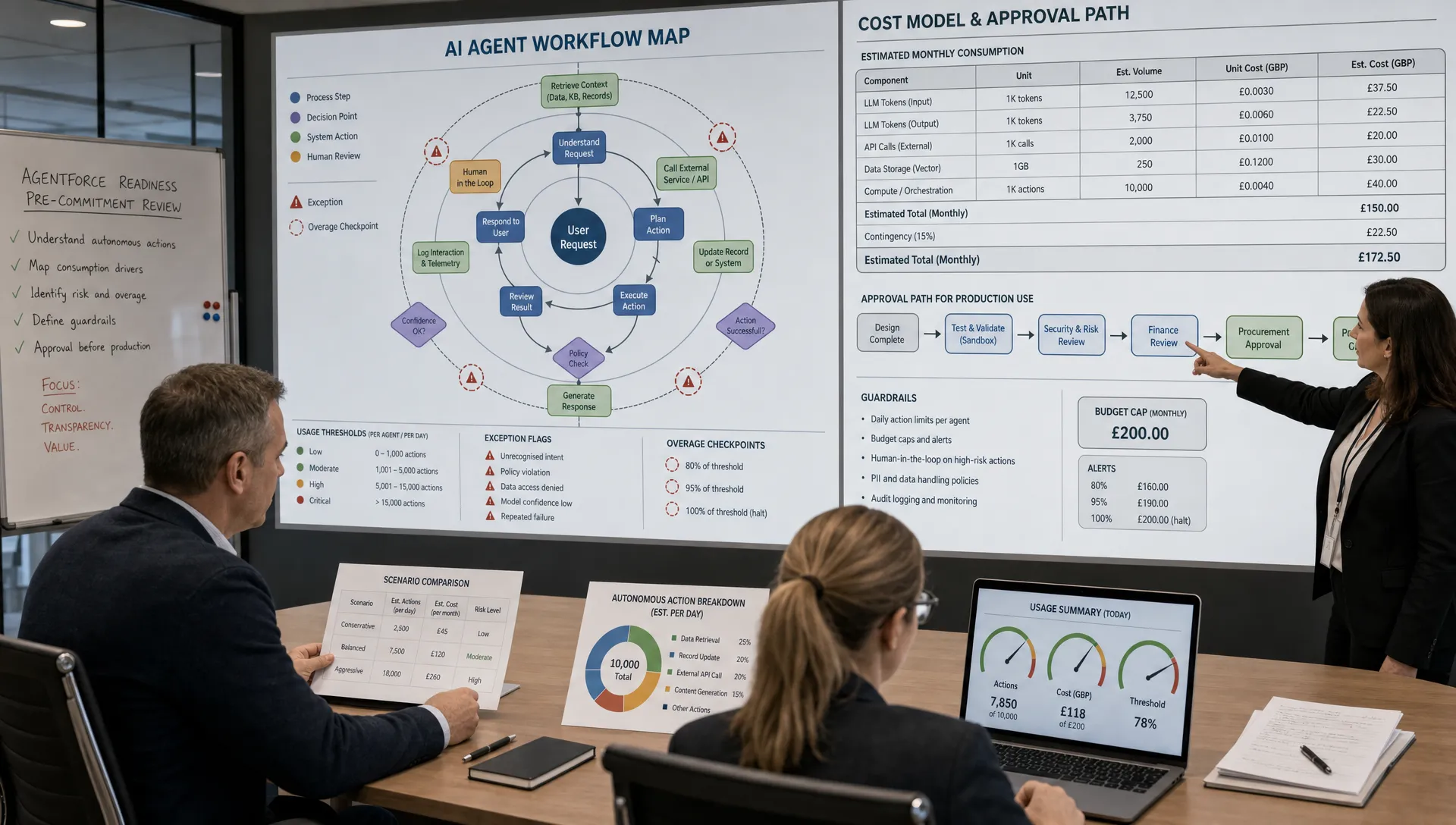
What should change in the finance model
A traditional Salesforce renewal model often starts with current licences, active usage, planned growth, and renewal uplift. That model is still needed for core clouds, but it is insufficient for agentic AI.
For AELA, the model needs to start with process volume.
How many cases, leads, records, claims, requests, tickets, or tasks might be touched by an agent? How often does each workflow run? How many steps sit inside the agent’s work? What happens during peaks? What is the failure rate? How much testing will happen before production? Which teams are allowed to create new agents?
A credible AELA business case should connect consumption to operational drivers. If the model only uses user counts and a generic adoption curve, it is not ready.
The table below shows the shift in modelling discipline.
| Commercial question | SELA lens | AELA lens |
|---|---|---|
| What drives spend? | Users, editions, bundles, clouds, and ramps | Agent actions, workflows, conversations, requests, credits, or equivalent consumption units |
| What creates waste? | Unassigned licences, inactive users, unused products | Low-value automation, uncontrolled retries, duplicated agents, test usage, and process loops |
| What does governance monitor? | Allocation, adoption, role changes, and licence assignment | Consumption velocity, use-case ROI, trigger logic, exception rates, and cap thresholds |
| What creates renewal leverage? | Clean usage data, shelfware evidence, benchmarked unit pricing | Transparent metering, historical consumption data, capped overage, and proven use-case economics |
This is why AELA negotiation should not sit entirely inside IT sourcing. It needs finance, architecture, security, operations, and process owners in the room. The contract is only one control. System design and governance are the others.
Defensive negotiation strategies before committing to AELA
Before a CIO or CFO commits to an AELA framework, the negotiation should focus on limiting unknown exposure. The aim is not to block AI adoption. The aim is to prevent a promising deployment from becoming an unbounded cost centre.
- Define the billable unit precisely: Do not accept vague wording around AI usage. The contract should state what is charged, what is excluded, and how composite tasks are counted. If a customer case triggers five agent actions, the buyer needs to know whether that is one billable event or five.
- Separate pilot, sandbox, and production usage: Testing and experimentation should not silently consume the same pool as production unless the economics are deliberate. Ring-fence pilots, define pilot duration, and agree what happens when a use case moves into production.
- Negotiate hard caps and soft alerts: A dashboard is useful, but it is not a cap. Finance needs contractual and technical controls that prevent runaway spend. Alerts at 50 percent, 75 percent, and 90 percent are helpful only if someone has authority to pause or approve further use.
- Pre-negotiate overage pricing: Overage is where weak AELA deals can become expensive. The price for consumption above commitment should be known at signature, not discovered during a period of operational dependency.
- Avoid front-loading the commitment: If AI use cases are still being proven, resist a large fixed commitment in year one. A ramped structure can be sensible, but only if each step is tied to realistic deployment milestones rather than vendor ambition.
- Demand usage transparency at the right level: Aggregate consumption is not enough. Buyers need reporting by agent, business unit, environment, process, and time period. Without that, chargeback and optimisation become guesswork.
- Keep AELA commercial terms separate from core renewal leverage: Do not let an AI framework weaken the negotiation position for Sales Cloud, Service Cloud, Platform, Marketing Cloud, or other established products. AI adoption should not become a reason to obscure shelfware in the rest of the estate.
- Write down governance ownership: The contract should reflect the operating model. Who can create agents? Who approves new use cases? Who owns consumption variance? Who decides when an agent is paused? If these answers are informal, the cost control is informal.
- Secure downshift and reallocation rights: If a use case fails, the buyer should have a path to reduce, reallocate, or repurpose commitment where possible. A rigid AI commitment is risky when the technology and operating model are still maturing.
- Model failure as well as success: Procurement teams often model the happy path. AELA requires a second model for retries, process loops, seasonal peaks, low-quality data, and duplicated automation. The downside case is where the contract earns its keep.
These actions sit alongside the classic Salesforce disciplines: timing, executive alignment, benchmark awareness, and a clean fact base. For broader commercial preparation, see our guide to Salesforce negotiation tactics that improve leverage.
The internal governance gap most buyers underestimate
AELA does not fail only in the contract. It can fail because the organisation treats AI agents like features rather than operators.
A feature is enabled. An operator performs work. That distinction changes accountability.
If an AI agent can resolve cases, update records, send messages, create tasks, or trigger workflows, then it is part of the operating model. It should have an owner, a budget, a set of controls, and a retirement path. Otherwise, every new agent becomes a small commercial experiment funded from a central contract.
This creates three governance questions CFOs and CIOs should insist on answering:
- Who is allowed to deploy an agent into production?
- Which budget absorbs the consumption when usage exceeds forecast?
- What evidence proves that each agent is producing value above its consumption cost?
The answers should be practical. A heavy committee for every minor automation will slow the business. No governance at all will create cost leakage. The right approach is usually tiered: low-risk use cases have simple thresholds, while high-volume or customer-facing agents require stronger approval and monitoring.
When AELA may be the right structure
AELA is not inherently bad. It may be the right structure when the buyer has a clear AI roadmap, measurable process volumes, and enough internal maturity to manage consumption.
It can make sense when AI agents are tied to high-value workflows, when the organisation can measure deflection, cycle-time reduction, revenue protection, or service quality, and when there is a credible plan to govern usage. In that case, a consumption-based framework may align cost with work performed.
The mistake is treating AELA as a discount vehicle or a convenient add-on to a renewal. It is neither. It is a commercial operating model for autonomous digital labour.
That is why procurement should be involved before the AI architecture is finalised. If architecture defines agent scope without commercial constraints, procurement is left negotiating after the cost drivers have already been designed into the system.
FAQ
Is AELA replacing SELA? Not necessarily. SELA and AELA solve different commercial problems. SELA is mainly a capacity framework for broader Salesforce licensing, while AELA is designed around agentic AI consumption. Many enterprises may have to manage both at the same time.
Is AELA more expensive than SELA? It depends on usage. AELA may be efficient for controlled, high-value AI use cases. It can become expensive when agents run at scale without caps, when billable events are poorly defined, or when overage pricing is weak.
What is the biggest Salesforce AELA negotiation risk? The biggest risk is agreeing to a consumption model without knowing what creates a billable event and without hard controls on usage. In agentic AI, small design choices can produce large cost differences.
Should CFOs approve Agentforce consumption centrally? At least initially, yes. Once patterns are proven, budget ownership can move closer to the business unit. But early AELA commitments should have central finance visibility because consumption behaviour is still hard to forecast.
Can a SELA still create AI cost exposure? Yes, if AI products or platform capabilities are bundled into a broader commitment without clear adoption and usage assumptions. However, the most distinctive AELA risk is metered autonomous activity rather than under-used seats.
Conclusion: treat AELA as a cost architecture, not a line item
Salesforce SELA vs. AELA is not a simple choice between old and new contracting. It is a choice between two different risk profiles.
SELA risk is largely about committed capacity. AELA risk is about autonomous consumption. The first asks whether humans will use what the enterprise bought. The second asks whether software will do more work than the enterprise can govern, forecast, or afford.
For enterprise buyers, the disciplined position is clear: do not sign an AELA until the billable unit, usage controls, reporting, overage pricing, and governance model are understood. The commercial structure should fit the operating reality, not the other way around.
If you are reviewing a Salesforce renewal, SELA proposal, or Agentforce commercial framework, SaaSed can help you pressure-test the contract before negotiation hardens. Start with a complimentary Salesforce audit conversation and bring the renewal facts, usage data, and open questions to the table.
Want this kind of intel on your renewal?
Don’t head into your next software negotiation alone
Talk to the team