
Salesforce SELA – Avoiding Bundling Traps and Securing Decoupled Pricing
A Salesforce SELA can simplify buying, but bundled pricing often hides the cost of each cloud. This guide shows how to insist on line-item pricing, renewal exit rights and guardrails before commitment.
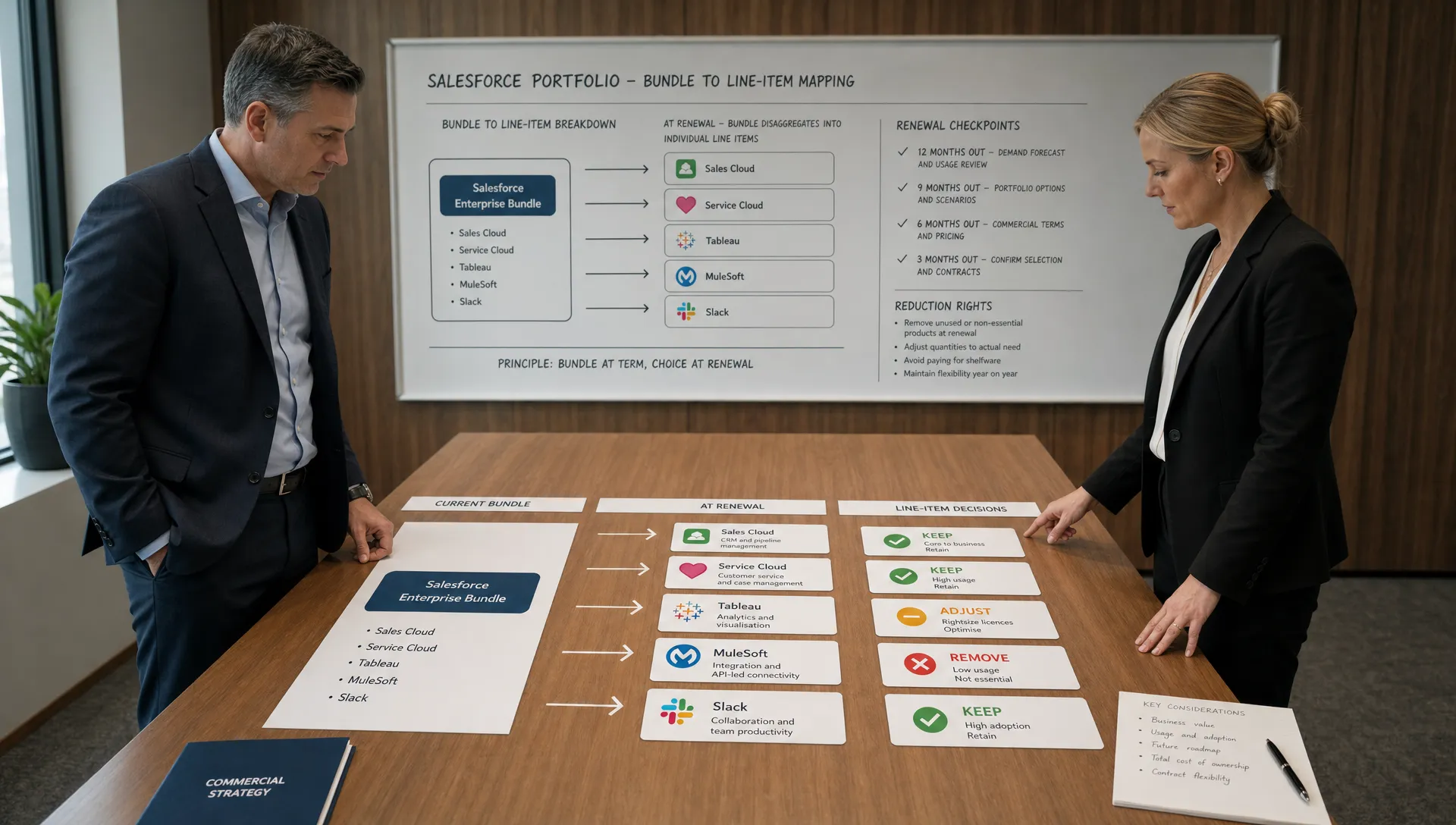
What does a good SELA commercial architecture separate?
A defensible SELA separates four things that vendors often prefer to merge: entitlement, consumption, price and renewal rights. If those layers remain separate, the business can govern adoption without surrendering commercial options.
The architecture should be simple enough for finance to audit, precise enough for legal to enforce and practical enough for IT to manage.
- Entitlement: What the organisation is allowed to use under the SELA.
- Consumption: What the organisation actually uses, by product, team, region and business process.
- Price: What each component costs on a standalone net basis.
- Renewal rights: What the organisation may keep, reduce, remove or renegotiate later.
The CIO owns technical dependency. The CFO owns economic exposure. Procurement owns the translation between those two realities and the contract. When the SELA is bundled too tightly, all three roles lose visibility at the same time.
Salesforce SELA commercial risk matrix
A SELA risk matrix translates attractive commercial promises into the specific traps they can hide. It also gives procurement a clean set of guardrails to negotiate before the order form is signed.
| Commercial Promise | Hidden SELA Trap | Procurement Counter-Measure / Guardrail |
|---|---|---|
| Unit Pricing | One blended annual price masks SKU economics and prevents product-level benchmarking. | Require SKU-level line items, standalone net rates, metrics, quantities and year-by-year pricing for every product. |
| Enterprise Access | Broad access is presented as flexibility, but contractual floors and minimum commitments limit reduction rights. | Define access scope, adoption assumptions, usage metrics and reduction rights before signature. |
| Multi-Year Certainty | Ramped spend creates a final-year anchor that becomes the starting point for the next renewal. | Set renewal baseline language, cap uplift assumptions and preserve the right to reduce products that were not adopted. |
| Product Bundling | Core clouds and adjacent products are merged, making it difficult to drop underused items without losing portfolio discounts. | Separate product families, assign standalone rates and include an unbundle clause that protects discounts on retained products. |
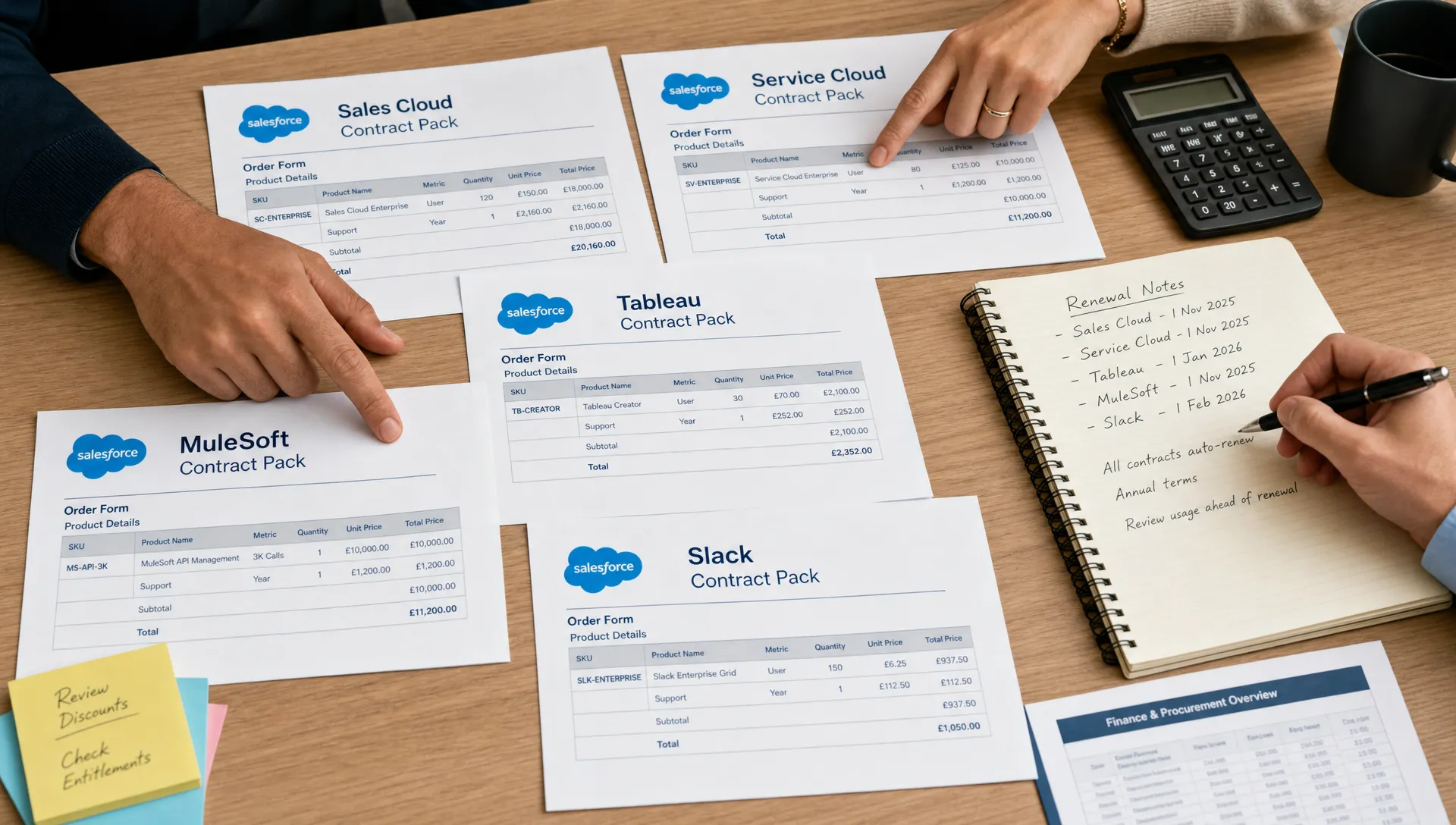
How should CFOs, CIOs and procurement leads run the SELA negotiation?
The SELA negotiation should be run as a commercial architecture exercise, not as a discount chase. Each leader should test a different risk: the CFO tests the financial floor, the CIO tests product dependency, and procurement tests the contractual exit path.
A large headline discount can be a weak outcome if the baseline is inflated, the ramp is unrealistic or the renewal rights are poor. The better question is not, how much discount did we get? It is, what did we commit to, what can we prove we need, and what can we change later?
- CFO view: Test whether the SELA creates a future spend floor that the business would not accept if each product were priced separately.
- CIO view: Test whether every product in the bundle has a real implementation path, accountable owner and dependency on the Salesforce stack.
- Procurement view: Test whether the order form gives enough line-item evidence to benchmark, challenge and renew selectively.
- Legal view: Test whether renewal rights, reduction rights, product definitions and discount preservation are written clearly enough to enforce.
- Business owner view: Test whether the value case is based on funded demand, not vendor-led aspiration.
The practical leverage work starts well before Salesforce presents the renewal shape. SaaSed’s guide to Salesforce negotiation tactics that improve leverage covers the preparation discipline in more detail.
What evidence should be ready before Salesforce sees the renewal strategy?
Salesforce should not be the first party to tell you what you use. Your internal evidence pack should already show entitlement, consumption, shelfware, growth demand and credible alternatives by product.
Build the evidence before the commercial conversation starts.
- Contract baseline: Current order forms, amendments, renewal dates, auto-renewal terms, uplift language and product commitments.
- Usage audit: Actual consumption by product, region, department and user group, with inactive and low-use populations separated.
- Shelfware analysis: Products or quantities paid for but not adopted, with reasons and remediation options.
- Roadmap test: A clear view of which Salesforce products are required for funded projects, not merely possible future initiatives.
- Leverage map: Alternatives, deferral options, consolidation options and products that can credibly be removed.
- Decision calendar: Internal deadlines that leave enough time for executive alignment, not just vendor paperwork.
The evidence pack does not need to be theatrical. It needs to be clean. Salesforce negotiations often become difficult because the buyer waits too long, then tries to negotiate from memory, hope and last year’s deck.
What red flags should pause a SELA signature?
A SELA should pause when the commercial model depends on trust instead of inspectable economics. The more the vendor asks you to accept blended value, the more explicit your contract needs to be.
Red flags do not always mean walk away. They mean slow down, isolate the issue and require written clarity.
- No component pricing: Salesforce will not provide standalone product rates inside the SELA.
- All-or-nothing discounting: The discount is positioned as dependent on renewing the full bundle, including products with weak adoption.
- Non-reducible renewal base: The agreement does not clearly allow reductions at renewal, or treats the final ramp year as the assumed renewal floor.
- Ramps without adoption gates: Spend increases are fixed by date rather than tied to implementation, usage or business readiness.
- Undefined enterprise access: The phrase enterprise access is used without precise product, metric, geography or user scope.
- Forced adjacent clouds: Secondary products are inserted to reach a volume threshold, even when ownership and adoption are unclear.
- No unbundle clause: The contract lacks language allowing product lines to be dropped while preserving discounts on the retained core stack.
The cleanest time to fix these issues is before signature. After signature, the argument changes. You are no longer designing the commercial architecture. You are asking to modify it.
Frequently Asked Questions
These are the practical questions buyers usually ask once a SELA moves from concept to order form. The answers below focus on commercial control rather than legal theory.
What is a Salesforce SELA bundle trap? A SELA bundle trap occurs when multiple Salesforce products are combined into one blended commercial commitment without transparent product-level pricing. The buyer may get a strong headline discount but lose the ability to benchmark, reduce or remove individual products later.
Can Salesforce provide decoupled pricing inside a SELA? Buyers can and should ask for decoupled pricing. The negotiation point is whether each product has a visible SKU, metric, quantity, standalone net rate and renewal treatment inside the wider enterprise agreement.
Does decoupled pricing mean losing volume discounts? Not necessarily. The objective is to preserve legitimate volume discounts while preventing all-or-nothing pricing that penalises the customer for dropping underused products at renewal.
Is enterprise access the same as unlimited use? No. Enterprise access usually sits within defined contractual rights, products, metrics and commitments. It should be reviewed for floors, caps, true-up exposure, product scope and renewal implications.
When should unbundling rights be negotiated? Unbundling rights should be negotiated before the SELA is signed. Once the bundle is embedded in the order form, the buyer’s leverage is usually lower and the renewal anchor is harder to move.
What if the SELA is already signed? Start by reconstructing the estate from order forms, invoices, usage data and stakeholder interviews. Even if the current term is fixed, a disciplined product-level audit can create leverage for the next renewal and identify shelfware before it becomes the baseline again.
How should you calibrate the SELA before renewal?
Calibrating a SELA means proving which products deserve renewal, which need reduction and which should be removed before the commercial anchor hardens. Volume discount thresholds should inform pricing, but they should never become behavioural anchors that force the business into bad economics.
A well-built SELA can work. It can reduce procurement friction, support a platform strategy and create commercial predictability. But it only works when the buyer keeps product economics visible and renewal rights intact.
The disciplined position is simple: accept scale where it creates value, reject opacity where it removes control.
SaaSed helps organisations review Salesforce contracts, SKUs, usage, shelfware and renewal exposure before negotiation pressure builds. If your next renewal is within the next 12-18 months, we can support a line-item contract benchmark and an independent SELA negotiation audit. To start with a quiet second opinion, book a complimentary Salesforce audit conversation.
Want this kind of intel on your renewal?
Don’t head into your next software negotiation alone
Talk to the team