
Salesforce Mid-Contract Reductions: Can You Actually Scale Down?
Downsizing rarely moves at the same pace as a Salesforce contract. This article explains why mid-contract scale-downs are usually blocked, and which clauses CFOs, CIOs and procurement leads need before signing.
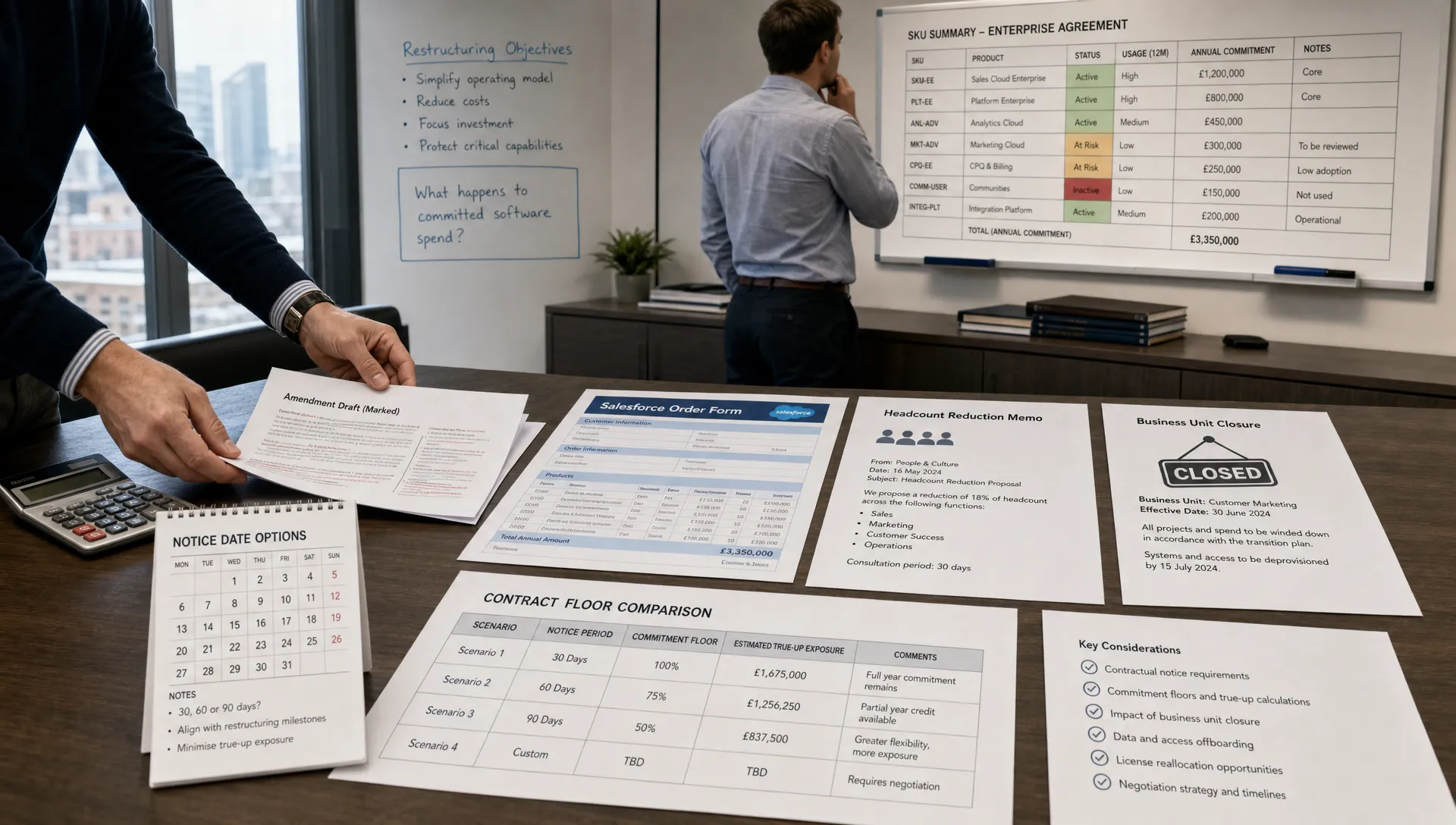
Why restructuring years expose weak contract design
Mid-contract reduction requests often appear during restructuring. That is not a coincidence.
Salesforce contracts are usually negotiated during planning cycles that assume growth, stable headcount, geographic expansion, or a major transformation programme. Then the business changes. A region underperforms. A sales function is merged. A support process is outsourced. A digital programme is delayed. A company acquired two years earlier is finally integrated.
The contract still reflects the old plan.
This is particularly visible where go-to-market teams change. For instance, if an enterprise reduces internal SDR hiring and shifts some prospecting work to a specialist B2B customer acquisition partner, the CRM usage pattern can change quickly. Licence demand may fall in one team and rise in another. But unless the contract allows reallocation, substitution, or reduction, the invoice may not follow the operating model.
The same pattern appears in IT consolidation. A business may standardise on fewer clouds, retire duplicate service tooling, or pause an analytics rollout. Good portfolio decisions do not automatically translate into lower Salesforce spend.
That is why procurement needs to treat flexibility as a priced contract term, not a nice-to-have.
Defensive procurement guide: clauses to insert before signing
Procurement teams cannot remove all commercial risk. They can stop the worst version of it: a rigid contract that assumes the business will never change.
Here are the defensive tactics to put into order forms and negotiated terms before signature.
- Define a reduction right, not a review right: Use language that states the customer may reduce named products, quantities, or annual contract value under specified conditions. Avoid wording that only requires the parties to meet or discuss optimisation.
- Set the calculation method in writing: The order form should state how credits, reduced fees, or adjusted quantities are calculated. If the price impact is left open, the right may be commercially weak.
- Negotiate product-level reduction caps: Secure the ability to reduce specific SKU families by a defined percentage at a defined time. A 10 percent or 20 percent product-level cap can be more useful than a vague enterprise-wide flexibility statement.
- Protect substitution value: If swap rights are offered, specify eligible products, timing, valuation, approval process, and whether unused value expires. The right should not depend on a fresh discretionary sales approval each time.
- Add corporate change triggers: Include divestiture, closure, merger, outsourcing, regulatory restriction, or material reorganisation language. These events are predictable enough to draft for, even if the timing is unknown.
- Separate experimental products from core commitments: Pilot products, new clouds and adoption-dependent modules should have shorter terms, exit checkpoints, or lower committed floors than mature business-critical products.
- Control ramp exposure: Link future ramp quantities to measurable deployment or hiring milestones where possible. If a ramp date is automatic, it can become a cost increase detached from actual adoption.
- Preserve renewal true-down rights: State that the customer may reduce quantities at renewal without forfeiting negotiated pricing on the remaining estate, subject to clearly defined thresholds.
- Restrict bundle lock-in: Require transparency on SKU-level pricing and dependencies. If a bundle cannot be unpicked, a future reduction may become practically impossible.
- Align notice periods with internal governance: Reduction windows are useless if the notice period closes before finance, IT and business owners have usage data. Build the contract calendar around your internal decision cycle.
These tactics sit alongside broader negotiation discipline. If your team is preparing a renewal or new enterprise agreement, the strongest leverage usually comes from the fact base built before vendor discussions begin. SaaSed has written separately on Salesforce negotiation tactics that improve leverage, including the importance of usage evidence, timing and internal alignment.
How to handle a live mid-contract reduction request
If the contract is already signed and the business needs to reduce now, the situation is harder, but not hopeless.
Start by reading the executed order form, amendments, master terms and any side letters. Do not rely on what was said in the sales process. Look for cancellation rights, substitution rights, ramp terms, affiliate language, renewal notice provisions, product-specific terms and minimum commitments.
Then build a clean commercial file. The file should show assigned versus active users, login data, feature adoption, product ownership, planned decommissions, business restructuring evidence, and future demand. This is not because usage alone creates a right. It is because evidence improves the quality of the commercial conversation.
Next, decide what you are actually asking for. A cash reduction, a product swap, a ramp delay, a shorter renewal, a partial credit, and a baseline reset are different asks. If you mix them together, the vendor controls the framing.
Finally, avoid giving away renewal leverage too early. A mid-contract concession can be tied to an early renewal or extension. That may be acceptable, but only if the buyer has already modelled the full-term cost, future flexibility, and alternative sourcing position.
This is where many enterprises lose value. They treat the live pain as the only problem. Salesforce treats the live pain as a path to the next commitment.
For procurement teams reviewing the clause set itself, it is also worth checking the wider cost drivers that often sit around reduction language. Minimum commitments, bundle dependencies, auto-renewal provisions and true-up terms can all influence whether a scale-down is commercially real. We covered several of these in 7 SaaS contract clauses that drive up Salesforce costs.
The CFO view: cash, not theoretical entitlement
For CFOs, the mid-contract reduction question should be translated into cash impact.
A licence reduction that does not change the invoice is not a saving. A credit that can only be spent on more software may not relieve budget pressure. A swap into another product may be valuable, but only if it replaces funded demand elsewhere.
The finance review should separate:
- Contracted annual spend
- Current cash obligation
- Unused entitlement value
- Avoidable future spend
- Renewal baseline risk
- Any concessions that require term extension
This framing prevents a common mistake: treating utilisation improvement as cost reduction. Better utilisation is good. It may improve value for money. But if the cash cost is unchanged, it should not be reported as a realised saving.
The CIO view: do not let architecture inherit procurement debt
For CIOs, the risk is different.
When mid-contract reductions are blocked, technical teams can be pushed into using products simply because they have already been bought. That may sound efficient, but it can distort architecture decisions.
A cloud that no longer fits the roadmap should not become the default just because cancelling it is difficult. Equally, a substitution right should not push the organisation into adopting another Salesforce product without a clear owner, integration case and operating model.
The CIO’s role is to give procurement a credible view of future demand. Not optimistic demand. Not vendor-shaped demand. Actual demand based on architecture, adoption capacity, data model constraints and business ownership.
That technical clarity gives finance and procurement a stronger basis for any reduction, swap, or renewal reset.
The procurement view: flexibility must be priced before signature
Procurement’s mistake is often timing.
Teams negotiate discount hard, then discover later that the contract cannot flex. The headline discount looked strong. The operating model changed. The savings vanished into unused commitments.
A better approach is to value flexibility alongside price. A slightly lower discount with meaningful reduction rights may beat a higher discount attached to a rigid floor. This is especially true where the organisation is restructuring, integrating acquisitions, changing sales coverage, or moving towards consumption-based products.
The procurement question is not simply “What discount did we get?”
It is “What happens if our forecast is wrong?”
If the answer is “we still pay the same”, the discount may be less impressive than it appears.
Frequently Asked Questions
Can Salesforce licences be reduced mid-contract? Sometimes, but usually only if the contract includes a specific reduction, cancellation, substitution, or adjustment right. Without that language, Salesforce will typically treat the signed order form as a committed spend obligation until renewal.
Is a Salesforce true-down automatic at renewal? Not always. Some customers can reduce quantities at renewal, but the commercial effect depends on the contract. Reductions may trigger repricing, loss of discount, bundle issues, or minimum commitment problems if protection was not negotiated.
Does low usage give us a right to pay less? Low usage is strong evidence for a renewal negotiation and may support a commercial request, but it does not usually create a contractual right to reduce fees mid-term by itself.
What is the difference between a swap right and a reduction right? A swap right lets you move committed value from one product to another. A reduction right lowers the commercial commitment. Swaps can improve value, but they do not necessarily reduce cash spend.
When should Salesforce scale-down rights be negotiated? Before signing the order form or renewal amendment. Once the contract is live, any reduction is usually discretionary unless the right was already included.
Conclusion: scale-down is a contract design issue
Salesforce mid-contract reductions are possible in narrow circumstances, but they are not a default feature of most enterprise agreements.
The hard reality is that a downsized business can remain tied to an upsized contract. The way to avoid that is not to hope for goodwill after the restructuring. It is to negotiate the reduction mechanics, substitution rights, ramp controls and renewal true-down protections before the commitment is signed.
If you are already mid-term, the next best step is to establish the facts: what the contract allows, where the shelfware sits, what the business actually needs, and which concessions would improve the next renewal rather than weaken it.
SaaSed helps enterprise finance, IT and procurement teams review Salesforce contracts, SKU usage and renewal exposure before they enter commercial discussions. If you want a clear view of where your flexibility really sits, you can book a complimentary Salesforce audit conversation.
Want this kind of intel on your renewal?
Don’t head into your next software negotiation alone
Talk to the team