
How Contract Negotiation Shapes Your Salesforce Outcome
Salesforce outcomes are rarely decided by discount alone. This article shows how contract negotiation affects cost, flexibility, risk and control long after the renewal is signed.
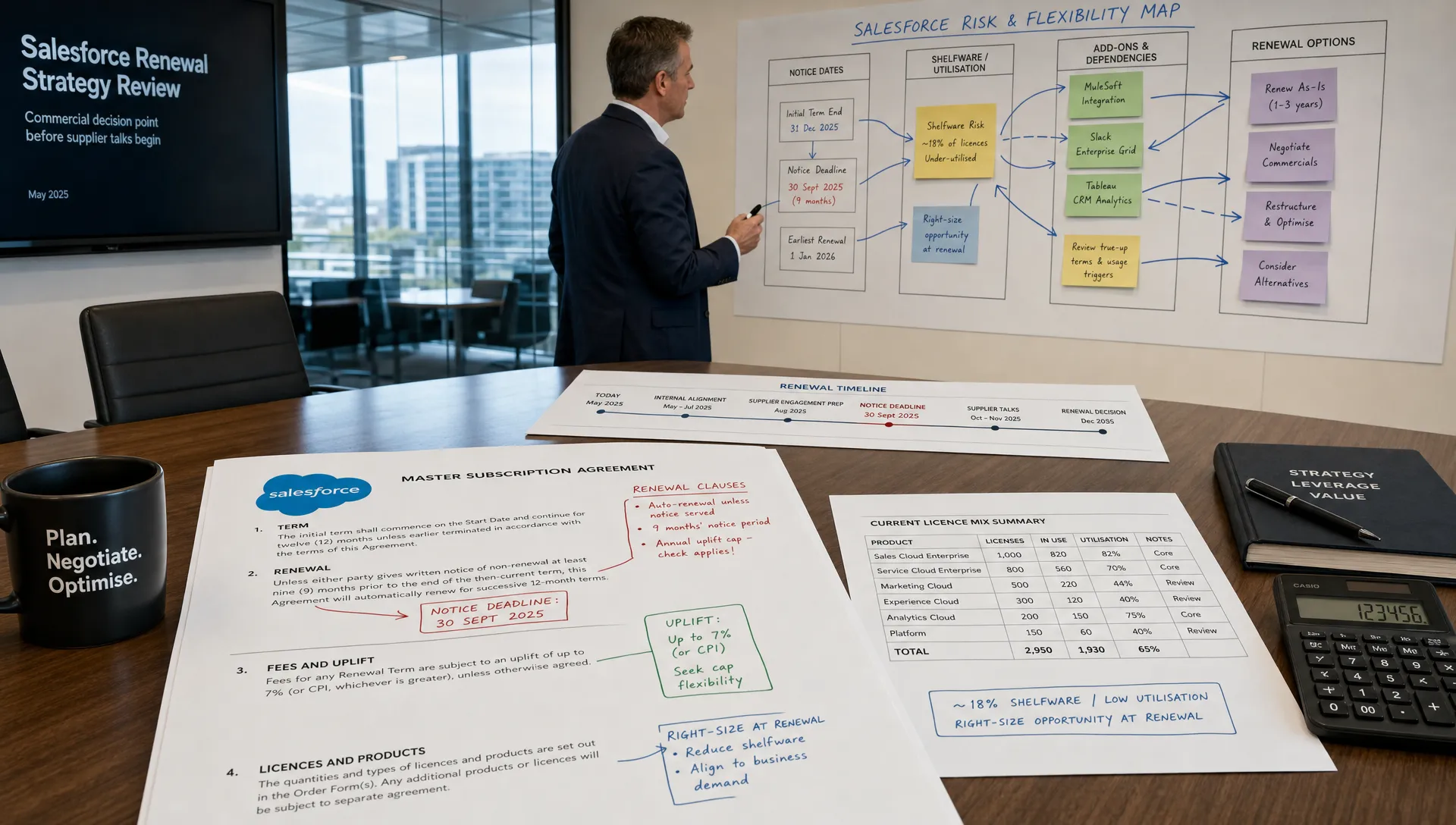
Finance, IT, procurement and legal need different seats at the table
Salesforce contract negotiation weakens when it is owned by one function in isolation.
Procurement can lead the commercial process, but it cannot invent the platform roadmap. IT understands adoption and technical dependency, but it may not see every commercial lever. Finance sees the budget pressure, but not always the licence-level waste. Legal can protect the organisation, but only if it knows which terms matter commercially.
A clear split of responsibility keeps the work grounded.
| Function | Best contribution | Risk if excluded |
|---|---|---|
| CFO or finance lead | Budget guardrails, approval logic, cost visibility and appetite for commitment | Commercial targets become vague or unrealistic |
| CIO or IT lead | Platform roadmap, operational dependency, user demand and technical constraints | The contract may not match how Salesforce is actually used |
| Procurement | Negotiation structure, supplier process, commercial options and internal discipline | The renewal becomes reactive and supplier-led |
| Legal | Risk review, enforceability, data terms, liability, audit language and renewal mechanics | Important protections may be left vague or unenforceable |
| Business owners | Demand validation, project plans and real usage expectations | Teams may renew licences for work that is no longer a priority |
Legal’s role is especially important when commercial promises need to survive beyond the meeting. A clause has little value if nobody can monitor or enforce it later. That principle appears in many rights-heavy environments too. Third Chair’s work on enforcing and licensing IP rights is a useful reminder that contractual rights only create value when they can be tracked, evidenced and acted on. Salesforce contracts are different, but the discipline is the same.

A poor outcome can look acceptable on signature day
Some Salesforce deals look fine when they are signed and painful a year later.
The first invoice may be within budget. The discount may look respectable. The stakeholder update may say the renewal is complete. Then the hidden problems appear.
A product bought for a pilot becomes a locked-in commitment. A business unit delays a rollout, but the licences remain. A new cloud is added mid-term at a weaker discount. The renewal uplift applies to a spend base that should have been reduced. A co-term arrangement brings forward the next negotiation before the organisation has had time to measure value.
This is why contract negotiation should not be judged only by the signature moment. It should be judged by how the contract behaves under pressure.
Can you reduce if demand falls? Can you expand without losing control? Can you explain the cost base to the board? Can IT govern consumption and licences without relying on spreadsheets and memory? Can procurement see the next renewal early enough to prepare?
If not, the contract may have bought short-term peace at the expense of long-term control.
What a good Salesforce outcome looks like
A good outcome is not always the lowest possible price. It is the best commercial fit for the organisation’s actual needs and risk.
In practical terms, that usually means:
- The licence estate reflects real usage, not historic optimism
- Renewal uplift and term length are understood and intentional
- Shelfware is reduced or given a clear correction path
- Add-ons follow the same commercial logic as the main estate
- Business owners can explain why each major SKU is needed
- Finance can forecast the next term without unpleasant surprises
- IT has enough flexibility to support the roadmap without overbuying
- Procurement has documented leverage points for the next renewal
This is also where stronger Salesforce negotiation tactics matter. Leverage is not created by being difficult. It is created by being prepared, aligned and credible. Our guide to Salesforce negotiation tactics that improve leverage explores that preparation in more detail.
A simple timeline for shaping the outcome
The best time to start is usually earlier than feels necessary. A renewal that is material to the business should not be treated like an admin task.
| Timing before renewal | What to do | Main objective |
|---|---|---|
| 180 days | Gather all order forms, amendments, renewal notices and product commitments | Build the contract fact base |
| 150 days | Audit licence assignment, adoption and inactive usage with IT and business owners | Separate need from waste |
| 120 days | Confirm roadmap changes, budget constraints and internal approval routes | Decide what the business should buy next |
| 90 days | Shape negotiation options, walk-away positions and preferred concessions | Enter supplier talks with control |
| 60 days | Review proposed order forms and legal terms against the agreed outcome | Avoid last-minute clause drift |
| 30 days | Finalise approvals and document future renewal lessons | Preserve leverage for the next cycle |
This timeline will not fit every organisation. Some teams are already inside the 90-day window. If so, the priority is not perfection. It is fast clarity. Find the renewal date, confirm notice obligations, identify unused spend, and agree the few commercial terms that matter most.
Frequently Asked Questions
When should Salesforce contract negotiation start? For a material Salesforce estate, start around six months before renewal. This gives finance, IT, procurement and legal enough time to review usage, contract terms and future demand before supplier pressure increases.
Who should own the Salesforce negotiation? Procurement should usually orchestrate the process, but not own the facts alone. IT must validate usage and roadmap needs. Finance must set budget guardrails. Legal must review terms that affect risk, renewal mechanics and enforceability.
Is the discount the most important part of the deal? Not always. Discount is visible, but flexibility, SKU structure, renewal uplift, minimum commitments and add-on treatment often shape the real cost over time.
What if we have a strong relationship with Salesforce already? A good relationship helps, but it does not replace preparation. Clear usage data and a well-structured commercial position make the conversation easier for both sides.
Can we improve the outcome if renewal is already close? Yes, but the scope is narrower. Focus on the highest-impact items: unused licences, renewal uplift, notice dates, contract term, payment timing, and any add-ons that could create long-term commitment.
A better Salesforce outcome is built before the call
Salesforce contract negotiation should feel less like a fight and more like a disciplined buying decision. The goal is not to make the supplier lose. The goal is to make sure the contract reflects what your organisation needs, uses and can govern.
That requires evidence before opinion, alignment before negotiation, and careful attention to the clauses that shape life after signature.
If you would like an outside view on your current Salesforce position, SaaSed can review the contract, SKU mix, usage picture and renewal risks with you. For a complimentary Salesforce audit conversation, speak with SaaSed.
Want this kind of intel on your renewal?
Don’t head into your next software negotiation alone
Talk to the team