
Which Software Agreements Need a Closer Second Look
Some software agreements are harmless admin. Others quietly decide next year’s cost, risk and leverage. This guide shows CFOs, CIOs and procurement teams which deals deserve review first.
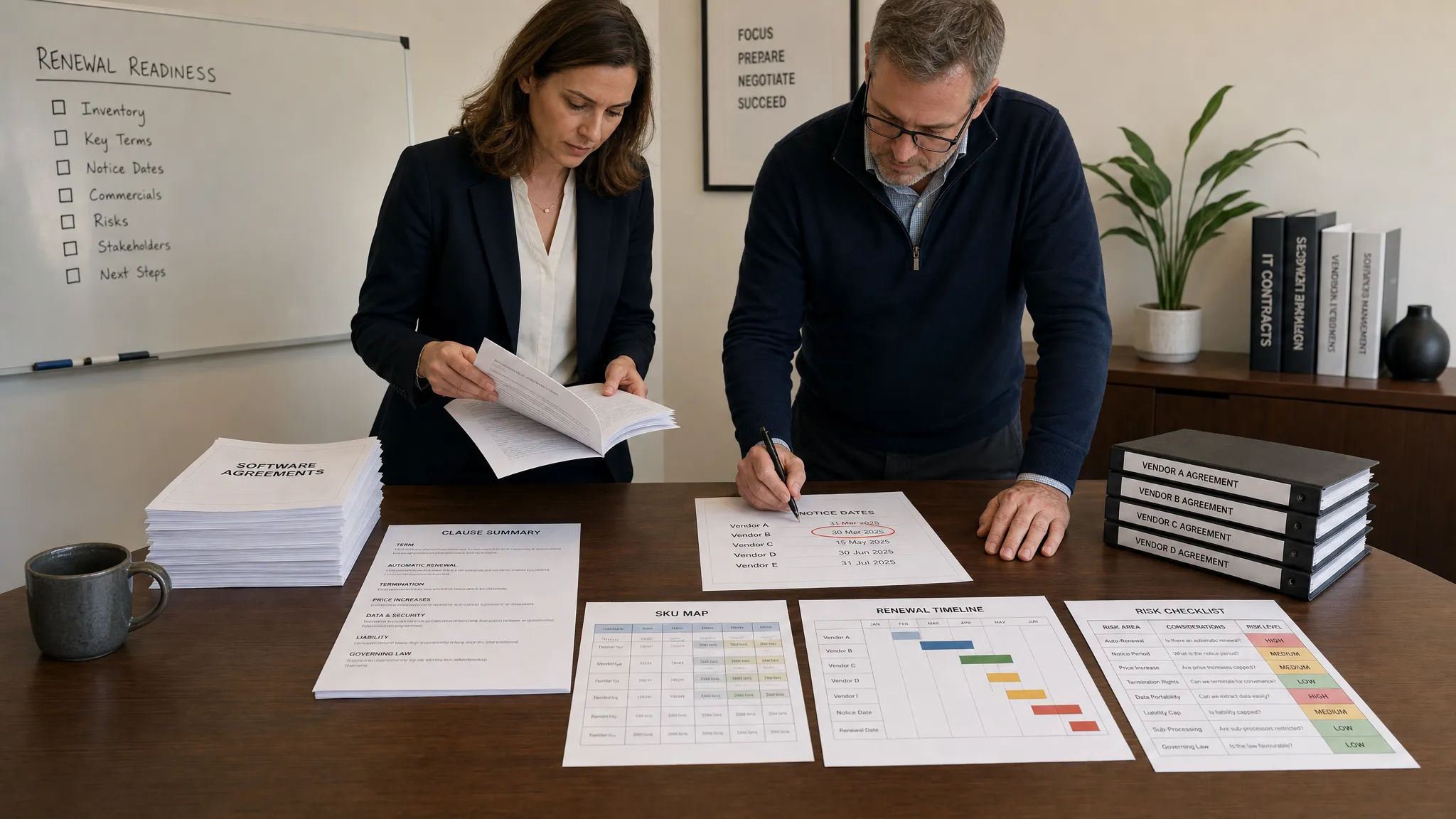
5. Agreements that no longer match the operating model
Some agreements are expensive because they were badly negotiated. Others are expensive because the business changed.
This is common after restructuring, hiring freezes, market exits, acquisitions, divestments or a shift in go-to-market strategy. The agreement may still reflect last year’s assumptions: more users, more regions, more projects, more integrations or a faster rollout.
That is why a second look should not begin with the contract alone. It should begin with what has changed in the business.
Useful prompts include:
- Have headcount, territories or sales teams changed since the last signature?
- Has the business moved to a different operating model, such as centralised service, partner-led sales or regional consolidation?
- Has another platform replaced part of the original scope?
- Are there acquired entities with overlapping tools or separate contracts?
- Are future projects still funded, or are they now only historical justification for unused licences?
This is where CFO and CIO alignment is valuable. Finance sees budget pressure. IT sees dependency and change effort. Procurement sees timing and leverage. The best answer usually comes from joining those views, not letting one team carry the full decision.
6. Usage-based, credit-based, AI and data-heavy agreements
The fastest-growing area of review is not traditional named-user licensing. It is usage, consumption, credits, AI features and data terms.
These agreements can be fair and useful, but they need a different control model. The risk is not only the unit price. It is the combination of uncertain demand, unclear ownership and weak consumption reporting.
In 2026, AI-related software agreements deserve particular attention. Many vendors are adding AI assistants, automation layers, data enrichment, predictive features or embedded credits. Before accepting them, check what data is used, whether customer data can train models, how outputs are governed, what audit trail exists and how pricing changes if usage increases.
For usage and credits, ask whether unused credits expire, whether overage pricing is fixed, whether consumption can be capped, and whether the vendor’s reports are detailed enough for internal chargeback or budget ownership. If nobody inside the business owns the meter, the supplier effectively owns the forecast.
A second look here should involve IT, security, legal, finance and the business owner. Procurement can lead the commercial process, but it should not guess the data or governance risk alone.
7. Agreements bought through resellers, marketplaces or partner routes
The buying route can change the risk profile. Resellers, marketplaces and partner-led deals can be helpful, especially for consolidation, billing or access to certain commercial structures. They can also make accountability less clear.
A second look should identify who is responsible for support, who controls renewal notices, which terms apply if there is conflict, whether discounts survive renewal, and how co-terming works across related orders.
This matters when the end customer assumes the vendor will behave one way, while the reseller agreement says something else. It also matters when a marketplace purchase creates convenience at the cost of flexibility later.
None of this means the route is wrong. It means the agreement should be read as a chain, not a single document.
How to run the second look without slowing everyone down
A useful review is focused. It does not need to become a committee exercise for every tool in the stack.
Classify agreements into three tiers.
| Tier | Typical agreement | Review depth |
|---|---|---|
| Tier A | Strategic, high-spend or operationally critical platforms | Full commercial, usage, risk and negotiation review |
| Tier B | Important departmental tools with moderate spend or dependency | Targeted review of renewal terms, usage and owner confirmation |
| Tier C | Low-cost, low-risk tools with easy replacement paths | Basic renewal control, owner approval and cancellation hygiene |
For Tier A agreements, the review should produce a clear position before the vendor conversation. That position should include current usage, future demand, walk-away constraints, commercial asks, timing risks and the internal approval path.
Five questions usually expose the weak spots quickly:
- What exactly are we committed to buy, and until when?
- Which SKUs, licences or credits are actually being used?
- What happens if we need to reduce, pause, swap or restructure the commitment?
- Which dates could weaken our leverage if missed?
- What business change has happened since the last agreement was signed?
If those questions cannot be answered, the agreement needs more than a second look. It needs a short, disciplined recovery plan before renewal talks begin.
Who should be involved?
The right people depend on the agreement, but strategic software should not be reviewed by procurement alone.
| Stakeholder | What they bring to the review |
|---|---|
| CFO or finance lead | Budget impact, cash timing, approval discipline and tolerance for commitment risk |
| CIO or IT lead | Platform dependency, technical roadmap, integration risk and feasibility of change |
| Procurement | Commercial strategy, negotiation timing, supplier process and contractual leverage |
| Legal | Clause risk, data protection, liability, audit rights and termination mechanics |
| Business owner | Actual adoption, future demand and whether the software supports real outcomes |
The most expensive mistakes often happen when one of these voices is missing. Legal may approve terms without usage context. IT may accept continuity at any cost. Finance may push for savings without seeing migration risk. Procurement may negotiate hard on price while the real issue sits in scope.
A proper second look creates a shared view before the supplier meeting. That alone often changes the quality of the negotiation.
Frequently Asked Questions
Which software agreements should be reviewed first? Start with strategic platforms, high-spend agreements, renewals within the next 6 to 12 months, bundled product families, agreements with minimum commitments, and any contract with unclear usage or auto-renewal terms.
How early should we review a major software renewal? For strategic platforms, start at least 6 months before renewal, and earlier if the agreement is complex or operationally critical. The goal is to gather evidence before the supplier controls the timetable.
Is a second look mainly a legal review? No. Legal review is important, but the second look should also cover usage, commercial leverage, renewal timing, SKU fit, business change and operational dependency.
Do smaller agreements ever need close review? Yes, if they carry sensitive data, create operational dependency, include unusual renewal terms or sit inside a wider vendor relationship. Spend is important, but it is not the only risk signal.
What if the supplier says pricing is non-negotiable? Treat that as a position, not a conclusion. You may still have room to adjust scope, term length, payment timing, product mix, ramp structure, support level or future price protection.
A better second look before the next signature
The point of reviewing software agreements is not to slow the business down. It is to avoid signing yesterday’s assumptions into tomorrow’s budget.
For Salesforce, this is especially important. The agreement can contain unused licences, awkward renewal timing, bundled products, uplift mechanics and commercial constraints that are hard to see without a structured review.
SaaSed helps organisations examine Salesforce contracts, SKUs, usage, shelfware, renewal readiness and negotiation risk before the renewal conversation becomes urgent. If you want a calm, practical view of where you stand, book a complimentary Salesforce audit conversation and we will help you decide what deserves a closer second look.
Want this kind of intel on your renewal?
Don’t head into your next software negotiation alone
Talk to the team