
What is actually a Salesforce SELA
A Salesforce SELA can simplify enterprise buying, but the wrong floor, bundle or true-down language can lock in years of waste. This guide explains the pricing mechanics, risk points and renewal checks procurement teams should run early.
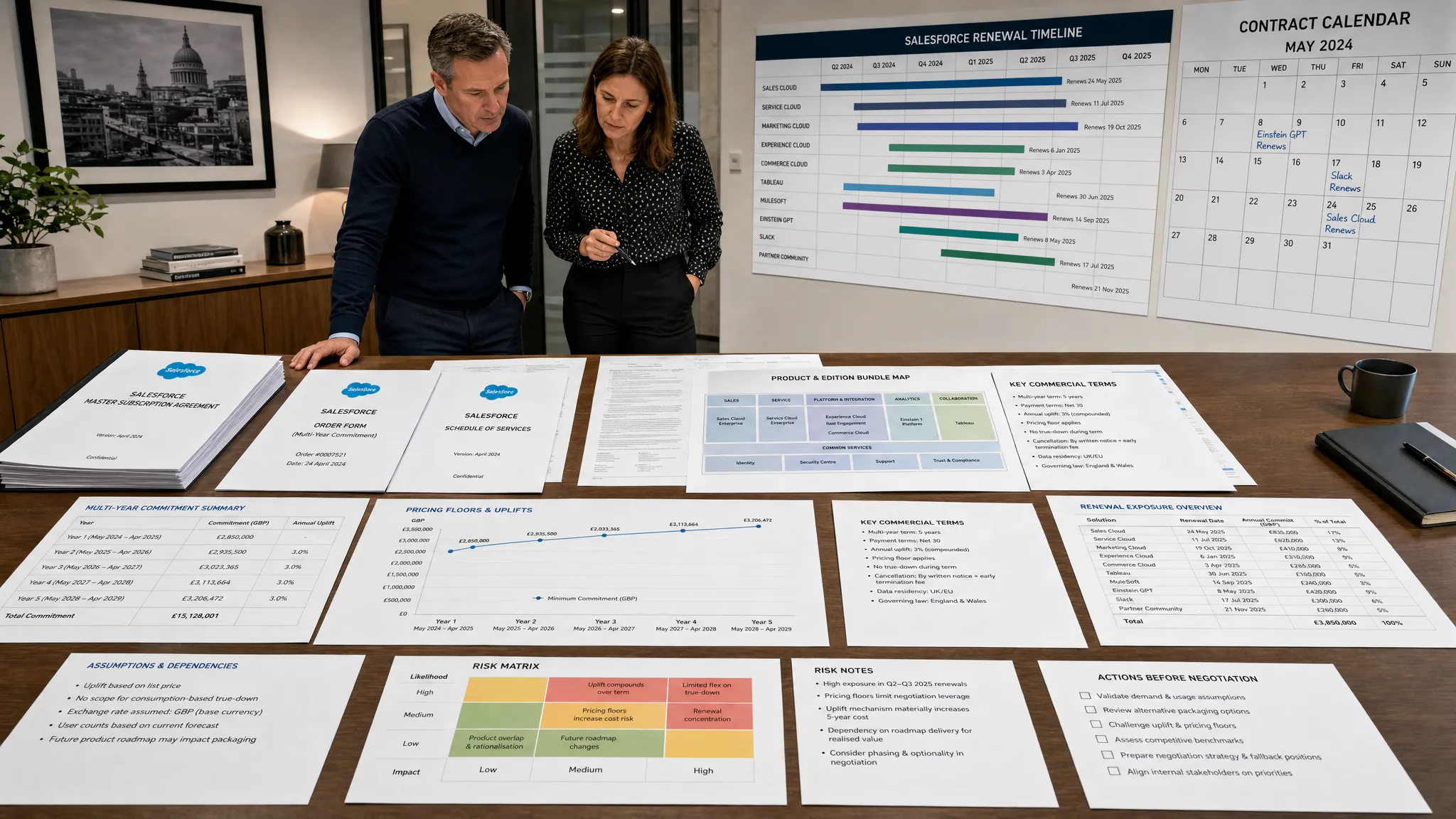
Hidden costs that often sit inside the agreement
The hidden cost of a SELA is not usually one dramatic clause. It is usually the compound effect of several ordinary-looking terms.
Minimum commitment language is the first place to look. A committed floor may be expressed as annual contract value, licence quantity, product family spend or a total term commitment. If that floor cannot be reduced, the customer is carrying adoption risk for the full term.
Ramp schedules are the second. A three-year ramp can be sensible if implementation is funded, resourced and already underway. It is risky when the ramp is based on a transformation plan that has not survived budget review.
True-down restrictions are often underestimated. Many SaaS contracts allow growth more easily than reduction. If the estate can only move upward during the term, the SELA should be modelled as a spend floor, not a flexible buying vehicle.
Product substitution rights matter when the roadmap changes. If a product does not land as expected, can the committed value move to another Salesforce product? If yes, under what approval process and at what price basis? If not, the customer may be left holding a product it no longer needs.
Support and success plan attachments can be material. Support packages, advisory services or success plans may be priced as a percentage of subscription value. If the subscription base rises, related costs may rise with it.
Consumption products need separate treatment. Data, automation, AI, integration and messaging models can behave differently from named-user licences. A low unit rate is not enough if the usage driver is unclear.
Renewal uplift and repricing rights should be read slowly. If the SELA creates a high committed baseline, any uplift applied to that baseline compounds. If discount protection expires at renewal, the customer may face both a higher baseline and weaker pricing.
For a wider clause-by-clause view, SaaSed has covered related renewal mechanics in 7 SaaS Contract Clauses That Drive Up Salesforce Costs. A SELA simply makes those clauses larger and more consequential.
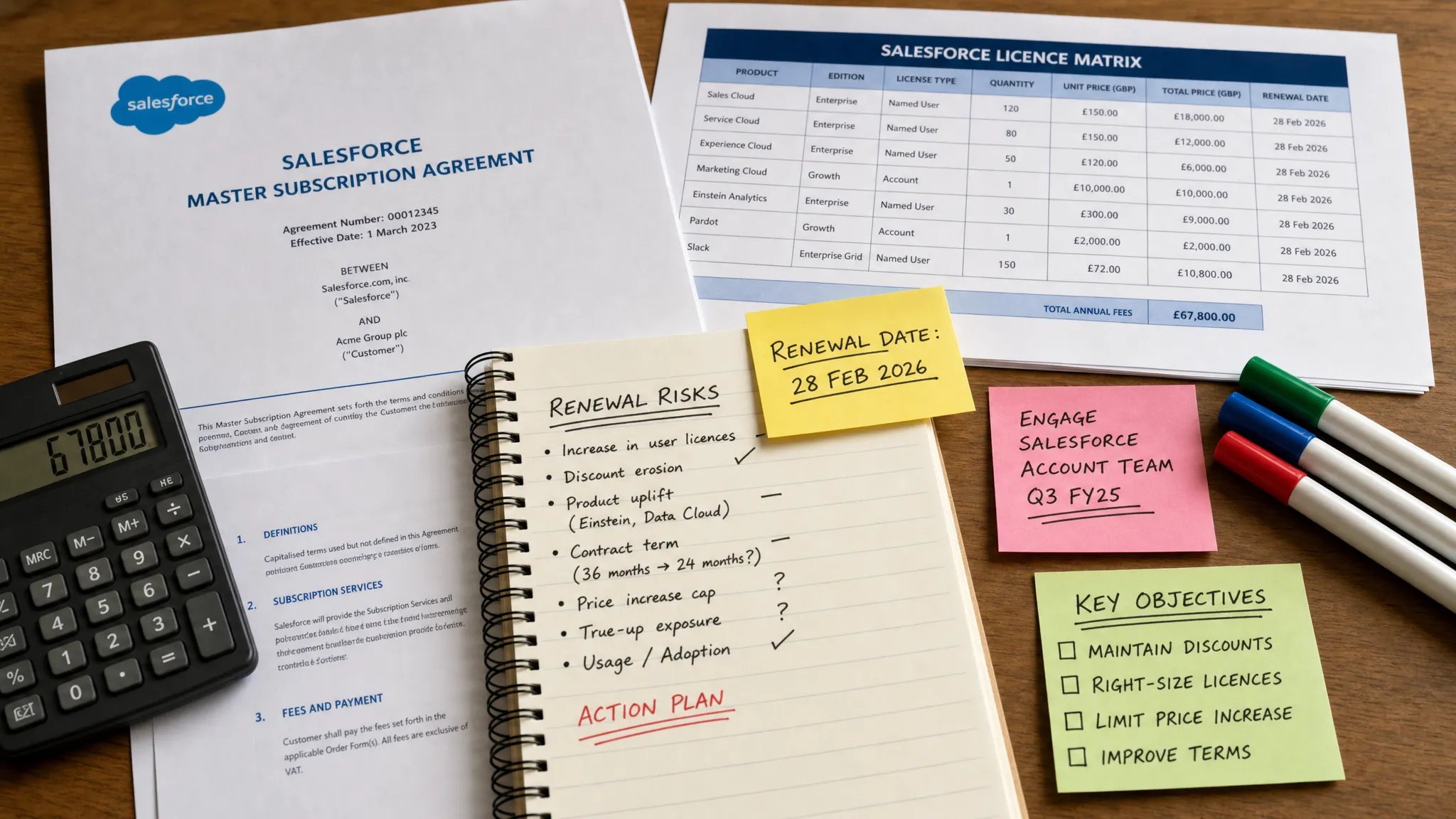
Actionable procurement checklist before Salesforce SELA talks
The strongest SELA negotiation usually starts before Salesforce presents a formal proposal. Once the seller has anchored the conversation around a strategic enterprise deal, it becomes harder to move back to first principles.
A disciplined renewal process should start early enough to audit usage, validate demand and build a commercial narrative internally. If your renewal process is still being built, this guide to what a strong SaaS renewal process looks like is a useful starting point.
Use the checklist below before you discuss SELA scope or pricing.
| Procurement check | What to do | Why it matters |
|---|---|---|
| Establish the current baseline | Reconcile order forms, invoices, amendments and active entitlements | Salesforce estates often contain more contracted rights than teams realise |
| Measure real usage | Review active users, login patterns, feature usage and business-critical activity by SKU | A licence assigned to a user is not the same as a licence creating value |
| Separate must-have from nice-to-have | Classify products by operational dependency, adoption maturity and roadmap certainty | This prevents low-confidence products from being treated as committed demand |
| Test the 3 to 5 year forecast | Build low, base and high scenarios for headcount, regions, projects and data volume | SELA floors are usually priced against optimism, not downside cases |
| Identify shelfware | Find unused licences, duplicate capabilities and products with weak ownership | Shelfware should become negotiation leverage, not renewal baggage |
| Ask for SKU-level transparency | Request product-level quantities, unit prices, discounts, support costs and renewal treatment | Bundled pricing can hide poor economics in individual components |
| Validate discount thresholds | Confirm exactly which volume or spend levels unlock each discount | Thresholds can stop the customer from right-sizing the estate |
| Check true-down rights | Document whether quantities or spend can reduce during the term or only at renewal | Lack of true-down rights turns a forecast into a liability |
| Pre-negotiate expansion pricing | Fix rates for additional users, products or consumption where possible | Growth should not be priced at weaker terms after signature |
| Review substitution language | Confirm whether unused committed value can move to other Salesforce products | Flexibility is valuable only if it is written into the contract |
| Model renewal exit | Calculate what happens at the end of the SELA if the organisation wants a smaller estate | The next renewal should not start from an inflated baseline by default |
| Check M&A and divestiture terms | Confirm how acquired, divested or restructured entities are treated | Corporate change can break the assumptions behind enterprise commitments |
| Control internal approvals | Require business owners to justify demand and fund adoption plans | Procurement cannot defend a SELA built on unowned forecasts |
| Prepare the walk-away option | Model a non-SELA renewal with right-sized quantities and phased expansion | Without an alternative, the SELA becomes the only path on the table |
This work is not administrative. It is where the leverage is created. As we have written before, most Salesforce value is already in your contract, but it only becomes visible when usage, obligations and renewal timing are analysed together.
How CFOs, CIOs and procurement leads should evaluate the decision
A SELA decision should not be framed as whether Salesforce is important. For most enterprise customers, it clearly is. The better question is whether the proposed agreement matches the organisation’s real operating plan.
For CFOs, the key issue is committed spend under uncertainty. If the SELA raises the floor faster than adoption rises, the finance team is pre-paying for confidence it does not yet have.
For CIOs, the key issue is architectural fit. If the SELA pushes the organisation towards products before the integration, data, security and operating model are ready, the technology roadmap starts serving the contract rather than the other way round.
For procurement leaders, the key issue is leverage preservation. A SELA can create leverage through scale, but it can also remove leverage if all future demand is committed too early.
A practical decision model should include three cases.
| Scenario | What to model | What it reveals |
|---|---|---|
| Base case | Expected adoption, planned projects and normal headcount changes | Whether the SELA works under the business plan most people believe |
| Downside case | Delayed projects, lower user growth, divestiture or budget pressure | Whether the organisation can live with the floor if plans slip |
| Upside case | Faster growth, higher consumption and more clouds | Whether expansion pricing and usage terms remain controlled |
If the SELA only works in the upside case, it is not a balanced agreement. It is a bet.
What a good Salesforce SELA should contain
A well-built SELA does not need to be perfect. It needs to be clear, measurable and defensible.
At a minimum, the customer should understand the committed value by year, the products included, the unit economics by SKU, the rights to reduce or substitute, the treatment of future purchases, the support cost implications, the renewal uplift position and the consequences of corporate change.
It should also include governance. Enterprise agreements fail when nobody owns usage after signature. Someone should be responsible for quarterly licence reviews, product owner sign-off, consumption monitoring and renewal evidence collection. Without that, the organisation will only discover the problem when the next renewal quote arrives.
A good SELA is not simply cheaper than buying product by product. It is better aligned to how the business will actually use Salesforce over the full term.
Frequently Asked Questions
What does Salesforce SELA stand for? Salesforce SELA usually stands for Salesforce Enterprise Licence Agreement, or Salesforce Enterprise License Agreement in US spelling. It is a negotiated multi-year enterprise contract for a defined Salesforce product portfolio, rather than a standard public SKU.
Is a Salesforce SELA the same as an unlimited licence? No. Some SELA structures may include broader access or unlimited-style rights for certain products, but the agreement will still have definitions, exclusions, usage rules, product scope and commercial limits. The contract wording matters more than the label.
How long is a typical Salesforce SELA? Many enterprise agreements are structured across 3 to 5 years, although the exact term is negotiated. Longer terms may improve pricing, but they also increase exposure if adoption, headcount or business strategy changes.
Can we reduce Salesforce licences during a SELA term? Often, reduction is limited or not allowed during the committed term unless specific true-down or flexibility language has been negotiated. Procurement should treat the committed floor as binding unless the contract clearly says otherwise.
What are the biggest hidden costs in a Salesforce SELA? The largest hidden costs usually come from shelfware, over-provisioned licences, ramp commitments, weak product substitution rights, support costs tied to subscription value, consumption overages and renewal repricing.
When should we start preparing for a Salesforce SELA renewal? For a large enterprise estate, preparation should start at least 9 to 12 months before renewal, and earlier for complex global environments. Usage data, stakeholder alignment and alternative scenarios take time to build.
Final thought
A Salesforce SELA can be a smart commercial structure when the estate is mature, the roadmap is credible and the contract protects flexibility. It can also become an expensive container for uncertain demand.
The difference is preparation. Before accepting a SELA proposal, make the current estate visible, test the growth assumptions and read the floor language carefully. The best negotiation is rarely won in the final meeting. It is won in the months before the quote hardens.
If you want an independent view of your Salesforce estate before SELA or renewal discussions begin, SaaSed can help you review the contract, SKU mix, shelfware and leverage gaps. You can book a complimentary Salesforce audit conversation with our team.
Want this kind of intel on your renewal?
Don’t head into your next software negotiation alone
Talk to the team