
Salesforce Contract Renewal Risks to Catch Early
Most renewal cost is decided before the final quote arrives. This guide helps finance, IT and procurement teams spot the Salesforce contract renewal risks that weaken leverage while there is still time to act.
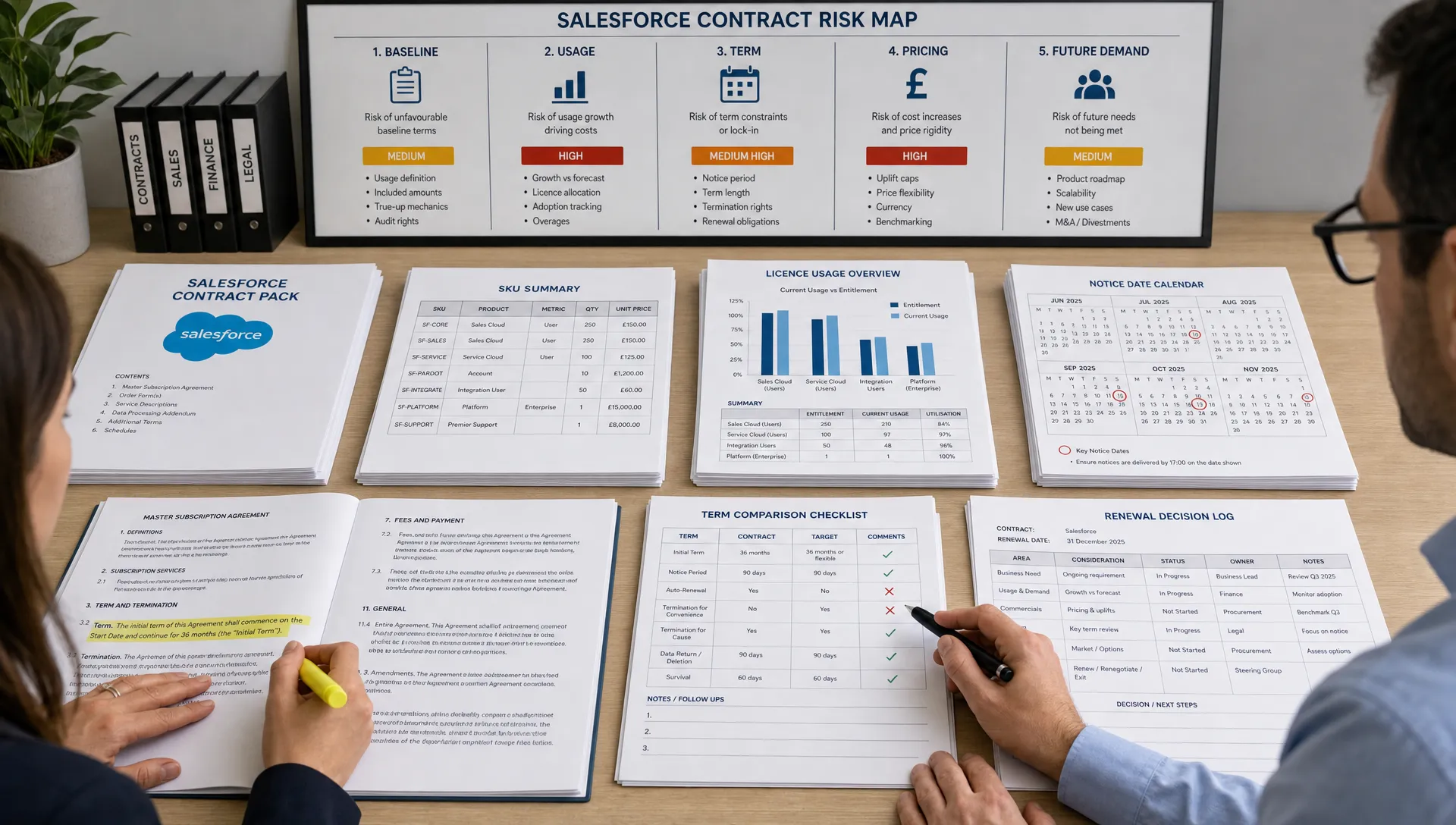
Risk 6: Future demand is based on hope, not operational reality
Salesforce renewals often pull in future plans: new markets, new support models, new digital programmes, more automation, more users. Some of those plans will be real. Some will be early ideas. Some will not survive the next budget cycle.
The renewal risk is paying today for a future operating model that is not yet approved, funded or staffed.
This is especially relevant where Salesforce supports sales, service, commerce, field operations or partner workflows. The licence position should match how the business will actually operate, not how it might operate in a strategy deck.
Take a retailer or distributor reviewing its customer operations. If part of the operating model shifts away from in-house fulfilment to a UK 3PL fulfilment and warehousing partner, the Salesforce demand model may change too. There may be fewer internal users, different integration requirements, different reporting ownership, or a different service process. That is not a Salesforce issue on its own, but it absolutely affects what should be renewed.
Early renewal work should force future demand into three categories: committed, likely and speculative. Only the first two should normally influence firm contract commitments. Speculative demand may still matter, but it should be handled through flexible commercial terms rather than hard volume.
Risk 7: Stakeholders are aligned too late
Salesforce sits across many functions. Sales wants continuity. Service wants stability. IT wants architectural control. Finance wants cost discipline. Procurement wants leverage and clean terms. Legal wants risk contained.
All are reasonable positions. The problem comes when they are reconciled too late.
Late alignment usually produces one of two bad outcomes. Either the renewal is rushed through to protect continuity, or the organisation presents mixed messages to Salesforce. Both weaken negotiation.
A better approach is to agree the internal position before the vendor discussion becomes detailed. That does not require every stakeholder to agree on every preference. It does require agreement on the essentials:
- What must be renewed without disruption
- What is under review
- What can be removed, reduced or restructured
- What future demand is approved versus uncertain
- Who has authority to make trade-offs
- What a good outcome looks like beyond headline discount
The earlier this is done, the less room there is for urgency to become the vendor’s strongest argument.
Risk 8: The team focuses on discount and misses control
Discount matters. Nobody should pretend otherwise. But a Salesforce contract renewal judged only by discount can still leave the customer exposed.
Control is the wider prize. Can you scale down if demand changes? Are future uplifts capped? Are product-level prices clear? Can you separate essential products from experimental ones? Are renewal dates and notice periods workable? Are support and success commitments aligned with what the business actually uses?
A renewal that gives a neat discount but locks in waste for three more years is not a strong result. A renewal with slightly less headline discount but cleaner terms, better flexibility and lower committed volume may be far better for the business.
This is where procurement, finance and IT need the same scorecard. If each function measures success differently, Salesforce can optimise the deal around whichever metric is easiest to satisfy.
A simple early-warning checklist
The best time to catch renewal risk is before the quote is the centre of gravity. The table below is not a universal timeline, but it is a sensible pattern for complex Salesforce estates.
| Timing before renewal | What to test | Risk you are trying to catch |
|---|---|---|
| 9 to 12 months | Contract baseline, notice dates, current commitments | Missed rights, weak evidence, automatic renewal pressure |
| 6 to 9 months | Usage, shelfware, SKU ownership, adoption | Paying for licences or products that are not needed |
| 4 to 6 months | Future demand, budget, stakeholder priorities | Renewing against unapproved plans or inflated forecasts |
| 3 to 4 months | Negotiation strategy, fallback options, target terms | Entering talks with no clear trade-offs |
| Final 90 days | Proposal review, redlines, commercial modelling | Focusing on urgency instead of value and control |
A readiness audit before renewal should test these areas before the account team’s proposal becomes the default version of reality.
Frequently Asked Questions
When should we start preparing for a Salesforce contract renewal? For a material Salesforce estate, start 9 to 12 months before renewal. Smaller renewals may need less time, but the contract baseline, usage review and stakeholder alignment should still happen well before the final quote arrives.
What is the biggest Salesforce renewal risk? The biggest risk is entering the renewal without evidence. If you cannot show what is used, what is unused, what terms apply and what the business needs next, your negotiation will rely too heavily on opinion and urgency.
Can we reduce Salesforce licences at renewal? Often, yes, but it depends on your contract terms, renewal structure, minimum commitments and timing. Reductions are much easier to argue when backed by usage data, clear business ownership and early notice.
Should we focus on price or contract terms? You need both. Price affects the immediate cost, but terms affect flexibility, future uplifts and your ability to correct course later. A strong renewal outcome usually balances cost reduction with better control.
Who should own Salesforce renewal preparation? No single function can do it alone. Procurement should manage commercial discipline, IT should validate technical and usage reality, finance should test budget and value, and business owners should confirm real demand.
Catch the risks while they are still negotiable
Salesforce renewal risk is rarely hidden because people are careless. It is hidden because the estate is complex, the contract history is fragmented, and the business keeps changing while the renewal clock keeps moving.
The earlier you expose the risks, the more choices you have. You can separate genuine need from shelfware. You can test future demand before it becomes commitment. You can challenge uplift with a clearer view of value. You can enter the conversation with Salesforce as a prepared customer, not a rushed one.
If you would like a second pair of eyes on your renewal position, SaaSed offers a complimentary Salesforce audit conversation. We will help you understand where the risks sit before they become expensive to fix.
Want this kind of intel on your renewal?
Don’t head into your next software negotiation alone
Talk to the team