
Is Salesforce Becoming What It Once Replaced
Agentforce is not just another Salesforce add-on. It changes the commercial logic from predictable seats to consumption, creating new risks for CFOs, CIOs and procurement teams before the renewal quote even lands.
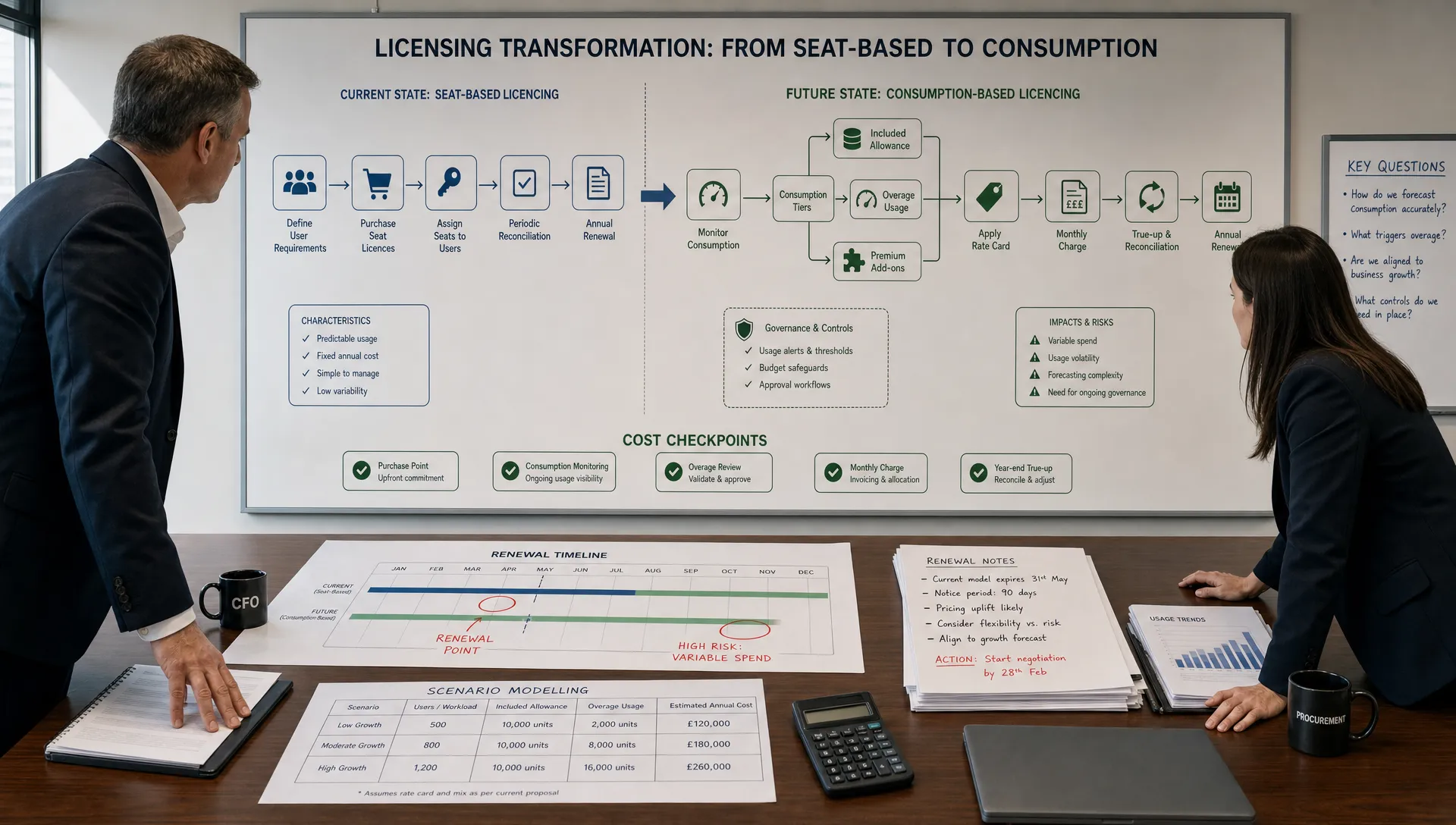
The SaaSed Blueprint: A Smarter Agentforce Strategy
A smarter Agentforce strategy does not start with a quote. It starts with a clean operating and commercial view of the work you may delegate to agents.
The aim is not to block AI. The aim is to stop AI from becoming an unpriced promise inside a renewal you cannot easily unwind.
Treat consumption as a risk to model, not a buzzword to celebrate
Procurement teams should ask for the unit economics before committing to scaled spend. Not in theory. In your environment.
Start with a small set of candidate use cases. For each one, define the business process, expected trigger volume, escalation path, systems touched, data dependencies and success metric. Then ask how each of those variables affects credit usage.
The most important question is not whether Agentforce can do the task. It is whether the economics still work when the task runs at real enterprise volume.
A basic scenario model should include low, expected and high usage cases. It should also include failure scenarios, such as duplicate triggers, poor data quality, excessive agent handoffs or business units launching similar workflows independently.
If you cannot model the downside, you are not negotiating. You are hoping.
Prove value with what is already included before you scale
Many organisations already have unused or underused value inside the Salesforce estate. Before approving a new AI commitment, establish what is included today, what has been paid for but not adopted, and what baseline credits or capabilities can be used for controlled testing.
This is where Finance and IT should work together early. Finance needs evidence of measurable value. IT needs proof that the use case is safe, governable and maintainable. Procurement needs a commercial position that is based on observed usage rather than vendor forecasts.
A vendor forecast is not evidence. A pilot with controlled volume, defined success criteria and measured credit burn is evidence.
Run controlled experiments with guardrails, then negotiate from evidence
A controlled Agentforce pilot should not be a loose sandbox. It should have a defined business owner, a defined workload, a defined ceiling and a defined stop condition.
Set guardrails before usage begins. Decide who can create or modify agents. Decide which systems agents may touch. Decide what happens when a threshold is reached. Decide whether business units can launch their own use cases or must go through a central governance route.
Qualitative evidence also has a place. Support tickets, admin feedback, sales operations notes and user interviews can show where friction is real. Some teams monitor external customer or practitioner conversations as early signals too. Tools such as Redditor AI's Reddit conversation discovery may help surface public questions worth reading, but those signals should remain context. Your negotiation should be anchored in your own workloads and your own economics.
Once you have measured results, you can negotiate differently. Instead of buying a broad AI story, you can buy capacity for use cases with known value, known constraints and known adoption paths.
Plan the Salesforce renewal and AI upsell as one strategy
The biggest mistake is treating the renewal, Data Cloud discussion, Agentforce pilot and commercial expansion as separate conversations.
Salesforce will not treat them separately. Neither should you.
If Agentforce appears six months before renewal, it is already part of the renewal strategy. If Data Cloud is positioned as a prerequisite or accelerator, it is part of the same commercial map. If flex credits are being offered as a way to keep options open, they belong in the same risk model as your core licences.
This is where timing matters. A strong renewal process gives you enough room to audit usage, test assumptions, align internal stakeholders and build alternatives before the quote frame hardens. SaaSed has written separately about what a strong SaaS renewal process looks like, and the same discipline applies here with more urgency because AI consumption adds moving parts.
The cleanest Agentforce negotiation is not the one with the loudest discount. It is the one where your organisation has already decided what it will use, how it will govern usage, what value is acceptable, and what risk it will not absorb.
What CFOs, CIOs and Procurement Leads Should Ask Before Signing
Before Agentforce is allowed to become a renewal line item, the buying team should be able to answer a few hard questions in plain English.
- What specific work will Agentforce perform? If the use case cannot be described without vendor language, it is not ready for a scaled commitment.
- What will trigger consumption? Identify the events, workflows, data calls or agent actions that create cost.
- Who owns usage governance? Consumption without ownership becomes everyone’s budget problem and nobody’s decision.
- What value has already been proven? Separate tested savings or productivity from projected savings or productivity.
- What happens if usage exceeds the model? The answer should be contractual, operational and financial, not just conversational.
These questions are deliberately simple. They are designed to cut through complexity. If a proposed commercial model cannot survive simple questions, it is not mature enough for a large commitment.
Frequently Asked Questions
Is Agentforce priced like normal Salesforce licences? Not exactly. Traditional Salesforce licensing is often seat-based, while Agentforce introduces consumption dynamics tied to agent activity, credits and workload volume. The commercial risk shifts from who has access to how much work the system performs.
What is the biggest procurement risk with Agentforce? The biggest risk is committing to consumption before understanding the workload. If the organisation cannot map workload to agent action to credit usage to cost, it cannot reliably forecast spend.
Are flex credits a bad idea? No. Flex credits can be useful when usage is governed and modelled. The problem is the Flex Credit Mirage: treating flexible credits as cost control when the organisation has not yet proven how fast credits will burn.
Should Agentforce be negotiated separately from the Salesforce renewal? Usually not. If Agentforce, Data Cloud or AI credits are being discussed near renewal, they should be part of one integrated commercial strategy. Otherwise the vendor controls the sequencing and the buyer loses leverage.
When should a company start preparing if Agentforce is appearing in account discussions? Start 6 to 12 months before renewal. That gives Finance, IT and Procurement time to audit the estate, test use cases, model consumption and set negotiation guardrails before the first formal quote lands.
Conclusion: Set the Frame Before the Quote Sets It for You
Agentforce may be technically brilliant. That is not the point.
The point is that the pricing model changes the commercial physics of the Salesforce relationship. Seat-based pricing made waste visible after the fact. Consumption pricing can make waste accelerate while everyone is still admiring the promise.
If you are 6 to 12 months out from a Salesforce renewal and Agentforce is starting to appear in conversations, this is the moment to act. Not after the first quote. Not after the bundle is framed. Not after the internal sponsor has already repeated the vendor’s numbers in a steering committee.
SaaSed helps CFOs, CIOs and procurement teams structure Salesforce renewals before the commercial frame hardens. If you want to map your renewal blueprint before the numbers lock in, book a complimentary Salesforce audit conversation and we will work through the pressure points with you.
Want this kind of intel on your renewal?
Don’t head into your next software negotiation alone
Talk to the team