
How Salesforce SELA Pricing Models Affect Renewal Costs
A SELA can lower unit prices, but the renewal maths can turn against you if floors, ramps and shelfware are left unchecked. This guide shows procurement, IT and finance teams where the hidden costs sit.
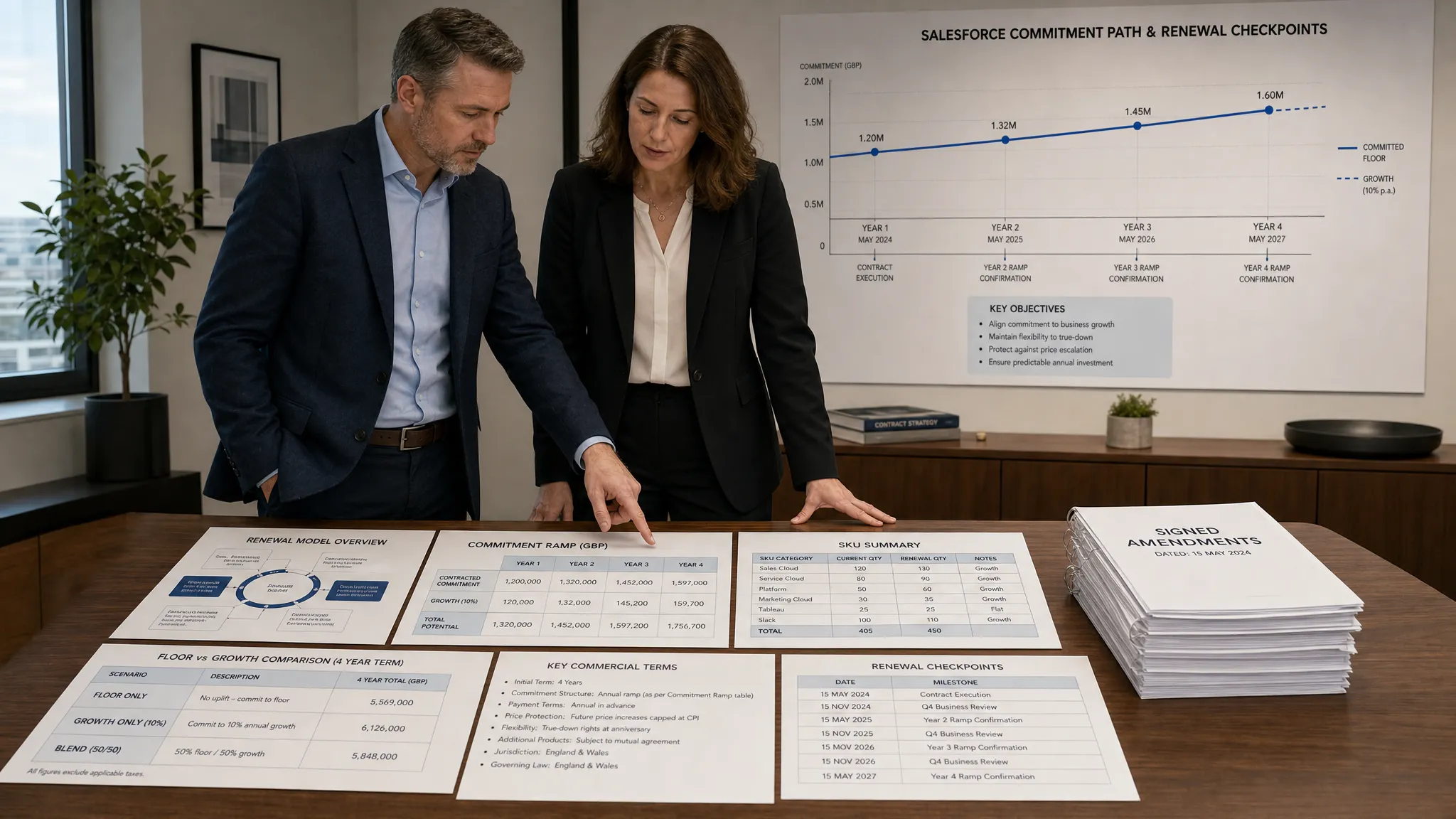
How hidden clauses affect SELA renewal costs
The most expensive SELA clauses are often ordinary-looking. They do not always announce themselves as risks. They sit inside renewal terms, minimum commitments, product restrictions and amendment language.
A renewal uplift clause can compound the final-year ramp. A minimum commitment can stop the buyer reducing spend even when adoption falls. A bundle clause can make one unwanted product commercially inseparable from the rest. A strict notice period can remove negotiating time. A no-cancellation position can turn a project delay into three years of unused spend.
The order of precedence also matters. If the sales presentation promises flexibility but the order form does not, procurement should assume the order form wins. If substitution rights are discussed but not written clearly, they may not exist in practice. If affiliates are expected to use the SELA, the contract should say which affiliates are covered and what happens when the group acquires or divests entities.
For a deeper review of contract language beyond SELAs, see SaaSed’s guide to SaaS contract clauses that drive up Salesforce costs. In SELA negotiations, those clauses do not disappear. They usually become more consequential because the spend is larger and the term is longer.
Do not let roadmap optimism become committed volume
Enterprise Salesforce forecasts often include future projects: a new service model, a partner portal, field sales expansion, a data initiative, a mobile customer experience or a regional rollout. Some will happen. Some will change shape. Some will be paused when budgets move.
The procurement mistake is treating every possible project as committed demand. A better approach is to split the roadmap into funded, approved and speculative demand. Only funded demand should sit comfortably inside a hard SELA floor.
One common over-provisioning path is the future digital product assumption. A team may reserve Salesforce volume because a mobile customer or partner experience might be built later. Treat that as a separate build-versus-buy decision. If the work is genuinely a bespoke mobile product, benchmarking the delivery route with a specialist such as a premium mobile app development agency can help finance price the project separately from the Salesforce licence commitment.
This discipline does not slow the business down. It stops unfunded ideas being converted into binding subscription spend.
Actionable procurement checklist before SELA renewal talks
The strongest renewal work starts before the quote arrives. If the first serious review happens in the final 30 days, most of the leverage has already been lost. For timing, governance and internal preparation, SaaSed’s guide to a strong SaaS renewal process is a useful companion.
Use the checklist below to find leverage gaps before Salesforce renewal talks begin.
| Area to check | What procurement should do | Why it matters |
|---|---|---|
| Contract pack | Collect the master agreement, order forms, amendments, addenda, product terms and renewal notices | Missing documents create blind spots and weaken negotiation control |
| Final-year run-rate | Build the renewal model from the last committed year, not the first invoice | Ramped SELAs often become expensive at the end of term |
| Minimum commitments | Identify annual floors, total contract value floors and non-cancellable spend | These clauses define how much flexibility you really have |
| Volume thresholds | Ask which quantities, products or spend levels were used to approve discounts | Discount protection may depend on staying above a threshold |
| SKU usage | Compare purchased entitlement against active, meaningful usage by SKU | This separates real demand from shelfware |
| Inactive users | Define inactivity, review login and role data, then validate with business owners | Dormant users can inflate the renewal baseline |
| Product bundling | Request pricing for core products separately from optional products | This exposes whether the bundle is hiding unwanted spend |
| Substitution rights | Check whether products can be swapped, when, at what value and with whose approval | Flexibility is only useful if it is written and operationally usable |
| True-down rights | Confirm whether reductions are allowed during term or only at renewal | Many buyers assume reduction rights that the contract does not give them |
| Renewal uplift | Model the impact of any uplift on the final-year commitment | A small percentage can be material on a large SELA |
| Price holds | Map which SKUs, quantities and affiliates are protected | Price protection may not apply to future growth or new products |
| Affiliate scope | Confirm covered entities, regions and acquired businesses | Gaps can create surprise purchases outside the SELA |
| Support and add-ons | Check whether support fees, sandboxes, storage or premium features are linked to the main commitment | Add-ons can rise as the estate expands |
| Amendment history | Review every mid-term purchase and its renewal treatment | Amendments can quietly reset the baseline |
| Internal ownership | Assign each product and growth assumption to a named executive owner | Unowned demand should not become committed spend |
| Alternatives | Prepare credible scenarios for reduce, renew, restructure or defer | Negotiation needs options, not just objections |
| Approval path | Align CFO, CIO, IT, procurement and legal before Salesforce engagement | Internal disagreement is visible to vendors and reduces leverage |
| Walk-away point | Define the commercial line where the business would rather restructure than renew as proposed | A negotiation without a boundary is usually just price acceptance |
This checklist should produce three outputs before negotiation: a clean usage baseline, a financial model of the renewal floor and a list of written terms that must change. Without those, the conversation tends to focus on headline discount. With them, it moves to scope, risk and commercial fairness.
What to ask Salesforce before accepting a SELA renewal quote
A good renewal meeting should not start with whether the price can improve. It should start with how the price was built.
Ask which annual value Salesforce used as the renewal baseline. Ask whether the discount assumes all current products remain in scope. Ask what happens if the organisation removes unused SKUs. Ask which future growth volumes are included and whether those volumes have to materialise. Ask whether any price hold applies to additional users, acquired entities or only the current estate.
Also ask for separate pricing scenarios. A clean scenario set usually includes the current scope, a reduced scope, a core-only scope and a growth scope. If every scenario pushes you back to the same bundle, that tells you something important about the commercial architecture.
Finally, make Salesforce explain the ramp. Not just the annual fee, but the reason for each step. A ramp tied to a funded deployment may be reasonable. A ramp tied to vague transformation language deserves scrutiny.
FAQ
Is a Salesforce SELA always cheaper than a standard renewal? No. A SELA can reduce unit pricing when demand is real and well governed, but it can cost more if the buyer commits to unused products, inflated user counts or aggressive growth assumptions.
What is a floor-growth commitment in a Salesforce SELA? It is a pricing structure where the customer has a minimum spend floor that increases over the contract term. In practice, the organisation may pay more each year even if adoption does not grow at the same pace.
Can a company reduce Salesforce SELA spend at renewal? Yes, but it depends on timing, evidence and contract language. Procurement needs usage data, SKU-level analysis, clear business ownership and alternative scenarios before Salesforce anchors the renewal on the existing commitment.
What is the biggest hidden cost in Salesforce SELA pricing models? The biggest hidden cost is usually the renewal baseline. If the final-year ramp, unused licences and bundled products become the starting point for the next term, the buyer may negotiate from an inflated position.
How early should procurement prepare for a Salesforce SELA renewal? For a mid-to-large enterprise, 9 to 12 months is sensible. That gives enough time to audit usage, review clauses, align stakeholders, test scenarios and avoid negotiating under deadline pressure.
Keep the SELA useful, not oversized
Salesforce SELA pricing models are designed around commitment. That can work in your favour when the commitment reflects real demand, clear ownership and a negotiated structure that protects flexibility. It works against you when the agreement converts hope into spend.
Before the next renewal, look past the headline discount. Check the floor, the ramp, the bundle, the threshold logic and the products no one uses. Those are usually where the renewal cost is hiding.
If you want a second pair of eyes on the contract, usage and negotiation position, SaaSed offers a complimentary Salesforce audit conversation. It is a practical way to understand where the leverage is before the renewal clock gets loud.
Want this kind of intel on your renewal?
Don’t head into your next software negotiation alone
Talk to the team